Fiscal Responsibility feat. Sweet Graphs

Back in April, I took a big step towards being a Real Adult and started my own budget spreadsheet. After just the first month, I was completely shocked at how much I was actually spending (read: THAT much on dining out?!) Now that I’m heading back into the tight grip of grad schooldom, I know that I need to prepare myself for the grad school lifestyle. Which, of course, means living within my means. My first step in this preparation process was to create a budget spreadsheet for myself. I’m a big believer in ‘knowledge is power,’ and had to embrace that mantra to keep my head up while working on this project.

I started in Excel with two of the provided templates: College Cash Flow and Monthly Home Budget. Both templates provides you with a file already outfitted with calculations to auto-fill the green boxes based on data in the yellow boxes. In the College Cash Flow file, you input your starting money on hand and monthly expenses by convenient categories likely to be used by college students (e.g. books, tuition, etc). Your total income, expenditures, cash flow, and ending balance are automatically calculated for each month. The Monthly Home Budget sheet performs a similar task, but on a shorter time scale. You also have an opportunity to compare your actual income/expenses to budgeted ones. Together they are both useful, but I found that with a little extra work I could create a more interconnected, useful budgeting tool, complete with visuals.

I wanted to know more about my individual purchases in addition to total monthly charges, so I added a section to the Monthly Home Budget sheet at the bottom where I could input each individual purchase with Date, Cost, Type, and Notes. I found that having to record each transaction separately also helped me stay aware of my spending as the month progressed. I have Office 2008 for Mac on my computer, so everything I mention subsequently will be specific to that version of Excel.The major amendments to the spreadsheet templates are as follows:

  1. I wanted to have a drop down menu of categories for when I input individual purchases, to eliminate the possibility of typos. This was more an issue of formatting than coding. 
  2. Screenshot 2014-05-21 21.28.05.png
    May was a pretty cool month. I was much more conscious of what I spent even after a month of keeping track and budgeting.
    1. Highlight the boxes where you want the drop down list.
    2. Data -> Validation
    3. Allow: Select “List”
    4. Source: highlight the categories from the Variable Expense section
    5. Okie doke. You can also copy/paste this format into other cells.
  3. Next, I wanted the “Actual” cost cells in my Variable Expense column to automatically update from my individual transaction list. But that meant that each categorical cell would only update with it’s specific type of expense.
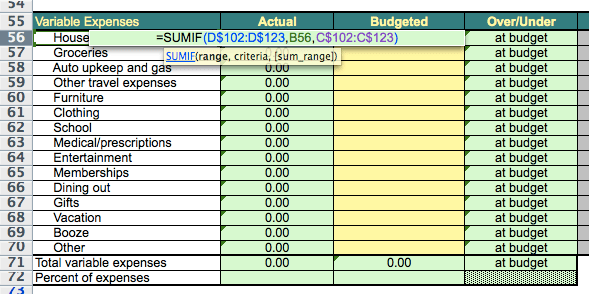
    Let me reassure you, this was not too difficult at all! And I felt like such a badass every time I figured out a tiny little thing. 
    1. In the Actual column next to the first category (household) type “=SUMIF(“
    2. Highlight “Type” column then insert a comma
    3. Click the category name then another comma
    4. Highlight the expenses column and end parentheses
    5. Repeat steps for each category/type (e.g. household, groceries, gas, etc.)
    6. Now that the Variable Expense Actual cost cells auto update, I changed the color to light green.  
  4. I wanted my monthly expenses to automatically be filled in on the College Cash Flow sheet. In hindsight, I could’ve made this a little easier on myself by rearranging the “Expenditures” list to match the ordering on the Monthly Home Budget sheet. 
    Oh man, Meridith, there’s not much going on here. Are you going to release a template for everyone. Maybe. Just maybe. 
    1. I started in April, so I would’ve gone to that month’s column in the CCF sheet. Clicked on the cell that matches up with the Household Costs row.
    2. Entered =’April Budget’!$C$55, where April Budget is the name of my Monthly Spreadsheet for April and C55 is the cell where my Household Variable Expenses are totaled. 
    3. Some expenses on the yearly sheet, like utilities, may be broken down into more specific categories on your monthly sheets. You can use =SUM() to compile those cells. 
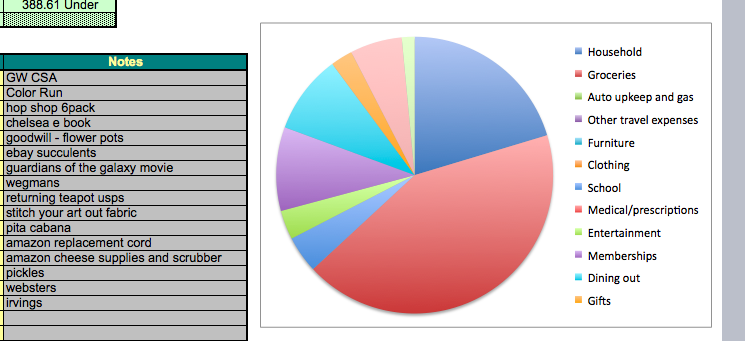
  5. I love visualizations. I wanted to see these data represented so I could see, at a glance, where my spending was occurring. Where are the sweet graphs?! Missing?!  No sweat, I just had to make my own. I had a pie chart of my variable expenses on my monthly spreadsheets. I kept the fixed expenses off because huge costs like rent would just overwhelm the graph. 
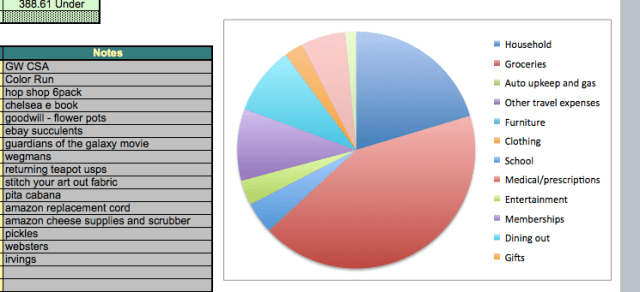
    Can you tell I like food?
    1. Highlight “Variable Expenses” and “Actual” columns
    2. Insert > Chart > Pie > whatever the most basic one is
    3. I also did a similar pie chart for the yearly sheet using the “Expenditures” and “Yearly Totals” columns.
Celebrating my time in Newcastle the proper
 way – dancing my heart out. 

Ahhhh, fiscal responsibility and organization. You really can’t beat it. Don’t be afraid to try your own tweaks to the budget sheets. I’d love to hear your insights. The important thing is that you’re staying aware. I’ve known many a young lad and lassie who just wanted to ignore their financial obligations and responsibilities. Your twenties are not for mistakes and frivolity! Ok…they are a little bit. I’ve mistaked and frivoled. But I’ve also been conscientious of long term savings, and because of that (in addition to supportive parents and lots of living at home) I’ve been able to do some really frickin’ cool shit! After completing my Master’s degree I moved home, worked for a few months, bought a plane ticket, packed a bag, and left for a completely wild 90-day, self-funded, solo adventure through Europe. I had zero responsibilities. Minimal worries about my funds. And all of the funs. All of them! Sure, it meant watching my money closely during my time in New Mexico. I rarely went out and spent money on beers and food. I lived with roommates with ridiculously cheap rents. I nearly never went shopping for clothes. But it was all completely worth while when I landed in Dublin and immediately had adventure after adventure!

I’ve been looking into what other things I can be doing to be extra responsible with my finances. I’m not anywhere near 40, but this cool article has really inspired me to think about awesome next level goals I can set for myself. I’ll be studying for my PhD for the next five years, and while that comes with a stable stipend, it’s not the same as having a job with a 401K and retirement plans and all of these other benefits that I’m mostly clueless about. If you are looking into other ways to keep yourself in check with your cheques, then you might want to consider the many financial apps available. SciFri has a lovely podcast on them. You know how much we love podcasts. I have friends that also swear by the cash envelope system. Each month you take out the budgeted amount of cash (lump sum or broken into categories) and that’s all you have for the month. You run out…tough cookies.

If you’d like more money saving tips throughout the week keep an eye on our STS Tumblr for extra posts. We’ll share different articles and our own personal insights on how we live on the cheap! We also want to hear about what’s your method? Any super awesome money life hacks that we could benefit from? By all means, let us know! 

Finding a Graduate Advisor

This is a question for either of you to answer. Over the course of my last year in school I’ve had the most difficult time finding out how to go about seeking potential (M.S.) advisors for graduate school. Like, I’ve tried looking at schools I would like to go to, and looking at researchers there, but I have had little success in making conclusions when my interests are wide-spread. So, how the hell do I narrow down my interests, and what is a (possibly) better way of finding and approaching potential advisors? I am (mentally) paralyzed.


Thanks, freshlypluckedscientist, for the awesome post request! First off, it’s going to be ok! You are not the only one who has felt like this! I’m also fairly certain that we are not the only two who have felt like this! Rachel and I have both gone through this process twice (M.S. and PhD) and we understand how difficult and frustrating the entire process can be. Both times I tried to get a head start on the process and both times I felt like I was always behind schedule and running out of time! Before I even get started on any suggestions or tips, I’d like to reassure you that it’s completely ok to take a year off to figure things out and generally just chill. I took a year off after undergrad and nearly 2 years off after finishing my M.S. degree. I’m now going to be a few years older than the rest of my cohort, but I am going back fresh and excited and motivated!  Like so many big life decisions, you just have to do you.   


If you are looking for any sort of biological research program it can be nearly impossible to sift through departmental websites of universities you are interested in to find potential advisors. Yes, lots of them keep up-to-date websites with a convenient section for Potential Students, but many others do not. When I was looking for M.S. advisors I focused my search by perusing the EcoLog listserve and Texas A&M Job Board. You can keep an eye out for posts by advisors advertizing available positions instead of having to seek them out yourself. One plus to seeking an advisor in this way, if they are posting on a listserve or job board, they likely already have a project with some sort of funding available.  Keep an open mind and cast a wide net when you are finding potential advisors. Here is where you can let your varying interests guide you. Once you contact someone you can start to narrow your interests a bit.  Also, there is nothing wrong with narrowing your search based on where you actually want to live for the next few years of your life.  I know when Rachel was looking for graduate programs, she knew she wanted to live near the coast.  This initial choice actually lead her to studying tidal marshes (which she loves!) as opposed to the many other inland types of wetlands.

NMSU was a great place for my MS.

Write a basic cover letter and then customize it for each professor to whom you send it. Basically, you need to write a short introduction of yourself highlighting your best attributes and attach your CV and any other pertinent information they may have requested. I am working on a cover letter post for spottedsharkheart currently so more to come on the intricacies of that! If they reply, gauge their interest and try and set-up a time to have a phone or skype conversation to discuss your mutual interests. Not everyone is going to write back. Professors have a packed schedule and they are probably receiving many similar emails. Don’t be afraid to send a follow-up email reminding them of your inquiry. You can send more than one follow-up if you are extremely interested in working with an individual, but keep in mind that if they are too busy to reply to your email, they might not be a super good fit anyhow.  During this search and email phase, don’t be afraid to explore options outside of your comfort zone. My background is biology, and come fall I am entering a PhD program in Statistics. Granted, I hope to find research where I can apply my developing skill-set in stats to ecological problems, but you never know where your path may lead.


Once you are in contact with a potential advisor, this is the time when you need to show that you have focused interests that mesh well with their own, but keep in mind that you aren’t locked into anything you discuss initially. This also applies to those pesky essays you might need to write during the application process. I had the hardest time with these and Rachel had to tell me multiple times that I am not going to be contractually bound to anything I wrote in them! Narrowing your interests is a tough one. I honestly don’t know how to go about doing this particularly well. You can peruse MS Grad listings on to see what pops out at you. You may also want to consider specializing in a skill that can be applied to many different situations (GIS, Stats, etc) so you will be able to work in many different fields.  Having various interests also likely means you could be happy doing several different things!  There is nothing wrong with that, and it actually increases your odds of finding a cool graduate program that speaks to at least some of your passions.


Don’t let letdowns get you down. I had a rough time when searching for PhD programs. Sometimes, they just don’t ever respond. Sometimes, they responded a few times and then…..nothing?! Other times, you get as far as a skype conversation with a professor only to find out that it does not appear to be a good fit. It’s a little late in the year currently to find an advisor and join a program (not impossible). Ask current professors on your campus for help.They have been through this during their education and they have helped countless others through the same process.


Anyone else have amazing advice about applying to graduate programs?  I would love to hear about it in the comments sections.  It would be amazing to make this post a resource to refer others to in the future!  

Welcome to Sweet Tea, Science

Mt. St. Helens, Summer 2012

Let us start by first saying welcome! We are excited and proud to be launching the Sweet Tea, Science blog today. We are two scientists from Kentucky currently working on obtaining our PhDs.  Aside from academic pursuits, we are passionate about sharing our interests in various STEM topics, travel, and sustainable living. It is our hope that through Sweet Tea, Science we can share our knowledge, practice our communication skills, and learn from you!

Costa Rica, Winter 2007

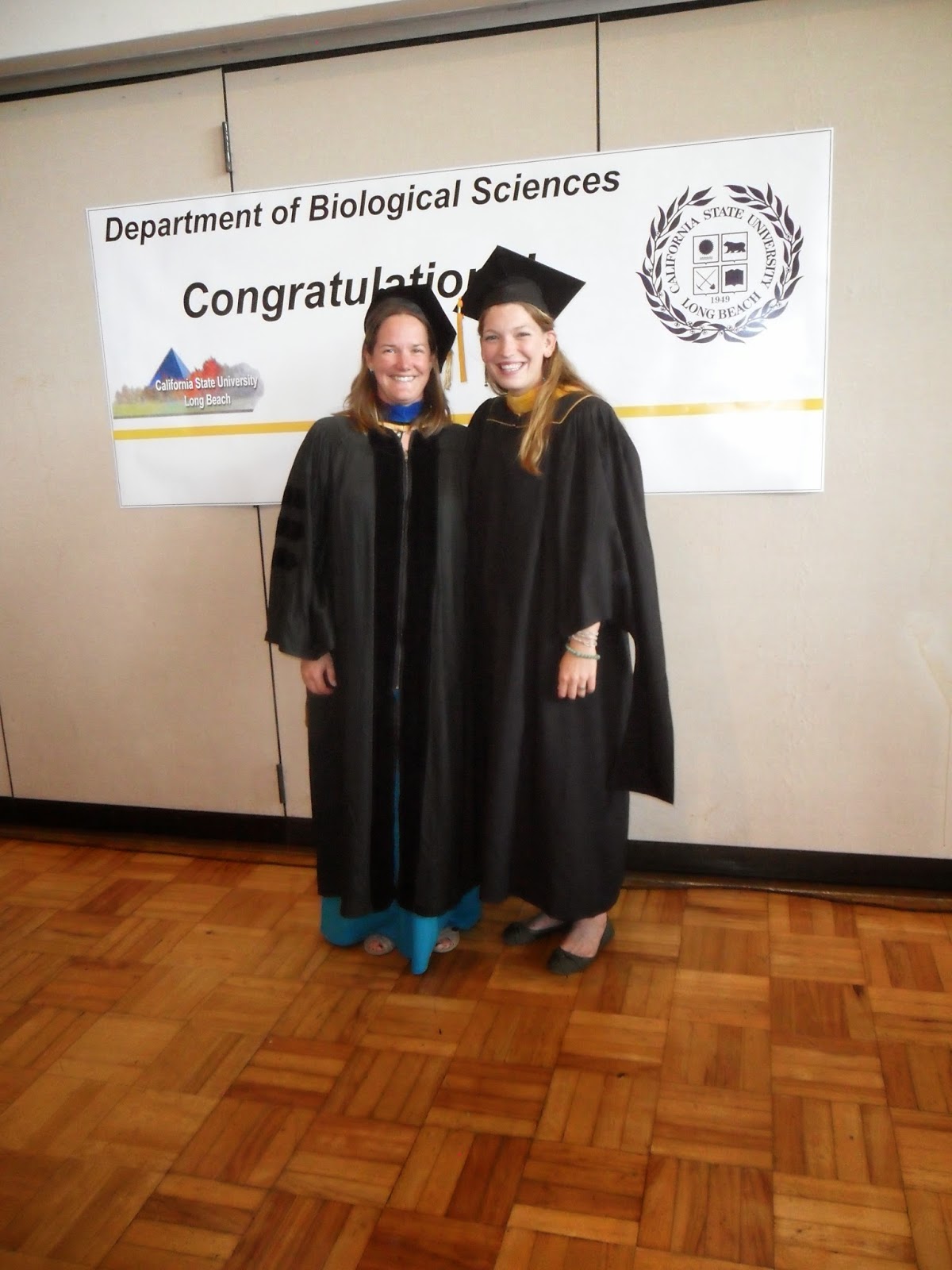
In addition to being hysterical scientists, we are also real life friends! We met in 2005 at Western Kentucky University where we both obtained a BS in Biology with concentrations in Biodiversity, Ecology, and Conservation. Meridith is an overachiever, and also has a minor in mathematics! During our time at WKU (go Tops!), we both completed Honor’s theses and graduated from WKU’s Honors College.  While in college we studied (we took pretty much every biology class together), traveled (numerous Central and South American countries, Africa, Michigan…), and adventured together (everything is an adventure!).  After graduating, we continued to learn and explore as a team, and now we are tackling the blogging world as a dynamic duo.

Florida, Spring 2007

Meridith went on from WKU to study algae cultivation for biofuel production at New Mexico State University for her Masters in Wildlife Science, with a minor in Applied Statistics. Again, overachiever. Her blog and Facebook page, Always A Scientist, started in early 2012 as part of an application to HiSEAS. Meridith continued with the blog off and on for two years, enjoying it immensely, but never fully committing to posts. She is currently about to start her PhD in Statistics and looks forward to the opportunity to apply stats to ecological systems.  Rachel went from WKU to sunny southern California to work on a Masters in Biology at California State University, Long Beach.  She completed her degree in the summer of 2012 and moved on up the coast to the central valley to tackle a PhD! Similar to Meridith, Rachel started her blog, Practical Ecologist, in November of 2012 and really enjoyed it, but didn’t have the time to commit to it like she really wanted.  What were two lady scientists to do?

Grand Canyon, Spring 2010

In November 2013, we decided to combine our powers and create a new blog (and associated media) to share our passions and interests. By working together on this endeavor we hope we can stay motivated and provide more consistent content for our readers. We envision this blog as a way to share longer posts about STEM-related topics, advice for students, peaks into life as a graduate student, fun science-y projects, insights into sustainable practices, and snapshots of how the process of science works.  We imagine our audience to be diverse and include people generally interested in science (everyone?), those who want to explore science with their kids or friends, college students, and aspiring graduate students seeking advice.  We will share shorter content via Tumblr, Twitter, Facebook, and Instagram. Follow us on all the things!

South Africa, Summer 2008

With that being said, we also want to hear from you about your interests, questions, and requests. What topics would you like us to cover and how? All the content from our old blogs can be found on this website, so feel free to give is a look over and tell us things you like or dislike.  Do you need help in any of your classes and think we could explain a concept more in depth? Are you looking to plan a fun vacation and want some amazing science or nature related activities included? Let us know! We are also eager to find guest contributors of all ages.