Making Time for Nature

One of my favorite environmental quotations goes as follows:

“One final paragraph of advice: do not burn yourselves out. Be as I am — a reluctant enthusiast… a part-time crusader, a half-hearted fanatic. Save the other half of yourselves and your lives for pleasure and adventure. It is not enough to fight for the land; it is even more important to enjoy it. While you can. While it’s still here. So get out there and hunt and fish and mess around with your friends, ramble out yonder and explore the forests, climb the mountains, bag the peaks, run the rivers, breathe deep of that yet sweet and lucid air, sit quietly for a while and contemplate the precious stillness, the lovely, mysterious, and awesome space. Enjoy yourselves, keep your brain in your head and your head firmly attached to the body, the body active and alive…”  ~Edward Abbey*

These are the words of wisdom I try to remind myself of when I am having a moral crisis over what sort of salad dressing to buy at the grocery store (Plastic vs. Glass??  High Fructose Corn Syrup vs. Palm Oil??  Too many decisions!).  While I absolutely want to work as hard as I can to understand and conserve the natural world, I also want to take time to walk around in the woods!  When I am working out in the field, I try and remind myself to stick my toes in the water or gush over a particularly adorable weevil.  This helps keep the balance in my life.  

Lett Lake, Snow Mt. Wilderness Area, 

Not everyone is fortunate enough to have a job that requires as much outdoor time as mine does.  Heck, even for those of us that work outside, having unstructured outdoor play time is really important.  Remember, just because you are playing, doesn’t mean you aren’t learning or growing.  How do you think kids learn?  Through play, naturally.  Playing in nature, whatever play means to you, is a great first step to exploration, questioning, and eventual understanding.  The question becomes, how do we fit hours into our busy schedules for outdoor recreation and soul-feeding fresh air?  I am currently on a quest to answer this question in my own busy life.  In an effort to make it happen, my partner and I (editor’s note: Meridith and her partner, too!) have committed to hiking once a week every week.  The life experiment is set to run for the summer (May thru August).  For us, there are no rules aside from “get outside and walk!”  I’m hoping to see some new places and explore spaces nearby that I have under appreciated or overlooked.  As of today, we have gone on a walk-about all but one of the weeks we intended! Not bad overall, and we are only getting started! Would you like to get your outdoor adventure one?  Here are my strategies for making it happen!

     
STS Guide to Making Time for Nature

Schedule Your Nature Time
You schedule your classes, your work week, and time to hang out with friends.  As busy people, most of us know that if an activity doesn’t merit a spot in our calendars, it isn’t likely to happen.  So, pick a time and place and pencil in your next outdoor adventure now!  

Multitask (sort of)
Meridith likes to multitask by visiting
 Joshua Tree NP AND looking fabulous.

No, I don’t mean you should be checking your email while you are out on the trail.  I do mean you should make this time do double duty in your life.  Have you been wanting to read that novel, but cannot find the time?  Bring along an audio book and headphones on your next hike. Heck, you can even listen to a sweet science podcast! Have a friend with whom you need to have a life update?  Bring them with you on your evening walk!  Been meaning to find quiet time alone for yourself?  Do a little yoga or meditation by the lake, or, you know, just sit and watch the bugs on the grass.  I think this could be an especially useful tactic for the busy parents in the crowd.  Spend time with your kids and get them tuckered out simultaneously!  Your time in nature can be just nature time, but it can also be friend time, family time, personal development time, or just you time.

Don’t Get Preoccupied with Exercise
I am 100% completely guilty of this sometimes.  I think this is obvious based on my own personal goal to “hike once each week.”  Exercise keeps me centered, and this is often how I multitask my nature time.  And, sure, getting out into nature can be a wonderful way to get some exercise and breath some fresh air.  Is hiking to the top of a mountain superior to driving out to a lake and having a picnic?  I don’t think so.  It really depends on what you like and what you are trying to get out of this time.  Importantly, you can get different things out of nature at different times.  Sometimes it’s a calorie burn and sometimes its a peaceful nap.

Our local spot:  Stebbins Cold Canyon, UC NRS
Think Local
National Parks are amazing, and there is a reason that Ken Burns called them “America’s Best Idea.”  I’m sure Ken would agree that America has had some other really good ideas, like these cookies,(most) of these famous internet cats, and the numerous state and regional parks across the great ol’ US of A.  Just Google “State parks of (your state name here)” and you will be well on your way!  You can also go straight to Google Maps and type in “State Park.”  Don’t forget to do a little internet sleuthing about regional parks, open space areas, land trust zones, wildlife areas, or Bureau of Land Management Areas (BLM Areas).  Meridith and I particularly love finding new BLM areas because these are public lands, meaning when you find one designated for recreation, you can camp for free!  You might find a gem you didn’t even know about within your 20 mile radius.  That is totally within striking distance, even for the most over-committed weekend warrior!    

Expand Your Concept of Nature
Take the suggestion above, and go even further.  Sure, nothing really beats being in a large natural area like a park (national or otherwise).  However, the green belt running through my town is beautiful, and I love walking and running along it.  Does your town have a green belt?  Do you even know what a green belt is?  You can also check out local arboretums and botanical gardens.  Find a local green space and play some Frisbee or lay in the grass!  Don’t get me wrong, if I could, I would be at Olympic National Park every single day, but I can’t.  I can, however, take a walk through the restored riparian area along the local drainage ditch anytime I want.  Even if you live right down the road from some great regional, state, or national parks, I would encourage you to take a little bit of time to explore these non-traditional nature experiences.

Build to Something Bigger
Point Reyes National Seashore, CA

Maybe it’s just my personality, but I am super goal oriented.  For me, setting a goal encourages me to do things I would never have made time for otherwise.  For example my 10-year goal to see all the US National Parks has resulted in numerous adventures that I’m not sure I would have facilitated otherwise.  Just two weeks ago, our household goal to hike once a week this summer lead us to take a short detour to Point Reyes National Seashore after attending a family graduation.  Giving your everyday actions context in the larger picture of you life gets you jazzed and propels you out the door.  And that, really, is what it’s all about.


**************************************************************

So there you have it! What are your plans for getting outside this summer? Any big outdoor oriented goals you want to share?


*Emphasis is my own

Road Trip Record: Three Ecosystems in One Hike

RMNP Montane Ecosystem
Time to get in the wayback machine for a trip down science/nature travel memory lane.  In the summer of 2012, just after I had finished my MS degree and just before I was slated to move on (and up the coast) to start my PhD, Meridith and I planned and executed the Amazing Besties National Parks Road Trip!  Meridith was tantalizingly close to completing her MS degree as well, so it totally counted as a double celebratory trip!  Our goal was to see as many national parks as possible, with an eye to balancing quality and quantity, and road trip our way from Las Cruces, New Mexico (Mer’s former hood), up to Portland, OR for the Ecological Society of America conference, then scoot back down the California coast to Long Beach, where I would pack my stuff into a truck and move!  If you’re new to this series of blog posts, I highly recommend you check out the summaries of the early stages of our trip, which were originally posted on Meridith’s former blog and later migrated to our current one.  Clickity-click for:  the take-off, Carlsbad Caverns National Park (days one and two), ABQ New Mexico, on the road, Zion National Park (day one and two), me getting us really lost, Arches National Park, a babal about invasive species, and Rocky Mountain National Park day one!   


Day 11
Rocky Mountain National Park
Total Miles Hiked: 8.9 (67.2 overall)
About 95% certain this is a portion of Bear Lake from above.

When last we left our Amazing Besties National Park Road Trip, we had just finished our first full day in Rocky Mountain National Park.  We had taken an awesome hike up Deer Mountain, seen 18 big horned sheep, and I had beaten Meridith in a friendly game of pool.  We didn’t let all this fun keep us up too late though.  We had big plans for the next day, July 20, 2012.  


Pretty sure this is Meridith “being a critter” in the montane ecosystem.
We got up early, as per the instructions of the friendly park ranger we spoke with on the previous day.  We were planning to hike the Flattop Mountain Trail, which peaked in altitude at 12,324 ft!  The ranger had warned us afternoon thunderstorms were common in the region, so we wanted to get an early start and avoid getting caught in the weather on an exposed mountain.  Plus, Bear Lake Road (the road to the trail head) would be closing after 9am, necessitating a shuttle trip if we didn’t get up and get going.  The many benefits of getting friendly with the park rangers!  I love having the inside scoop.


Wildflowers and feetz
We were rewarded for our early start with a sparsely populated Bear Lake area, which is one of the most popular spots in the park.  After a stop to apply sunscreen (easy to get sunburned at high altitude!) and fill up our hydration bladders, we found the Flattop Mountain trailhead and began our ascent.  The park ranger had suggested this trail based on our desire to get a bit of a physical challenge (8.9 miles roundtrip and almost 3000 feet of elevation gain) and see all three high altitude ecosystems the park had to offer. We are the nerdiest of nerds.  

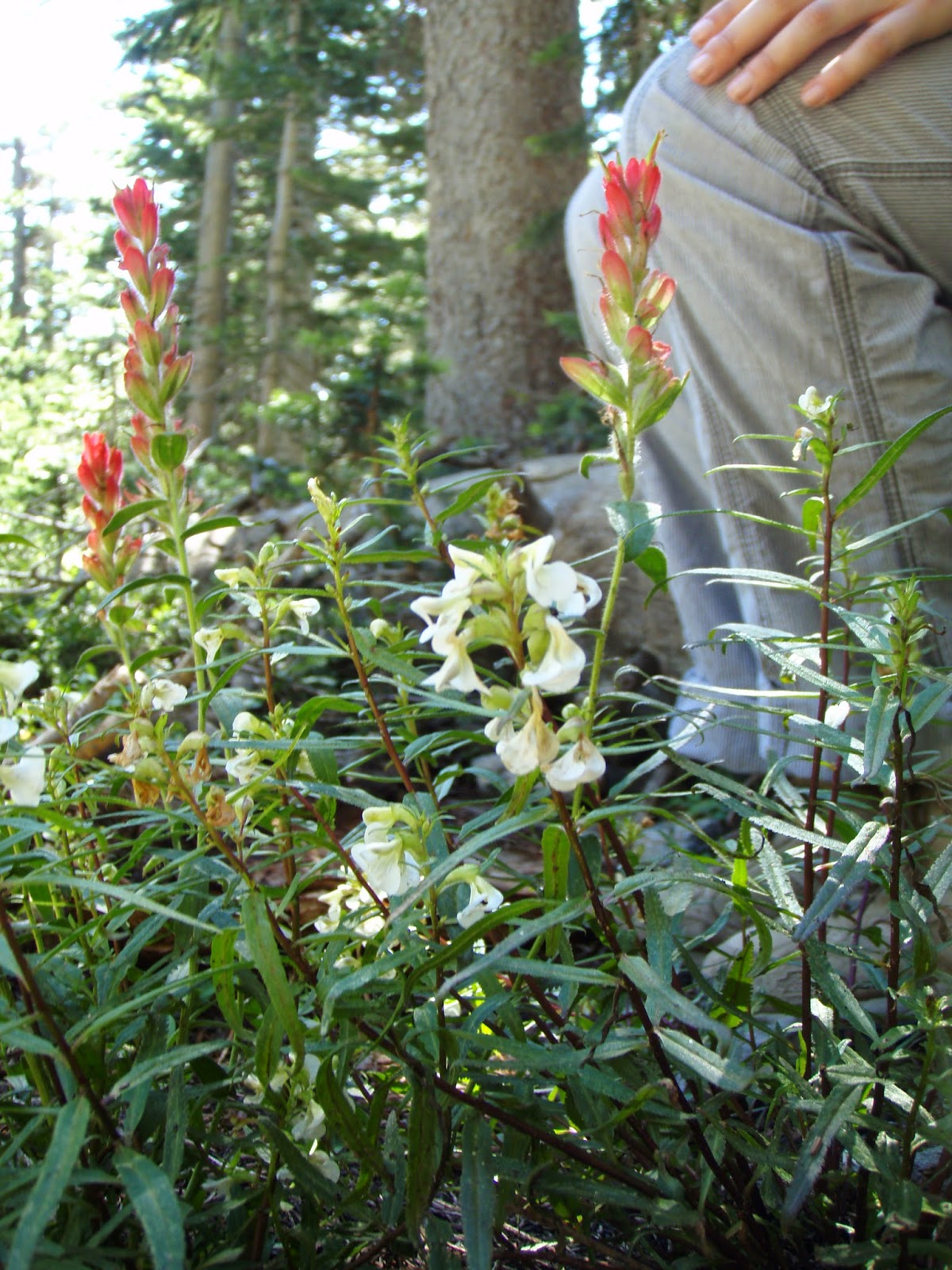
We started off in the montane ecosystem, much like what we had hiked through the day before on Deer Mountain.  According to the park’s website, montane ecosystems occur between 5,600 and 9,500 feet.  We saw many of the characteristic pines of this ecosystem.  We were also treated to some lovely lupins (Lupinus), Indian piantbrush (Castilleja), as well as some other pretty wildflowers whose faces don’t have a name in my mind.  One of my favorite parts of climbing up is looking back down at the same landmark over and over again.  Watching Bear Lake get smaller and smaller as it peeked from between trees made the first mile or so go very quickly.


Subalpine Ecosystem, everything look so intense!
That is a huge cairn, which we though was hysterical.
As we moved up into the subalpine ecosystem, spanning the range from 9,000 to 11,000 ft in elevation, the vegetation began to change.  Short, gnarled subalpine spruce and Engelmann fir dominated the landscape, but a few pines persisted.  Most of the larger trees we spied had the tops snapped off, making them look a little naked.  We hypothesized (like you do) that snow was the likely culprit.  I remember being in Africa and thinking I could tell, just by the character of the plant life, that this was a hard place to live.  I felt the same way about the tough looking scrub trees along the trail.  Way to stick with it, guys!  At this point in the hike, the types of animals we saw also started to change.  We saw our first yellow-bellied marmot!  These guys are essentially just fatty squirrels.  It’s funny, because the noises we made upon catching our first glimpse were very similar to the noises he made while checking us out from his rock.  Appreciative squeaks all around!  
Amazing alpine tundra!
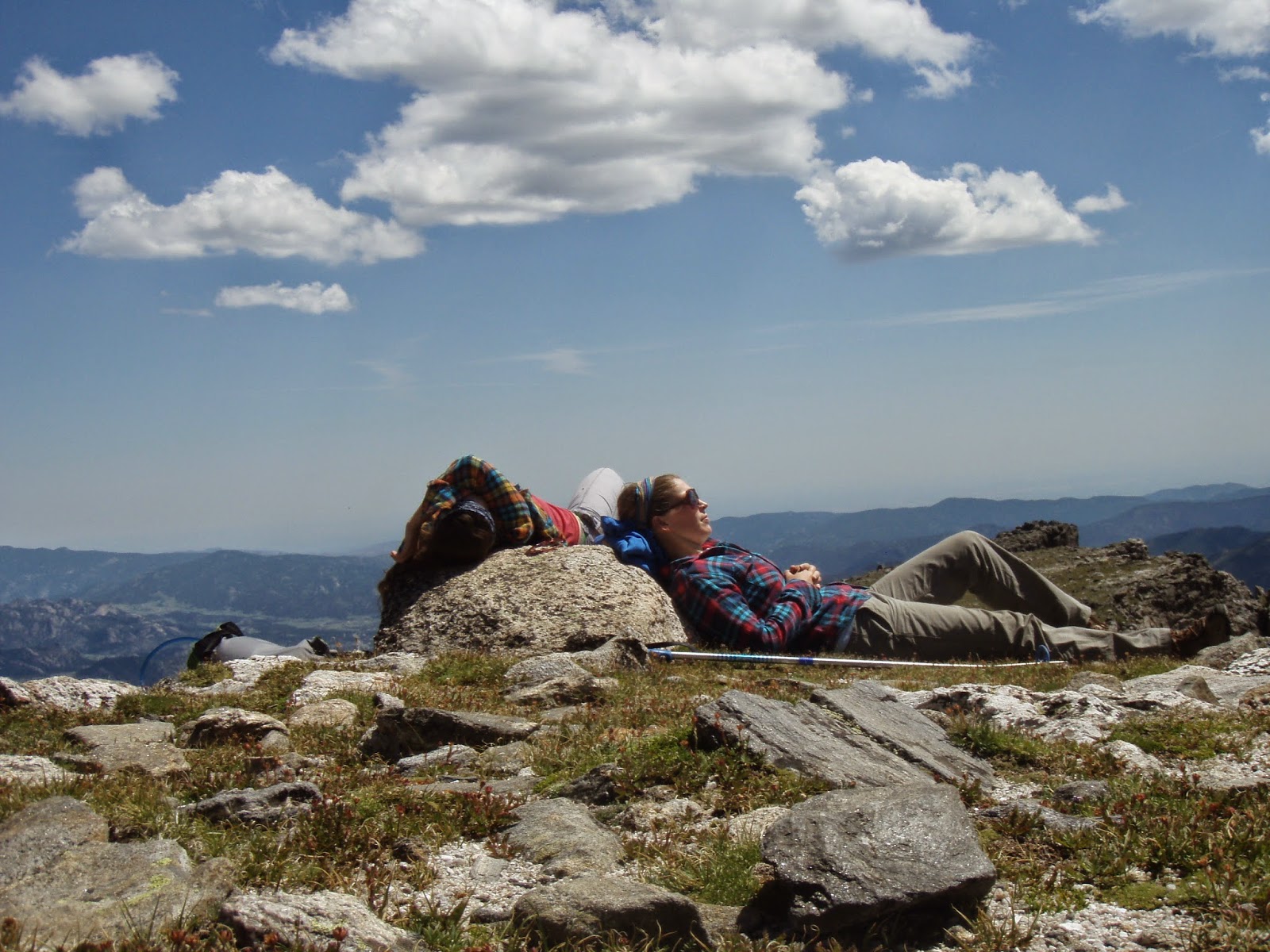
Mt. top naps for the win.
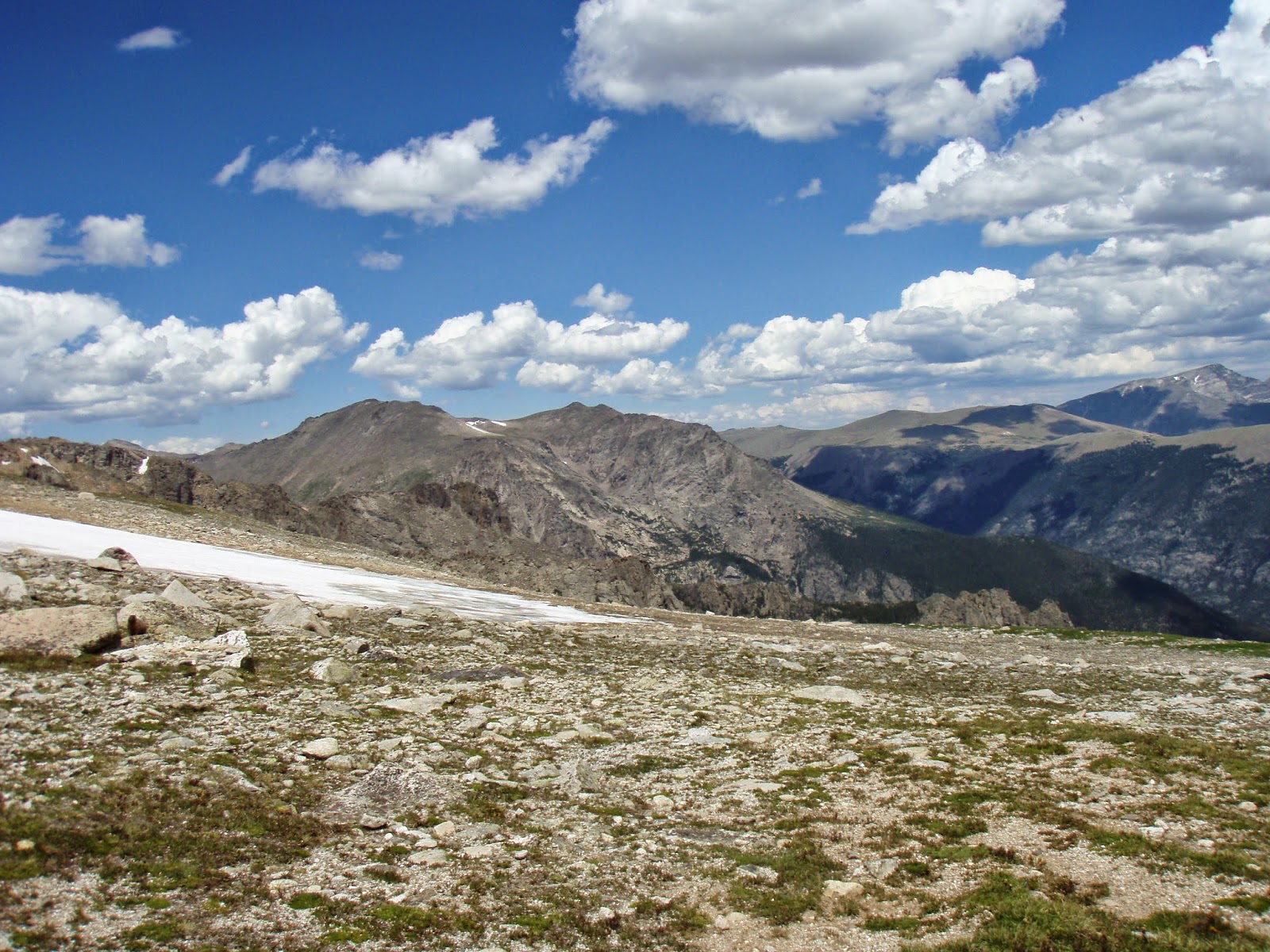
Finally, our hike brought us into a true alpine tundra ecosystem.  I think I might have been annoying Meridith a little bit with the phrase, “I totally have a crush on this ecosystem.”  I totally do!  It’s just so fascinating.  This ecosystem begins around 11,000 or 11,500 ft in elevation, past the point where trees can grow.  Due to the exposure, liquid water is a major limiting resource, meaning tundra is basically a type of desert ecosystem.  I was instantly squatting down, peaking at plants, and pointing out adaptations I thought were similar to those we had seen at Zion and Arches National Parks.  Suddenly, we heard the most precious of little sqees.  A pika!  This adorable alpine guinea pig pretty well made my day.  Due to my love affair with the tundra, it took me a little while to notice that Meridith had flagged down and boarded the Struggle Bus.  The impacts hiking at high altitude have on a person are, in my experience, not correlated at all with physical fitness.  In retrospect, Meridith likely had a touch of altitude sickness.  Pro tip for those prone to such things, a preemptive Advil or some such thing can help you make it!
Being the total trooper that she is, Meridith made it to the top of Flattop Mountain (and so did I)!  We both oohh-ed and awww-ed at the view for about 2.5 seconds before taking an epic mountain top nap.  Highly recommended.  When we awoke, we were both feeling grand.  We ate a spot of lunch, then poked around the mountain top, enjoying our accomplishment, before heading back down the way we had come. (Editor’s note: This is about the time I decided to aggressively drop my camera for the umpteenth time, dislodging some vital wiring innards, essentially rendering the back screen useless. However, it still managed to arrive alive at the end of our journey!) See Meridith’s previous post about the proper way to descend on a hike.
For example, on the way down, you might notice a huge field of wildflowers
you missed on the way up!
We were feeling really good about ourselves at this point, and super excited about the play day we had set-up with one of our friends from the previous night.  We shared food and chatted around the campfire well into the evening.  He convinced us to take Myers Briggs Personality test and, as fate would have it, Meridith and I have super compatible personality types.  The descriptions pretty much said, “You guys should be best friends and take lots of adventures together.”  Noted Myers Briggs.  Eventually, we had to break-up the party and head to bed.  The next day, we were hitting the road again, this time for Yellowstone National Park!
Obligatory NP Sign Pic

LIT to KY Pt 1: Planes, trains, and moral conflict

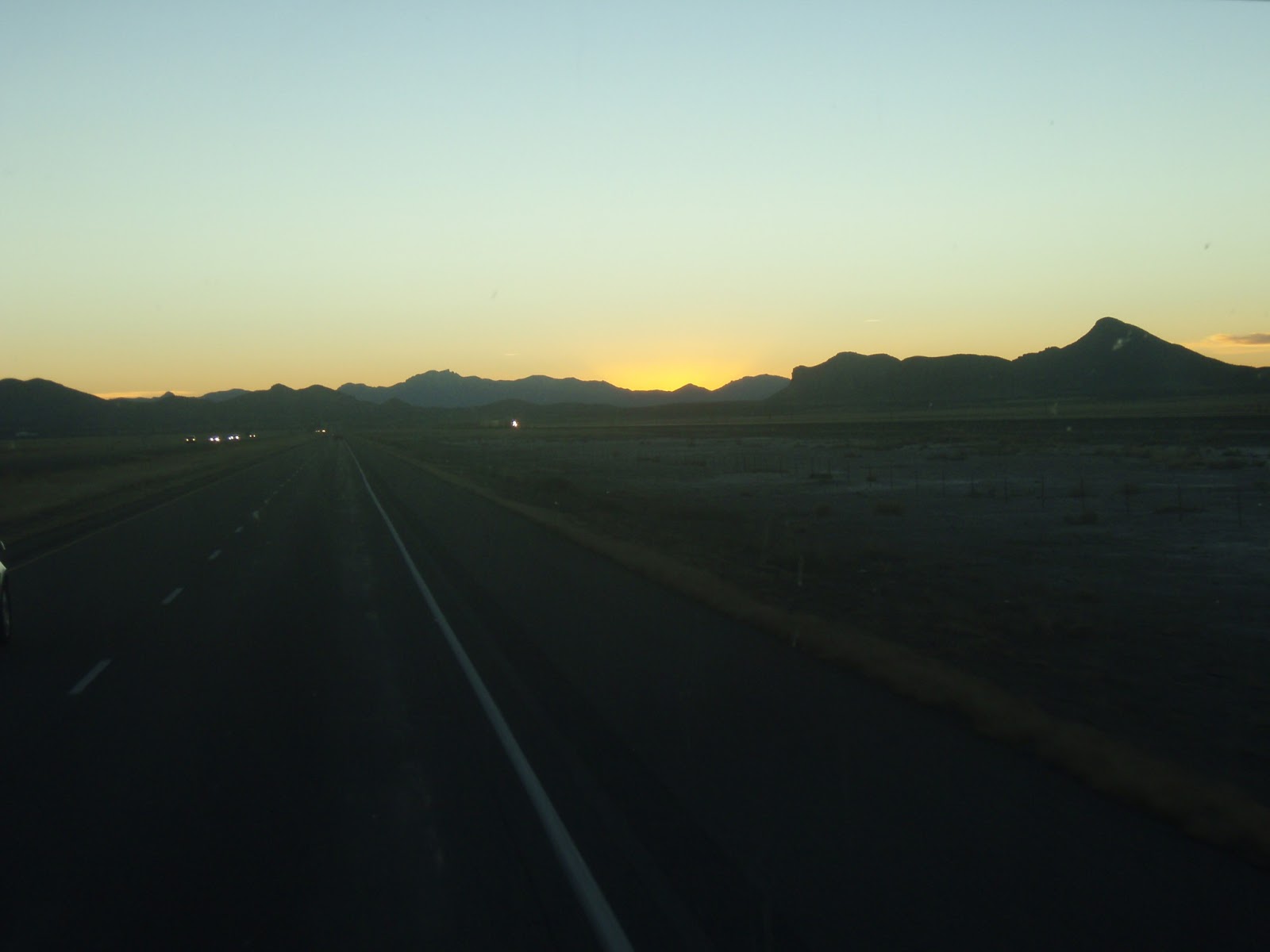
My Greyhound view on the 20hr trek between NM and CA.
As a preface, this is part one of a two part post about my recent trip home to Kentucky.  Part two will take the more traditional form of my other Low Impact Travel (LIT) posts where I discuss my adventures and the little ways I try to alter my travel behaviors to reduce my ecological impact.  However, I wanted to take some time and space to talk about an issue which often troubles me, how and why we choose our means of transportation.  Please note that while this post does contain some science, it’s mostly my own opinions and rational.  It should be taken as neither fact or prescription, and is simply the conversation I have been having with myself for the past 4 years, converted into essay form.  
Part One:  Some Science
I don’t know if you’ve noticed yet, but I travel a lot, and I really enjoy it!  I am, however, generally conflicted when it comes to the subject of plane travel.  It’s a pertinent topic considering the new study published in Environmental Science and Technology last week (for some good summaries of the study you can look here or here, but I suggest you read the paper).  The study’s authors Jens Borken-Kleefeld, Jan Fuglestvedt, and Terje Berntsen offer very accurate estimates of the climate impacts of different modes of long distance travel (in their study 500-1000 km) by comparing impacts at 100% vehicle occupancy vs. average occupancy.  They also expand the definition of “climate impacts” to things beyond simple CO2 emissions, though no matter which measure you examine, the story is relatively consistent.  Spoiler alert, plane travel loses big time, every time.  Now, allow me a moment of European envy.  One of the options in their study, high speed electric rail, boasts zero grams of CO2 emitted per vehicular kilometer.  Obviously, that is just based on the fact that these trains don’t have tailpipes, and who knows where that electricity is generated, but trains lack some of the fundamental climate impacts included in plane travel such as the creation of cirrus clouds and the indirect production of ozone.  So, plane travel, not so good…yet I’m going to try and write a low impact travel post in which I take a plane?  It seems mildly disingenuous to me.  
The thing is, I know that lots of people face these same sorts of problems.  Obviously, I need to visit home.  It’s good for my mental health, I adore my family, and I don’t know if anyone else has had a southern mother but…even if I didn’t want to go home, I would.  So allow me a moment to try and work through this moral quagmire here, in this forum.  I’m going to use my potential trip home over Thanksgiving to make this a bit more tangible.  Admittedly, holiday pricing sort of skews the picture for us, but that is when most people do most of their long distance traveling, so I feel it’s appropriate.    
Part Two:  Time, Money, and Convenience
This is how Clark Gable and I prepare for train travel.
First, let’s break this problem down economically based exclusively on the upfront cost of travel.  When I first moved to California, I had some pretty romantic visions of myself boarding a train and chugging the 2264 miles back to Kentucky for the holidays.  I might also have envisioned myself in some pretty excellent period garb; I might also have been riding on the train with Rhett Butler.  That’s beside the point, because in 2013, taking the train in the USA is not substantially cheaper (or cheaper at all!) than plane travel in many cases.  For example, this coming Thanksgiving, it will likely cost me around 450 dollars to take a plane to and from home for the holidays.  The train would cost me about 500 dollars (included in this cost is the necessary bus from Chicago to my final destination).  Taking a bus all the way across the country would run me only about 375 dollars.  If I drove my car, by myself, it would cost me about 393 dollars.  I suppose this part isn’t super surprising and matches up relatively well with the findings of  Borken-Kleefeld et al. (2013) who found coach (that’s European for bus) travel to pose the lowest climate impact.  So, hooray, the cheapest form of travel is also the most environmentally friendly.  That’s a good thing.  The fact that the train costs more than the plane in this case is probably partially due to timing and partially due to the fact that I’m not just traveling between two major Amtrak hubs.  But how many people are just going between LA and Chicago, for example?
So, let’s say you, like myself, don’t mind the bus and love saving money.  Maybe you’re leaning toward a Greyhound trip for your next adventure.  Let’s now expand the analysis past just upfront costs, and things get a little more complicated.  For my long distance holiday travel, I’d say driving alone in my personal car is out of the question.  It would take me about 33 hours, so I would need to pay for lodging (a hostel or a campsite at about 20 dollars a night) and I would have to get my oil changed and what not before and after the trip (another 80 or so dollars).  After taking these things into account, driving is about the same cost as a flight or train travel.  According to the study, gasoline cars, even at maximum capacity, were second only to airplanes in their carbon impacts.  So let’s just throw that idea out.  Then there is the seemingly appealing option of taking the bus.  To get me home for the holidays, I would be in transit via bus for 2 days and 6 hours.  I don’t know about you, when when I take a long trip, I’m always very tired afterward and need a day to recoup, so that’s essentially three days lost on either side of the vacation, or almost a whole week!  Let’s say you get paid 10 dollars and hour, that is a net loss of 480 dollars if you can’t work remotely.  Okay, so maybe for such a long trip, Greyhound isn’t what we want.  What about the train then?  To get me back to KY from CA would take almost 66 hours via train, or almost three days.  So, the train takes longer than the bus.  An advantage of the train, however, is the free WiFi and more comfortable seating where one could, potentially, get some work done.  Last, we have plane travel, which could get me back to KY in as little as 5 hours (no counting transit to and from the airport).  So I only lose two or three days to travel (depending on recovery time), and a lot of planes and airports have WiFi now, so I could even work in transit.  
Okay, so up to this point, this essay might seem a little…unusual based on my general content.  And that’s a fair observation.  The truth is, I want to advocate for coach and rail travel, I want to say that I never fly because I know how bad it is for the environment, and I want both those statements to be true.  Unfortunately, that’s just not the case.  So, where do we go from here?  I think I have quoted Colleen Patrick-Goudreau previously, but she often says “Don’t do something because you can’t do everything.”  I think that applies here.  So, what to do?  I think we must all apply some careful time and thought to how we move around the world.  Consider your personal circumstances carefully.  After all, convenience cannot be the only factor when making choices…that’s sort of how we got into our current environmental mess.  Based on my own personal reflections, I do have some recommendations, but I encourage each of you to do individual research and make choices based on your own knowledge and morals.    
Part Three:  A Practical Ecologist Guide to Transportation Selection
1.  Traveling with friends who don’t dig alternative transportation?  Carpool every time possible in the most fuel efficient vehicle available.  Squeeze in, sit close, just do it.  Appeal to their wallets, that generally works.       
2.  If you are traveling somewhere nearby, maybe within the 1000 km (about 620 miles) range proposed by  Borken-Kleefeld and colleges, I would strongly advocate that you take the bus.  I’ve taken quite a few regional Greyhound trips, the longest lasting about 20 hours, and they aren’t as bad as you probably think.  I’ve met some really nice and interesting people, and I got to see parts of the country that you just miss when you are traveling via plane.  And hey, if you have a job where you can work from your computer, you don’t really need the internet, and you don’t get carsick, you can probably take the Greyhound just about anywhere you want to go!    
3.  If you are traveling regionally or if you have a flexible job which allows  you to work remotely, take the train!  The seats are comfortable, the views are great, and the free WiFi is pretty speedy.  Once I am done taking courses, I have big plans to do this for the holidays.  At that point, my office will be my computer and I’ll have a lot more freedom to take transportation that is less efficient time wise.   
4.  If you have a job that really requires your physical presence or gives you limited flexibility in vacation time you really have two options:  don’t take the trip at all or hop on a plane.  While I know that some people might advocate for the former option, I really don’t.  I do, however, advocate that we make our plane travel as efficient as possible.  Carpool or take public transit to and from the airport.  Try to avoid buying bunches of plastic-packaging while you’re on the move (etc.  etc. etc.), and make your trip count!  When I’m on the other side of the continent, I try to see as many of my friends and family as possible, even if that requires the occasional Greyhound up to Chicago for a weekend.  
5.  Purchase carbon offsets when you are forced to choose the less efficient mode of transportation.  This could be a whole post later, but make sure you do a lot of research before purchasing an offset and don’t fall into the trap of using more carbon because you plan to purchase an offset later.  Carbon offsets are by no means a perfect system, but they are a tool we currently have at our disposal.  Alternatively, calculate how much you would have spent on a carbon offset and donate that amount to a environmental/conservation NGO of your choice.  
“You take your car to work, I’ll take my board..” ~Weezer
Last Word:  In closing, I would like to remind you (and myself) not to lose faith.  Changing technology and infrastructure could really alter things.  That’s why it is important that, whenever possible, we vote with our wallets and support the industries in which we believe.  We cannot let convenience be the only factor that drives our choices.  It’s also really important to remain realistic about the impacts our personal choices have, for both the good and the bad.  It’s easy to say that plane travel is less efficient than train travel, but it’s more difficult to translate these things into the currency of our daily lives.  Last, recall that this conversation becomes even more important when we consider our daily travels which can easily add up to have more substantial impacts (for the good or the bad) than our holiday or vacation travel.  I would argue that choosing the most fuel efficient way to get to and from work daily might be even more important than how you get home for Christmas.   
What do you think?  Should convenience play no role in our transportation decisions?  How do these conflicting factors play out in your life?