
Collaboration is a vital part of the scientific process. Do you think I’m going to save the world on my own? Nope. I’m going to need at least a little bit of help. The more great minds working on a project, the faster advancements may be made. And we need advancements (I’m look at you, self-driving car peoples)! Any sort of collaboration is difficult across distances. Technology has made the process easier and email is currently the main tool for communication for researchers. While I’m really proud of the older generations of scientists for getting on track with email, I’m afraid I’m going to have to ask them, and everyone, to utilize Google Drive for their collaboration needs.
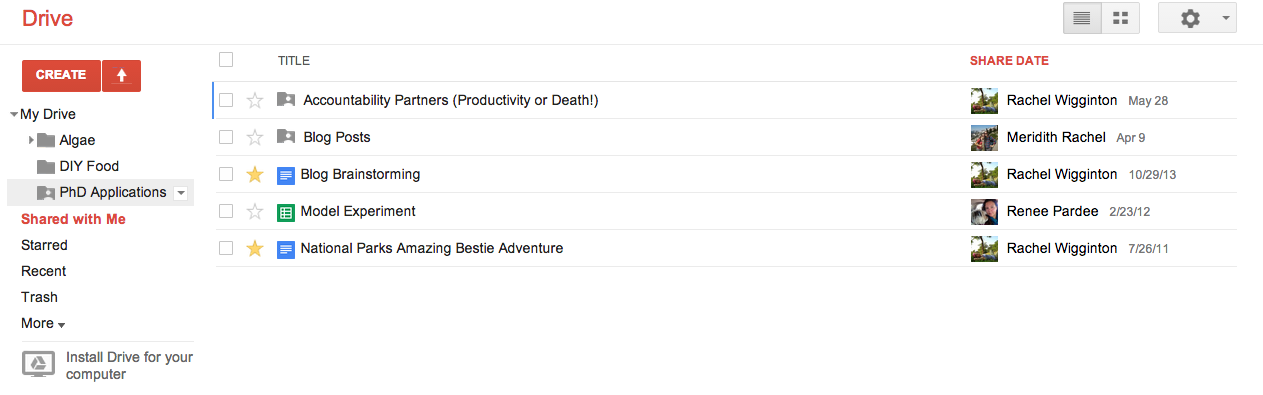 |
| Being able to access my Google Drive from anywhere keeps me productive! |
Google Drive was repeatedly been a useful resource throughout my graduate school years. I could share files and folders with my undergrads so they would always have access to protocols, data sheets, etc. It made for fast communication and kept my data safely stored in multiple locations. However, when I was working on writing manuscripts I would email it to all of my co-authors whenever they needed feedback and would inevitably have to shuffle their responses and changes back into a master copy. This updated copy I would then save as a new file. My third manuscript has yet to be submitted because my advisor and I accidentally worked on two different file versions, and now she has to incorporate her updates into my most recent version. I never wanted to use Google Drive to have people revise my papers because I couldn’t for the life of me find anywhere to turn on Track Changes. But when I was working on my PhD application essays and desperately wanted people’s feedback, I realized Google Drive always has track changes on! And it’ll keep track of who edits what, when, where, and why! Ok, not why. Unless they leave a comment!
So if you want to collaborate on a piece exclusively on Google Drive
1) Start a file – it can be a document, presentation, spreadsheet, drawing, etc
2) Share it with your collaborators. – You can share via a provided link or email. You may also control the level of privacy your work has.
3) Write and edit the file! – All together now!
4) Keep an eye on the changes/comments made by others – Anytime you want to open your revision history, click “All changes saved in Drive” at the top of the page.
5) Profit
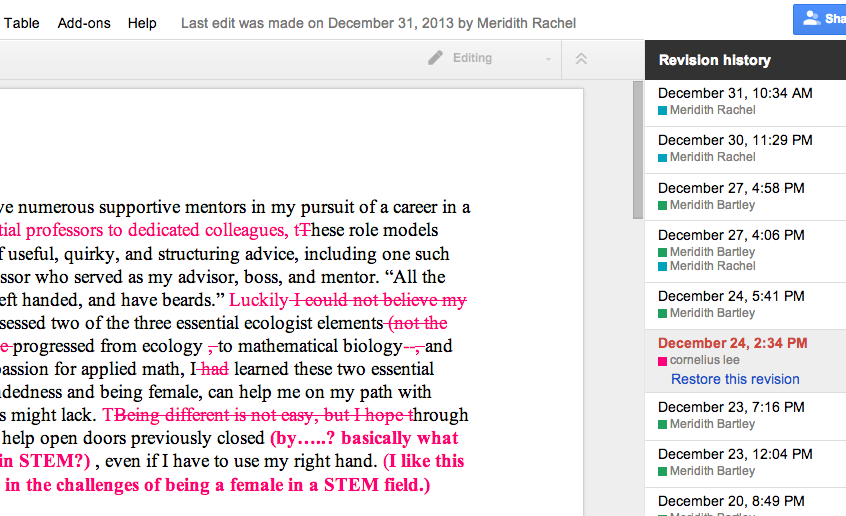 |
| So many revisions! So many colors! |
Writing that army of essays was undoubtedly one of my least favorite parts about the graduate school application process. I absolutely could not procrastinate them because I wanted to get as many discerning eyes on them as I possibly can. Now that all of my PhD applications are submitted I have the power of hindsight, which allows me to see just how much my essays benefited from the help of several friends’ advice. Some ended up being completely rewritten multiple times. Multiple people were able to review and revise the essays at the same time, and I never had to compare different file versions emailed to me. No going back for me now. Go ahead. Put those theses into GDocs. Your manuscripts. Your group work assignments. Unleash the power of automatic track changes and maximize collaboration! Never worry about hitting save again.


 Sweet Tea, Science