Cover Letters of Interest

Once you’ve gone through the process of finding potential grad school advisers, the next step is to contact them. It can be quite scary. That fear that you’ll craft a seemingly marvelous letter, attach your well-written CV, send it off, and then…hear back nothing. Or worse, you’ll hear back, but they aren’t interested in your obvious brilliance. Try not to get in your own head too much. Think of it more as the start of an epic journey towards the next step in your blossoming academic career. The professors that show the most interest in you are going to be the ones that are the best fit for your unique interests and skills. Writing about yourself is hard, but now is the time to brag on yourself a bit. Say it with me, “I am a badass science baller and all the profs want me.” Keep in mind that this letter does not need to be perfect. I just looked back at the cover letter I sent to my MS advisor (keep anything you write about yourself!) and it’s nearly 2 full pages long with way too much information. Thankfully, she wasn’t bored, and I had a wonderful, productive Master’s experience.

Say it again!

There’s a fine line between a letter of inquiry and a cover letter. Basically, if there is a posted opening with the advisor, then it is a cover letter. Otherwise, it’s a letter of inquiry, simple as that. The aim of such a letter, when writing to potential advisers, is to express your informed interest in them and their research, while also presenting a focused snapshot of yourself. Informed interest is important. Make sure you familiarize yourself with their work. Read their papers.  Brainstorm ideas for how your work could compliment theirs.  I’m not going to lie, this can be tough. I find it helps to remind yourself that you are not contractually bound to follow through with the ideas you come up with and present during your application process (Editors Note: This was my mantra to Meridith during her PhD application!  Glad to see it sunk it.). You just want to show that you are an intelligent being with a real interest in a similar field of research and that you can come up with relevant ideas.

To begin, you’ll want to state your interest in their lab and ongoing project(s). A common pitfall is to contact a professor about an area of research in which s/he is no longer active. Check the dates on those publications!  Additionally, some professors will be looking for more than one student to work on a several different projects. Clarify early why you are writing to them. They get numerous emails daily and the easier it is for them to read your email, the easier it will be for them to respond. Next, the second paragraph should be a self introduction. What are your recent experiences, and how would the skills you have benefit you if you were to join this person’s research group? The third paragraph should be dedicated to expressing your interests, goals, and ideas for research. The final paragraph is a little more general.  You can think of it as a summary:

I think my interests, skills, and future plans could potentially fit in well with your research program.  If you have room for a PhD student in the (interest term and year here), please let me know if you would be open to discussing my interests or experiences further. I have listed some of my major accomplishments below, but I have also attached my full CV if you would like further information about my past experiences and skills. I know you are very busy, so I appreciate any time you can give me.  Thank you very much.

I like to include a little bulleted list of notable accomplishments to whet their appetite. I wouldn’t advise giving them more than your “top 5.”  The goal here is to entice them to open your attached full CV.  Good achievements to mention are:

  • GPA
  • Grants or scholarships awarded (and how much $$ you were given)
  • Examples of academic excellence (exceptional GRE scores, special skills, unique courses taken with grade)
  • Evidence of research experience (REUs, internships, volunteer positions in research groups, etc.)
  • Publications (with links) or presentations/posters 

The internet already has loads of posts on this topic and plenty of sample letters to reference. Don’t rely on just this post!

Contemplative Mammoth’s Post
Dynamic Ecology’s Post
The Professor is In’s Post
Simple Sample Letter
In Depth Cover Letter Essentials

Please let us know if you have any other great cover letter references! We’d love to let this list grow and provide a wide array of recommendations for the future graduate students among us!
Collaboration Station: Google Drive

Collaboration is a vital part of the scientific process. Do you think I’m going to save the world on my own? Nope. I’m going to need at least a little bit of help. The more great minds working on a project, the faster advancements may be made. And we need advancements (I’m look at you, self-driving car peoples)! Any sort of collaboration is difficult across distances. Technology has made the process easier and email is currently the main tool for communication for researchers. While I’m really proud of the older generations of scientists for getting on track with email, I’m afraid I’m going to have to ask them, and everyone, to utilize Google Drive for their collaboration needs.

Being able to access my Google Drive from anywhere keeps me productive!

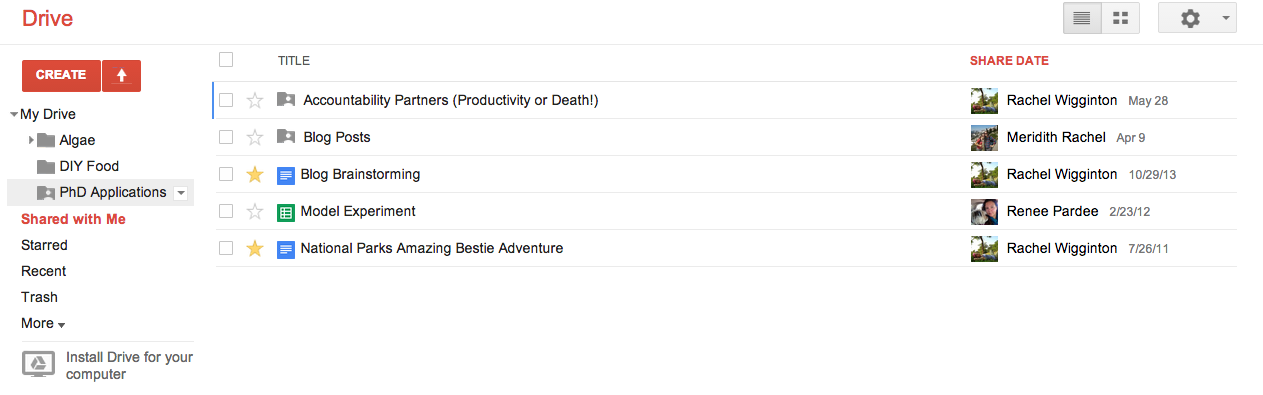
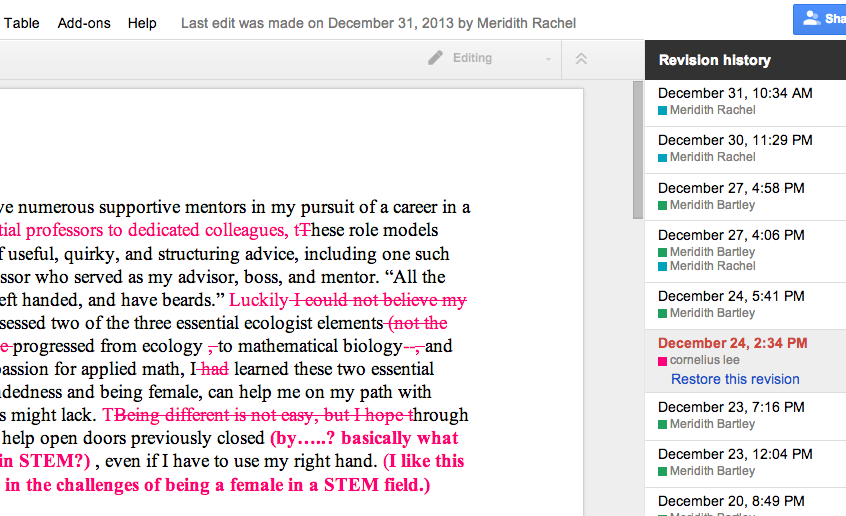
Google Drive was repeatedly been a useful resource throughout my graduate school years. I could share files and folders with my undergrads so they would always have access to protocols, data sheets, etc. It made for fast communication and kept my data safely stored in multiple locations. However, when I was working on writing manuscripts I would email it to all of my co-authors whenever they needed feedback and would inevitably have to shuffle their responses and changes back into a master copy. This updated copy I would then save as a new file. My third manuscript has yet to be submitted because my advisor and I accidentally worked on two different file versions, and now she has to incorporate her updates into my most recent version. I never wanted to use Google Drive to have people revise my papers because I couldn’t for the life of me find anywhere to turn on Track Changes. But when I was working on my PhD application essays and desperately wanted people’s feedback, I realized Google Drive always has track changes on! And it’ll keep track of who edits what, when, where, and why! Ok, not why. Unless they leave a comment!

So if you want to collaborate on a piece exclusively on Google Drive
1) Start a file – it can be a document, presentation, spreadsheet, drawing, etc
2) Share it with your collaborators. – You can share via a provided link or email. You may also control the level of privacy your work has.
3) Write and edit the file! – All together now!
4) Keep an eye on the changes/comments made by others – Anytime you want to open your revision history, click “All changes saved in Drive” at the top of the page.
5) Profit

So many revisions! So many colors!

Writing that army of essays was undoubtedly one of my least favorite parts about the graduate school application process. I absolutely could not procrastinate them because I wanted to get as many discerning eyes on them as I possibly can. Now that all of my PhD applications are submitted I have the power of hindsight, which allows me to see just how much my essays benefited from the help of several friends’ advice. Some ended up being completely rewritten multiple times. Multiple people were able to review and revise the essays at the same time, and I never had to compare different file versions emailed to me. No going back for me now. Go ahead. Put those theses into GDocs. Your manuscripts. Your group work assignments. Unleash the power of automatic track changes and maximize collaboration! Never worry about hitting save again.

Finding a Graduate Advisor

This is a question for either of you to answer. Over the course of my last year in school I’ve had the most difficult time finding out how to go about seeking potential (M.S.) advisors for graduate school. Like, I’ve tried looking at schools I would like to go to, and looking at researchers there, but I have had little success in making conclusions when my interests are wide-spread. So, how the hell do I narrow down my interests, and what is a (possibly) better way of finding and approaching potential advisors? I am (mentally) paralyzed.


Thanks, freshlypluckedscientist, for the awesome post request! First off, it’s going to be ok! You are not the only one who has felt like this! I’m also fairly certain that we are not the only two who have felt like this! Rachel and I have both gone through this process twice (M.S. and PhD) and we understand how difficult and frustrating the entire process can be. Both times I tried to get a head start on the process and both times I felt like I was always behind schedule and running out of time! Before I even get started on any suggestions or tips, I’d like to reassure you that it’s completely ok to take a year off to figure things out and generally just chill. I took a year off after undergrad and nearly 2 years off after finishing my M.S. degree. I’m now going to be a few years older than the rest of my cohort, but I am going back fresh and excited and motivated!  Like so many big life decisions, you just have to do you.   


If you are looking for any sort of biological research program it can be nearly impossible to sift through departmental websites of universities you are interested in to find potential advisors. Yes, lots of them keep up-to-date websites with a convenient section for Potential Students, but many others do not. When I was looking for M.S. advisors I focused my search by perusing the EcoLog listserve and Texas A&M Job Board. You can keep an eye out for posts by advisors advertizing available positions instead of having to seek them out yourself. One plus to seeking an advisor in this way, if they are posting on a listserve or job board, they likely already have a project with some sort of funding available.  Keep an open mind and cast a wide net when you are finding potential advisors. Here is where you can let your varying interests guide you. Once you contact someone you can start to narrow your interests a bit.  Also, there is nothing wrong with narrowing your search based on where you actually want to live for the next few years of your life.  I know when Rachel was looking for graduate programs, she knew she wanted to live near the coast.  This initial choice actually lead her to studying tidal marshes (which she loves!) as opposed to the many other inland types of wetlands.

NMSU was a great place for my MS.

Write a basic cover letter and then customize it for each professor to whom you send it. Basically, you need to write a short introduction of yourself highlighting your best attributes and attach your CV and any other pertinent information they may have requested. I am working on a cover letter post for spottedsharkheart currently so more to come on the intricacies of that! If they reply, gauge their interest and try and set-up a time to have a phone or skype conversation to discuss your mutual interests. Not everyone is going to write back. Professors have a packed schedule and they are probably receiving many similar emails. Don’t be afraid to send a follow-up email reminding them of your inquiry. You can send more than one follow-up if you are extremely interested in working with an individual, but keep in mind that if they are too busy to reply to your email, they might not be a super good fit anyhow.  During this search and email phase, don’t be afraid to explore options outside of your comfort zone. My background is biology, and come fall I am entering a PhD program in Statistics. Granted, I hope to find research where I can apply my developing skill-set in stats to ecological problems, but you never know where your path may lead.


Once you are in contact with a potential advisor, this is the time when you need to show that you have focused interests that mesh well with their own, but keep in mind that you aren’t locked into anything you discuss initially. This also applies to those pesky essays you might need to write during the application process. I had the hardest time with these and Rachel had to tell me multiple times that I am not going to be contractually bound to anything I wrote in them! Narrowing your interests is a tough one. I honestly don’t know how to go about doing this particularly well. You can peruse MS Grad listings on to see what pops out at you. You may also want to consider specializing in a skill that can be applied to many different situations (GIS, Stats, etc) so you will be able to work in many different fields.  Having various interests also likely means you could be happy doing several different things!  There is nothing wrong with that, and it actually increases your odds of finding a cool graduate program that speaks to at least some of your passions.


Don’t let letdowns get you down. I had a rough time when searching for PhD programs. Sometimes, they just don’t ever respond. Sometimes, they responded a few times and then…..nothing?! Other times, you get as far as a skype conversation with a professor only to find out that it does not appear to be a good fit. It’s a little late in the year currently to find an advisor and join a program (not impossible). Ask current professors on your campus for help.They have been through this during their education and they have helped countless others through the same process.


Anyone else have amazing advice about applying to graduate programs?  I would love to hear about it in the comments sections.  It would be amazing to make this post a resource to refer others to in the future!