A Day in the Life: Summer Field Work

Restored marsh area.

Despite what Starbucks is trying to tell you, fall doesn’t officially start in the Northern Hemisphere until September 22nd at 10:29 pm (equinox party anyone?).  And yet I felt now might be a great time to reflect on the summer.  At this point, if you’re a semi-regular reader you probably know a bit about my interests, but today I want to share a peek inside my summer work.  It was fun, it was muddy, and it was also just a ton of work!

I’m just for scale, look at the height on that hybrid Spartina!

But before I can really tell you what I did, I need to tell you why I did it.  As a PhD student, I’m nurturing a little research agenda that I hope will mature over time.  Right now, it’s at that horrible tween stage where it wants to be a grown up research agenda, but I keep driving it to the mall and embarrassing it in front of its friends.  Regardless, when people ask about my work at parties or family functions, I tell them I study the impacts of invasive plants in tidal wetlands.  Tidal wetlands are hugely important in terms of impacts to biodiversity (nursery habitat for many organisms) and ecosystem services (carbon storage, flood abatement, water filtration, and the list goes on…).  Ironically, in California, only about 10% of our historic tidal wetland area remains, and to add insult to injury wetlands are one of the ecosystem most impacted by invasion.  

But, why invasive plants?  Plants are primary producers, hanging out at the base of the food web, and when they change, other things change in really interesting ways.  My master’s research focused on the impacts of an invasive plant on songbird food webs.  I found the plant impacted the insects, which the birds ate, thus impacting the birds.  I was intrigued!  That’s how I knew a PhD was right for me, after my MS, I have about 1,000 more questions.  In my current research, I try to understand:  How do changes in invasive plant density impact the effects these plants have on ecosystems?  How does restoration approach impact ecosystem recovery after the removal of an invasive plant?  How does understanding the function of invaders in ecosystems impact management choices?  I have approximately a billion other small questions that I try to address, but those are the biggies.


Now, what does a work day in the life of someone trying to answer these questions look like?  For about 6 months out of the year, it looks like me sitting at my desk, at my computer.  But during the field season, especially the summer, things are very different.

Studying Restoration in the Low Marsh

Restoration site types:  Native Spartina foliosa (top left), actively replanted (top right), passive eradication (bottom left), invasive hybrid Spartina (bottom right).
Tidal marsh plant communities are structured largely based on environmental stresses associated with inundation by the daily tides.  When I’m working at my restoration sites, I’m down in the lowest elevations where plants persist.  That means I need to be in the marsh, ready to work when the tide is low enough.  Each field day, I rise at least two hours before the low tide level I need to get my business accomplished.  Most of the time this summer, that meant being up at 4 am.  I’ll admit it, it was a bit of a drag being up that long before the sun.  I would change into my field clothes, make some coffee (so necessary), grab the lunch that I (hopefully) pre-made the night before, and head out the door.  I jumped in my car, which is (again, hopefully) pre-packed with all the gear I’ll need for the day, and swing out of my parking lot to pick up my employee and potentially a few volunteers.  Once we are all loaded up, we start the hour and a half drive out to one of my six sites in the San Francisco Bay Area.  These awesome people are really what makes all my work possible, so if they fall asleep approximately 20 minutes into the drive, I focus on NPR and coffee.
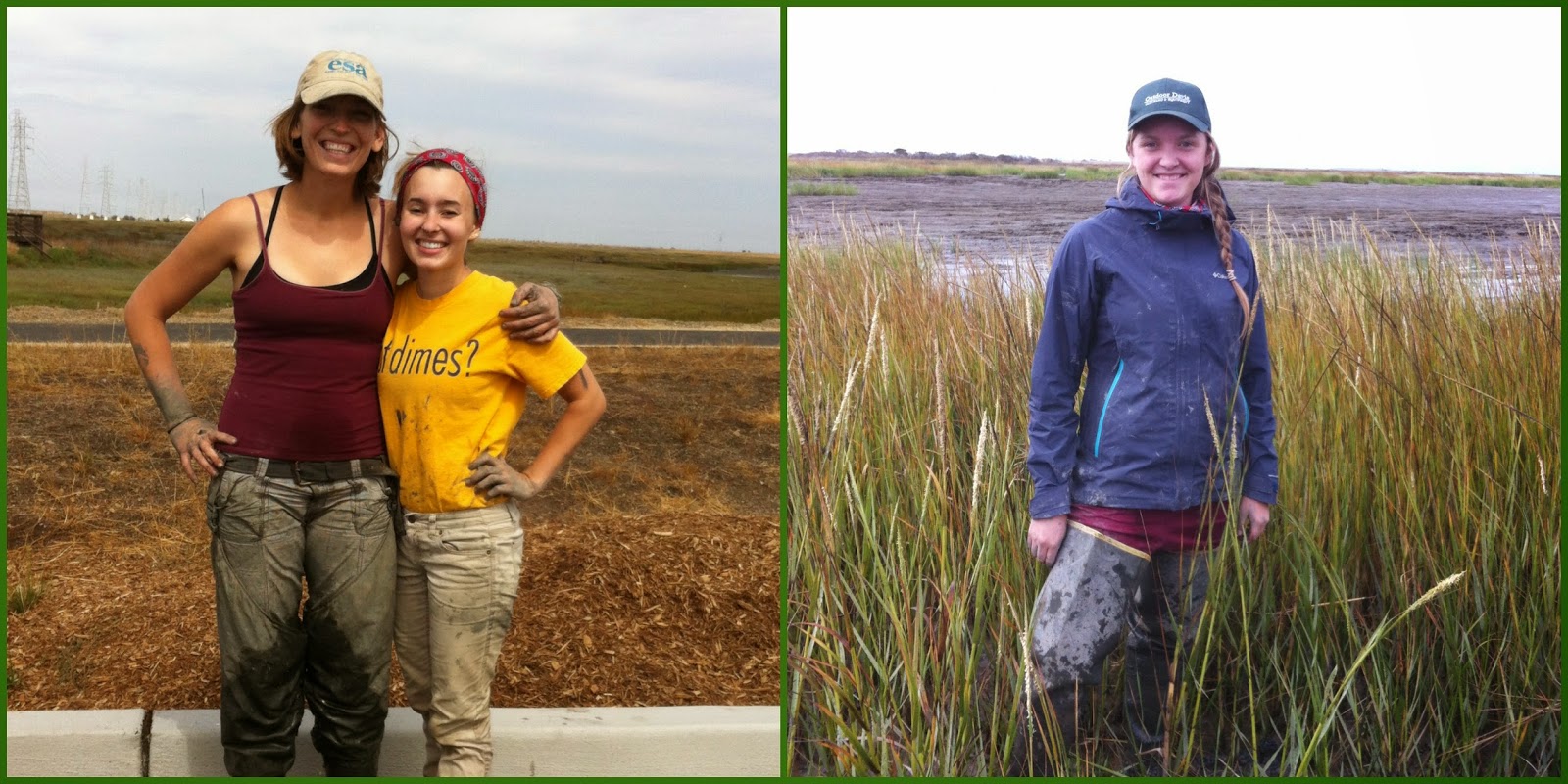
Two all star members of the wetland field crew!
Once we arrive, we pull on our waders and prepare to get muddy.  For this restoration work, I’m very interested in how invertebrates living in the soil are impacted by the different restoration approaches, specifically active replanting of native plants versus just eradicating the invasive and letting things passively progress.  So, I take a lot of soil cores.  Soil cores for grain size, soil cores for water content, soil cores for inveterate identification, soil cores for benthic algae analysis.  So.  Much.  Mud.  I also get to play with adorable crabs and watch the sun rise up over the bay.  In the end, it’s always worth the early wake up call.  Depending on the site and the day, the tidal window could be open for 4-7 hours.  As the sea creeps back up toward the land and my transects, we pack up our gear and lug 30 pound buckets of mud back to my car.

Muddy gear ready to be rinsed.
*Cue very obnoxious pop music and more coffee to make it through the drive home*

What happens back at the lab that evening really depends on the time of day and what the plans are for the next day.  Generally, we spray off all our gear (salt water = gear death), preserve and store all the samples we took, and go take showers.  Lather, rinse, repeat for about 20 days spread out over 1.5 months.  

Studying Management in the High Marsh

My other experiment this summer examined how different densities of an invasive plant might have different impacts to the ecosystem.  This plant, (Lepidium latifolium, or white top) can occur in several different elevations in the marsh, but my master’s work showed the largest impacts were in the high marsh zone.  Thus, I’ve concentrated my current work in that area.  So, unless the tide is really high during the middle of the day, I’m generally not very tidally restricted for this work.  I’m super interested in the impacts of invasive plants at different densities because we generally know about what things are like when these invaders are absent and when they are really bumping.  That middle stage?  A bit foggy.  That’s where I come in, or so I hope.  
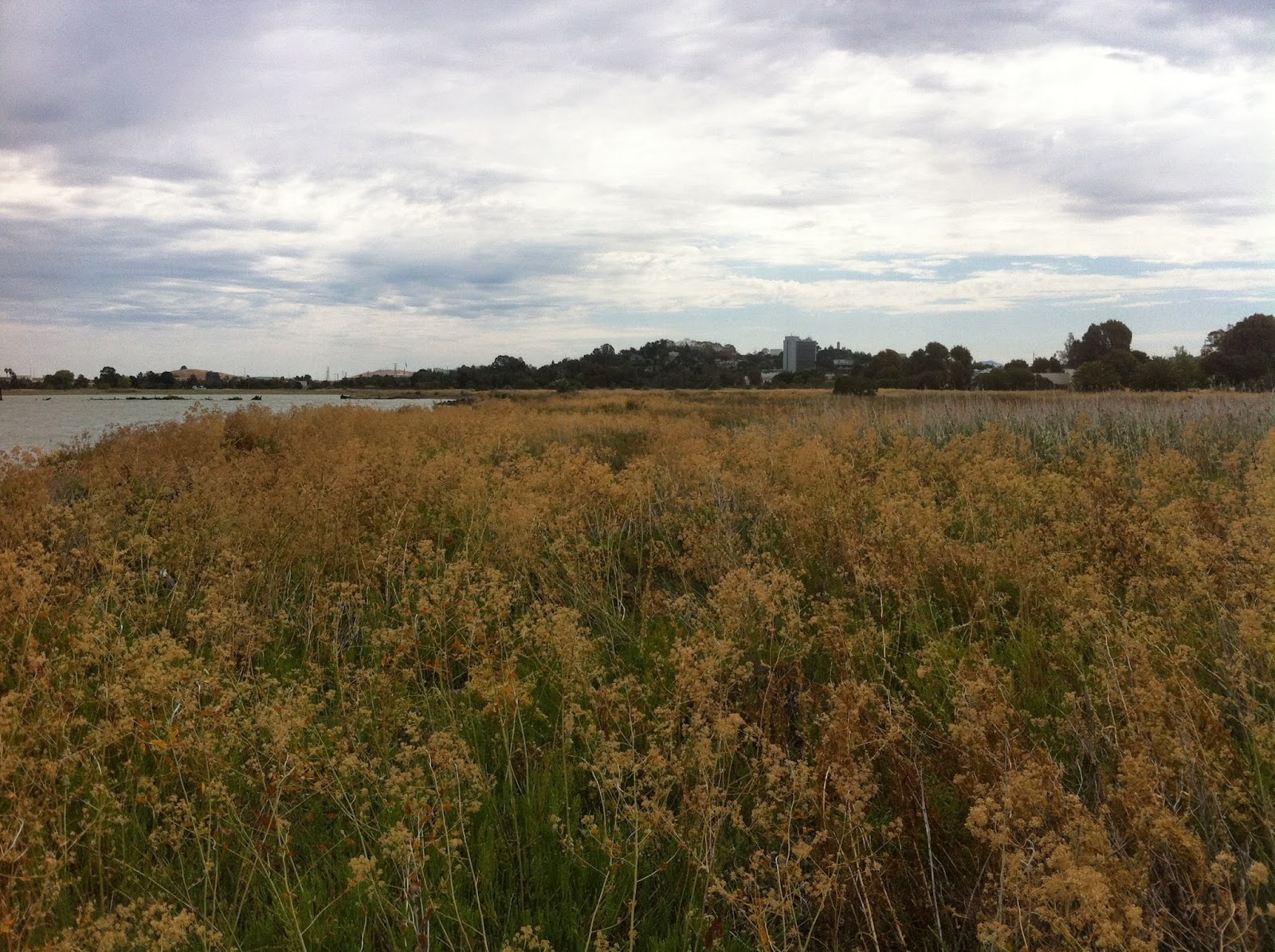
Marsh full of Lepidium.
On Lepidium mornings, I wake up at 6 am, which feels like a luxury, let me tell you.  I make coffee, grab my lunch, and head out to pick up my helpers for the day.  Once we arrive at the field site, we set to work counting stems.  I’m attempting to hold stem density constant between the different treatments, so a lot of this summer was spent driving out to the site and clipping out any extra stems that had sprouted up from the time of my last visit.  These little suckers resprouted so aggressively!  I learned a lot about how often I need to actually do this reclipping.  I piloted this experiment this summer, so I didn’t take all those lovely soil cores in this case.  I’m stoked for this February when I expand this project to three sites and really go for it!
___________________  
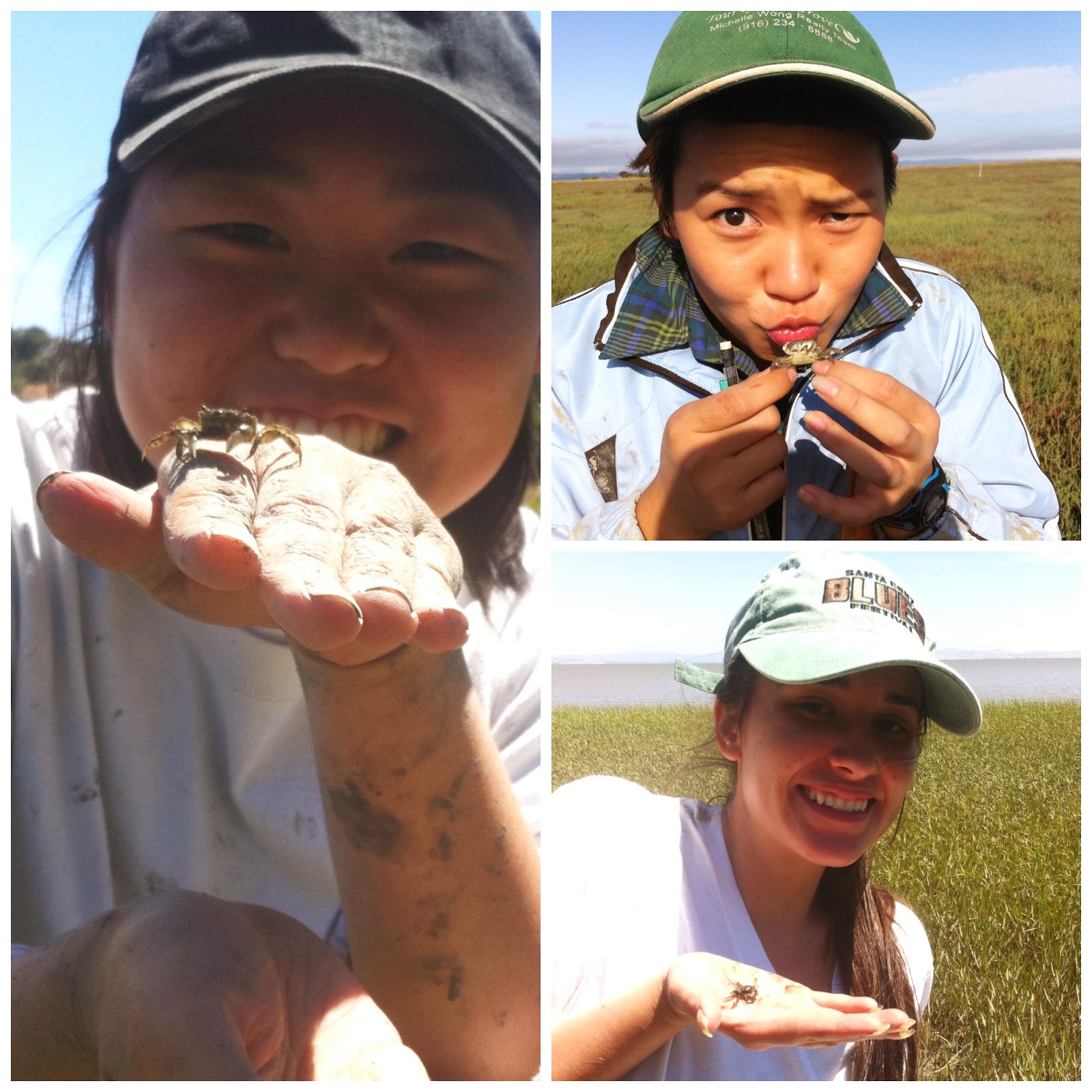
Crab lovin’.
When I look back over this summary and compare it to my feelings after my first field season in the winter, I know I’m starting to make progress down my research path.  In all honesty, during the winter I was simply trying to keep my life together.  This time around, I felt I could breathe more easily, reflect more often, and make much better decisions over all.  I also felt like this summer I actually have a lot of fun in the field!  Sure, logistics are still difficult, and I definitely have a metric ton of mud still in the lab fridge to work through this week.  Overall though, I feel like I can say things went well!

For those of you who are getting ready to start this graduate school journey, just remember that no one has it all together.  Anyone who pretends that they do is absolutely full of it.  This is a learning process, and learning is way scary!  Talk to people you trust, take breaks when you need to, and remember why you signed up for this in the first place (cause you totally volunteered, btw)!  Trust me; it’s always confusing, but navigating that confusion will become much more of a fun adventure!   

Until next time!  If you need me, I’ll probably be in the lab.     
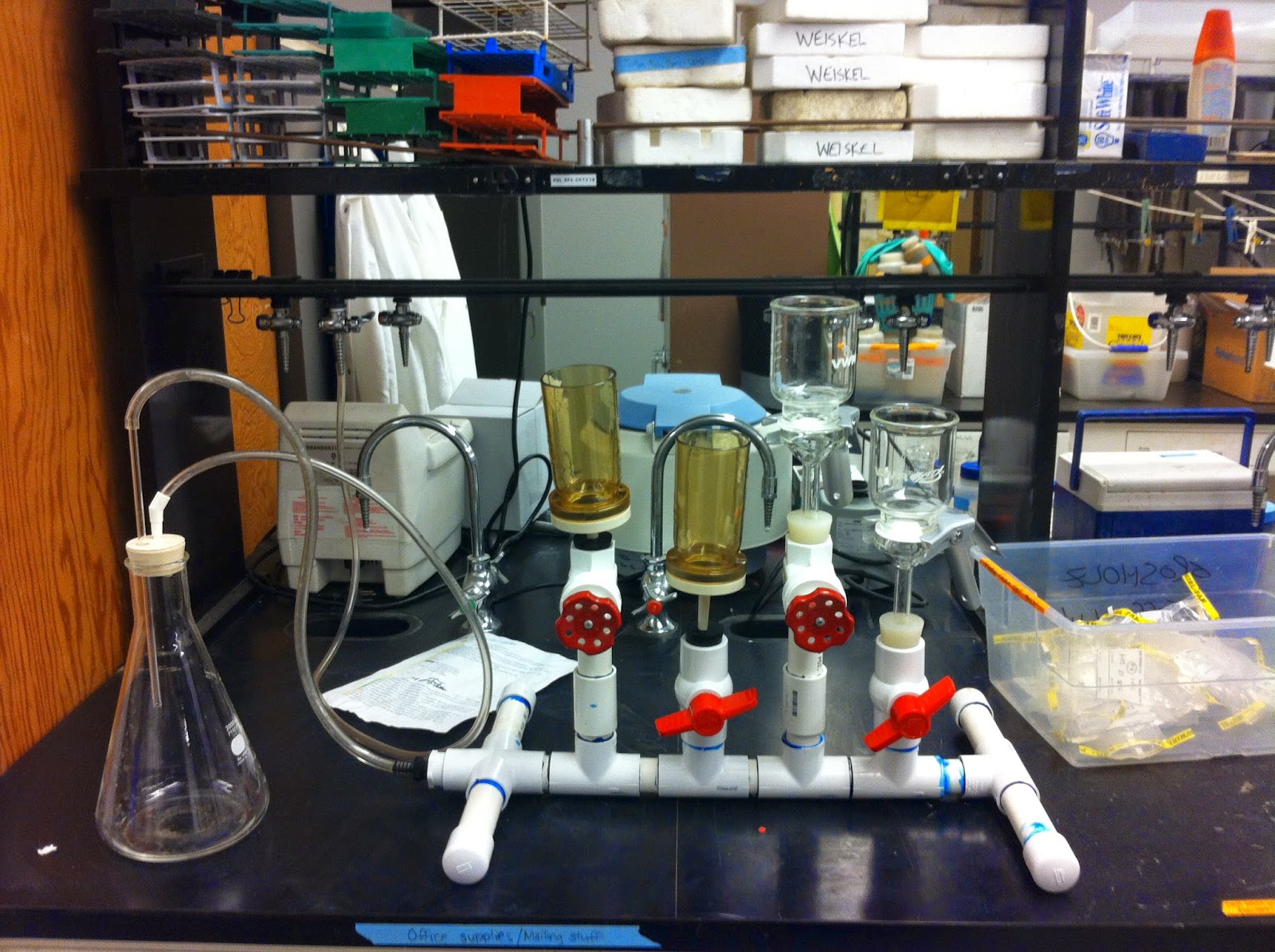
Beakers and stuff, like a real scientist.

Share a Science Documentary Day

Science documentaries. I’ve got a sneaking suspicion that you love them. You’ve watched both iterations of Cosmos; you’ve joined Stephan Hawkings on an exploration of the universe; you’ve learned about the rovers, landers, orbiters, and space stations exploring our solar system; you’ve experience Sr. David full-on gushing over a hedgehog. If I were to write a blog post trying to convince you to check out some of Sweet Tea Science’s favorite science documentaries, you would scoff because you are so on top of that. And that’s awesome! Seriously, let’s take a moment to appreciate our collective thirst for knowledge!

However, let’s not get so ahead of ourselves that we forget to share this excitement, enthusiasm, and thirst with others!

I have been inspired by a lovely evening out with my partner and his friend. We had been enjoying a few beers, and we got on the subject of education, intelligence, science, space and…well, you know how conversations can go. We eventually got on the subject of exploring our solar system and trying to understand the creation of the universe. Now, keep in mind that I love these kinds of conversations and could go on and on for a while. My comments are often prefaced with “I saw once in a documentary that…[insert science here]”. I was shocked to find that the friend had never heard of some of what we were discussing. It wasn’t that he didn’t have an interest in the topics, quite the opposite! He tried to write it off as us just being inherently smarter than him, but honestly, it was just a product of being an avid science documentary watcher. The knowledge is out there, I just Netflixed my way to it! I want others to know that they can too!

I am beginning to realize that there exists a set of people out there that are interested in exploring the sciences, but they don’t believe in themselves or don’t know what avenues to explore to help with their intellectual endeavors. This is where we come in. I’m going to assume that the majority of readers are here because they are totally into science. If we all independently hosts screenings of science documentaries and invite lots of our friends that might not normally choose such a film, then think of all of the science converts! I propose we
take this opportunity to organize. I nominate September 17th, 2014 as the first annual Share a Science Documentary Day!

This is a project that will require the help and support of the online scientific community. Science Side, I’m looking at you!

Your STS Homework:

1011425_10101307980269262_1191846856_n.jpg

1. Share your favorite science documentary. You may do this in the comments here, on our Tumblr, or on your own social media outlet of choice! Be sure and tag us, @SweetTeaScience, so we can reblog/post/tweet you. Feel free to use the tag #SciDocuDay2014!

2. Host a Science Documentary Viewing on September 17th, 2014. Invite friends now and get people excited!

3. After your viewing don’t forget to try and start a dialogue. Talk about what you just learned and encourage others to share their impressions.  (Editor’s note: I think this would be a great time to talk about how to pick a documentary that isn’t bunk and how to be a skeptical consumer of information.  I mean, I love me some Netflix docus, but I’ve also quit some half way because…bunk.)

4. If you’d like, write up a little something about your event. What did you watch; did people enjoy it; would you host a similar movie night again, etc. We’d love to hear back and post your feedback on our blog or Tumblr!

Best of luck to everyone choosing a film to watch. Here might be a good place to start. We’ll keep you updated via tumblr about our own plans and movies that we choose to watch at our respective events! If you have any suggestions we’d love to hear them.

Winning Your First Professional Conference

If you’re in Portland for a conference, you should
probably go hike at Mt. St. Helen’s
Hello September!  Can you believe it?  I know I can’t.  Classes are ringing back into session all over the country, and most people are gearing back up after the summer.  For me, September is going to be a month of getting things back in order after a really intense stretch in July and August.  I wouldn’t say I’m gearing down, but without vacation, 8+ hours of manual labor, or time sensitive lab samples to deal with, I’m hoping I can refocus and reorganize.  One project I’m giving special attention this month is updating the analysis of chapter two of my Master’s Thesis, which I will be presenting at a conference in October (and submitting for publication before the end of 2014…I think I can…I think I can…). (Editor’s note: I know she can!) Professional conferences are very helpful as benchmarks for your research.  They give you something to work toward in the short term, and they also provide a great forum for research in progress (either in progress of collecting data or analysing it).  Aside from this, professional conferences are great opportunities for loads of other reasons, which are completely applicable for those who don’t have research to present yet.  If you are gearing up for your first conference this fall, or if you are on the fence about the usefulness of attending, here are my thoughts on how to get the most out of your first academic conference.    


Don’t let cost be an issue.  Conference registration, travel to the venue, eating while you are in town…  The costs of attendance can add up fairly quickly.  However, this is absolutely not a reason to not attend a conference.  First things first, look around for someone willing to give you money!  Apply for grants through your department, college, office of scholar development, or the conference itself.  All of these places are very invested in developing the next generation of researchers (that’s us!). These grants can go to cover the costs of registration, or you can apply specifically for travel grants to cover transit costs and lodging while you are there.  Are you part of a lab group?  Don’t be shy, ask your PI if they are willing to give you some funding to attend the conference.  They might not be willing to cover all your expenses, but they are invested in your success and want to help!  At my first conference, I carpooled to the venue and shared a hotel room with my PI, and she kindly covered these costs.  Finally, sign-up as a student volunteer.  Most big conferences really count on student volunteers to make things go.  Who do you think works the registration desk, the information booth, and is there to call the IT people when a projector stops working?  Often, these volunteering positions aren’t an easy ride (think ~15 hours throughout the conference), but they will result in a comped registration fee.  I’ve done this a fair few times, and while it isn’t my first choice way to get to a conference, it’s totally worth it.  


As a student, you also have to learn how to do things for cheap.  Set your budget for how much you can spend at the conference and stick with it!  Personally, I’ve slept 5+ people to a hotel room, picked up some PB&J supplies at a local store, and even Couchsurfed by way through the conference week.  As long as you show up in your business casual attire, no one is going to know where you slept or where you bought your lunch.


Once you’ve made it to the conference, don’t forget to pace yourself.  It’s always a good idea to scope the conference schedule in advance and pick out the talks and posters you really need to see.  However, it’s also super easy to get excited (Wait?  There are other people out there who care about the impacts of invertebrate grazing on invasive plant productivity?!) and schedule yourself to death!  Generally, there are a number of speaker sessions running concurrently,and you can easily get yourself scheduled to the point of running from room to room every 20 minutes from 8 to 5.  At that rate, you will be pooped by day two.  Prioritize, be flexible, and don’t be afraid to just take a break!
 
Get an academic wing-person.  Especially if this is your first conference, try to find a more senior student who has attended before and shadow them.  Don’t be shy, they seriously won’t mind.  Everyone remembers being the new kid in the room and how overwhelming that can be.  This person will tell you which mixers are worth your time to attend, introduce you when they know someone, and invite you to lunch so you don’t have to eat your PB&J alone.  In the absence of an experienced friend, having anyone to double team a mixer or a poster session with is a great idea.  It’s way easier to approach a group as a duo.  Additionally, if you’re shy like me and have an outgoing bestie like Meridith, you are basically hitting the wing-person jackpot.


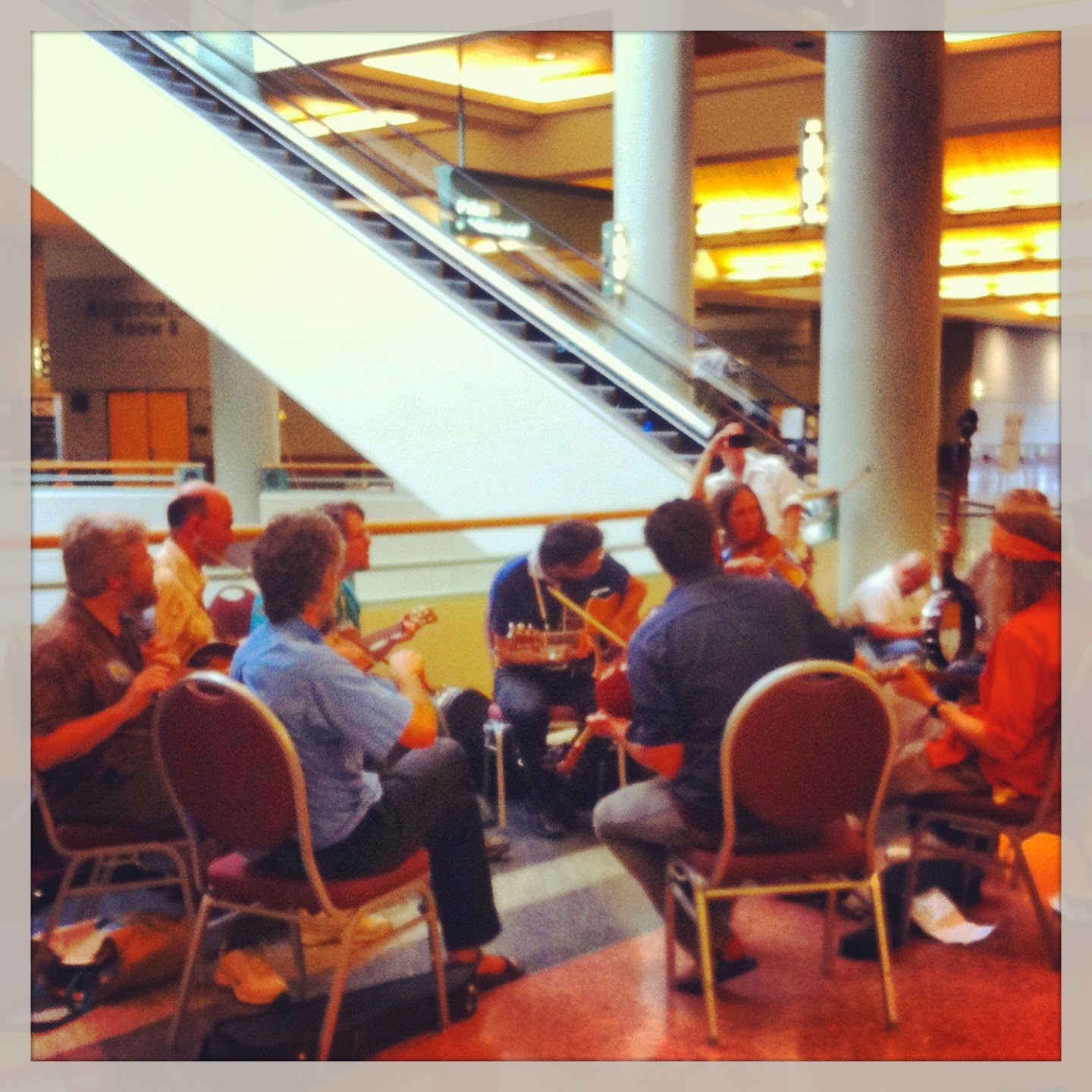
Jam session outside the poster session.  An ESA tradition
and an informal networking opportunity!
On the subject of mixers, when you’re at a conference you need to embrace cocktail hour.  Do you have to drink?  No.  Do you need to go to a mixer or a bar, probably.  Informal interactions with peers and senior researchers are not just going to fall into your lap.  You have to seek them out.  Let’s be honest, walking up to a person who does work that you respect is stressful.  Heck, being that person that everyone wants to talk to is stressful (I imagine).  Having a beer helps the social anxiety.  And, let’s just get this out there, networking is necessary.  You come to a conference to see the latest research and techniques in your field.  Beyond that, and perhaps more importantly, you go to conferences to expand your professional network.  As a reserved person, I will quickly tell you that networking is the literal worst.  Luckily, there are ways to make it more manageable and enjoyable.  


First, we will assume that cocktail hour is 100% not your thing, or you want a more structured networking experience.  This is where the internet stalking abilities of the modern world can be harnessed to your advantage.  Look through the conference program and identify people you want to meet.  Now, Google them, get their email address, and drop them a line!  Tell them who you are and why you want to meet with them and set-up a lunch/coffee meeting.  Alternatively, you can try to catch them after their talk and set-up this interaction.  Second, set goals for your networking.  I got the most amazing tip from one of my conference wing-people last summer at the Ecological Society of America (ESA) conference.  He told me that at each conference he just tries to expand his network by 6 people.  In other words, he practices quality over quantity.  Six people who you think you could actually email after the conference is likely more useful than cards from 20 people you met at a poster session.  Last, don’t be afraid to expand the networking experience to after the conference is finished.  Did you see an amazing talk, but couldn’t catch the speaker after the fact?  Stalk that conference program and shoot them an email.  I always try to remind myself that when I am at a conference, I’m with a group of people who I already have a lot in common with, and that makes all these social interactions seem much less intimidating.         


Present something or at least be ready to present yourself.  Having conference presentations on your CV is so helpful when applying for graduate school, grants, and fellowships.  Talk to your PI and ask if there is any data she has that could use a first pass at statistical analysis.  This is good for everyone involved!  Your PI gets a co-authorship on a presentation by a student and their data gets at least a cursory looking over.  For you, the experience of analyzing data and adding the presentation to your CV is great!  Plus, in those awkward networking moments, talking about what you brought to present is super helpful.  Bonus point for putting your Twitter handle or website on your presentation. Twitter is the water cooler of academia at large (or that’s what they are saying on Twitter), so be ready to inter-network (ha!). Not into the idea of a presentation?  At least be ready to present yourself.  Have your elevator pitch ready.  Who are you?  Where are you from?  What is your academic standing (undergrad?  grad student?)?  What are your interests and goals?  Plan it out before you go so when you are on the escalator making small talk with Mrs. Hot-shot-researcher she remembers you as well spoken and enthusiastic!    
Tall grass prairie restoration tour!


Last, don’t forget to explore!  Often, conferences equate to traveling to a new city, state, or even country!  Sure this is a professional opportunity, but it’s an opportunity for personal growth as well.  See the sites, check out the local nightlife, and go for a hike at the nearest National Park.  ESA 2014 was near the college where a friend of mine earned his undergraduate degree.  He arranged an amazing trip for a bunch of us to see a huge prairie restoration that he worked on while studying at the college.  One of my favorite memories from ESA 2013 is going to an 80s dance party with Meridith to find that the club’s floor was on top of ball bearings.  Much bouncing and singing-along ensued.  And there was plenty of time for more science the next day.   


So, there you have it!  Those are my conference going tips, but in the big scheme of things, I’m still a newbie.  I would love to hear tips and tricks from others!  Let us know in the comments below!