It’s time again for an installment of the STS Book Club! This time, it’s a novel of the young adult variety. Perhaps a perfect stocking stuffer for the 11-year-old, nature-lover in your life? Or, you know, your story-loving 20-something PhD student.
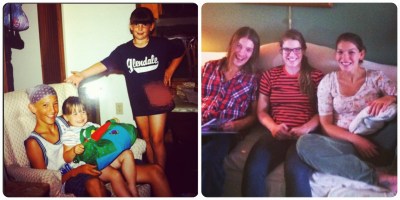 |
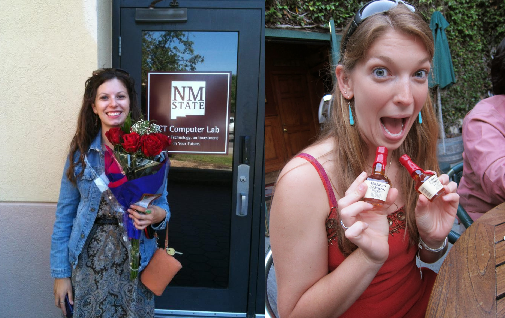
My co-conspirators, then and now. Notice that I have grown in my
appreciation of pants-wearing. |
I grew up on a farm in south central Kentucky with a small expanse of second growth forest rimming the yard and cultivated fields. My siblings, cousins, and I would spend hours in those woods, building treehouses, turning over rocks, and chasing imagined creatures through the understory. Mostly, we would pretend that we were surviving. We would play like we were 100 instead of, maybe, one mile from home. We had our dogs and we had our “tools” (usually a pocket knife or a hammer), but mostly we had our bravery and our brains. It’s that same feeling of playing at survival that thrills me about backpacking or long canoe trips to this day. No doubt this persistent desire to prove myself against some sort of untamed wilderness was inspired, in part, to my childhood reading list: White Fang, Hatchet, “To Build a Fire,” Julie of the Wolves, and My Side of the Mountain, to name a few. I rediscovered my love of young adult and children’s novels when I was writing my Master’s thesis. I found I had less dreams about amphipods if I read before bed, and usually, by the end of the day, I had the reading comprehension of a 14-year-old. I rediscovered my well worn copy of Gary Paulsen’s Hatchet, and the rest is history.
“Not hope that he would be rescued–that was gone. But hope in his knowledge. Hope in the fact that he could learn and survive and take care of himself. Tough hope, he thought that night. I am full of though hope.” ― Gary Paulsen, Hatchet
Over the past 3 years, I’ve re-read many of my childhood favorites and also discovered a few new novels in the genera that I truly love. I’d like to share one of those with you now. Ice Whale, by Jean Craighead George is a book I read over the summer when I was traveling. George has a great track record with her writing, as she is also the author of My Side of the Mountain and Julie of the Wolves, a novel which won her a Newbery Medal. Plus, I read on her website she has a memoir for children called The Tarantula in my Purse. If I write a memoir, I hope the title is half as impressive!
On with the review!
 What is Ice Whale about?
This is an epic tale, spanning families, generations, and two centuries. The real story begins in 1848, when young Eskimo boy, Toozak, witnesses a bowhead whale being born. He feels connected to the whale, which has a distinctive marking that looks like a dancing Eskimo. Some years later, the boy, now a young hunter, accidentally betrays the location of a group of bowhead whales (Balaena mysticetus) to a whaling ship. To atone for this mistake, the young man and his future offspring are bound to the fate of the whale whose birth he witnessed, and they must protect him till he dies. Bowheads can live over 100 years, so this initial plot point propels the story through time. Characters and families come, go, and weave together in unexpected ways. There are numerous themes: ocean exploitation, changing culture of native peoples, survival, and science! All the action of the novel is set against the raw beauty of the arctic, an area close to George’s heart and a location she often visited during her life. I really think everyone can find something to love in this novel.
Why I liked it?
So many reasons. First, this novel was published after Mrs. George’s death by her two children, Twig (a writer of children’s literature) and Craig (a biologist who wrote his PhD dissertation about bowhead whales!!). You can hear Ira interview the two about working on the novel on Science Friday. I love the idea that the author’s interest in her son’s research inspired such a creative endeavor. Also, as Craig edited the novel with his sister, you know the biology is spot on in the book.
Second, the whales are characters with personalities, but I’m not certain I’d call George’s approach ananthropomorphism. Whales have names, but they are represented by squiggly lines intended to represent whale calls. Whales do not converse so much as share their intentions through the author. The whales live, fear, love, and are aware of other beings. I love this passage about a meeting between Toozak and the whale, which the Eskimo has named Siku. Below, Siku’s name is written from the whale point of view, as a line representing a series of sounds.
“  surfaced to breathe again, saw the boy, and rolled on his side to bring his eye to the surface. He looked at Toozak and Toozak looked at him, and saw his human-like eyes, with pupils, irises, and eyelids much like his own.
stared long into Toozak’s kind eyes. And something happened between them.”
Finally, I love the science this book sneaks into its pages. I learned a lot about bowhead behavior, range, and general biology while reading this book. I also learned some new facts about the arctic. The conservation message is clear, though I cannot say I 100% agree with it (if you read it, let me know your take!). On the whole, I think this work stands as a vision of a hopeful future with a strong warning about the follies of the past.
What could have been better?
The novel spans 200 years, and, honestly, the characters and connections can be a little dizzying. And for a book with such a complex plot, the writing was very simplistic, stark almost. Obviously, the intended audience is somewhere between 10 and 13 years of age, but I couldn’t help but wonder if the actual plot would be too confusing for a child of that age. You could take the same approach my mother always took and read the same books as your kids. That way, you can discuss it together (fun!) and help with any potential confusion.
 |
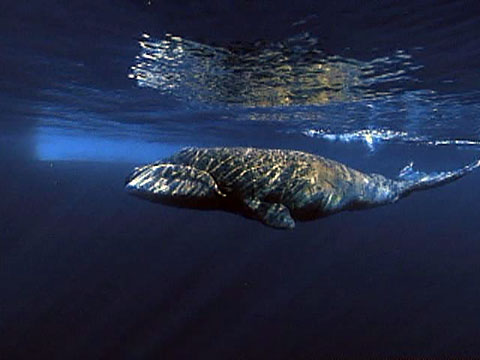
| Bowhead photo courtesy of NatGeo |
Who should read this novel?
As I said before, this is a novel for middle school kids, but I really enjoyed it. Once I accepted the sparse writing style, I was really taken with the world George created. So, I think everyone should read this book! Maybe you’ve got a child, a case of childhood nostalgia, or you have an overworked brain and just want to be transported. In any case, this is a book for you!
Want to learn more?
Start by checking out Jean Craighead George’s official website. For a particularly adorbale side-note, look a the section “On Writing.”
Check out some other reviews of the book here, here, and here.
Here is a great NY Times tribute to the author upon her death.
Check out this NOAA page with some fun facts about bowheads!
If you read the book or plan to, comment on this post! I would love to discuss it with others!



 Sweet Tea, Science