
Let’s start off with the obvious. Recycling is great! I think that everyone should be doing it as often and for as many products as they can. However, it’s not always that cut and dry an issue. I will likely write in the future about specific types of recycling (ex: tech product recycling, plastics more specifically), but I want to take this time to talk about recycling in general. I hope this post isn’t a huge bummer; I’m going to view it as a good dose of the realness. You see, the efficiency of recycling really depends on what you are recycling and where you live.
 |
| View from the front yard of my childhood home. I love this place with all my being. |
I’m going to start off with the latter, that where you live impacts how efficient a choice recycling is for you and your household. As you probably know, not all recycling programs are created equal. I have experienced both ends of the recycling support spectrum in my life. I grew up on a farm in south central Kentucky, and, to this day, there is no infrastructure for recycling where my parents live. Luckily, when I was growing up, my father’s 45 minute commute took him right past a recycling facility, and about once a month we loaded all our glass and aluminum (I don’t think they took plastics) into my Dad’s car. While this worked for us, most of our neighbors had no means of getting their recyclables to the distant facility, and now that my father has moved to a much closer job (10 minute commute, he is so happy!) my parents are without a means to recycle. On the other end of things, after moving to California, I’ve been lucky enough to live in two cities that take their recycling very seriously: Long Beach and Davis. Despite this, when I was researching this post I found that some things which I had been able to recycle in Long Beach (ex: Styrofoam, soymilk cartons) are not accepted here in Davis. Oops, looks like all that washing out of my roommate’s fast food containers has been for not.
Through my own life, you can see the two major ways that location impacts recycling. First, infrastructure impacts recycling efficiency. Lavee (2007) performed an analysis of a study from Israel showing that recycling of municipal solid wastes is most economically beneficially in areas with dense populations due to low start-up costs and the ease of consolidating the recyclable materials. So, recycling is most economically viable in large, urban areas where waste doesn’t have to travel very far to get to the processing facilities*. Second, depending on where you live, something things just will not be recyclable. Take my example above with the Styrofoam, and apply it to your area. This information is important, not just because it informs your decision on what to buy, but because improper recycling hurts us down the line. The more time and person-power required to sort through our recycling, the less cost effective the system becomes. Additionally, if you (or people at your apartment building) mix trash in with the recyclables, your items might end up just getting tossed due to health concerns for workers at recycling facilities. Last, depending on the recycling facility, some items commonly thrown into recycling bins can really harm equipment. For example, plastic sheeting (like what products come wrapped in) and thin plastic bags get wrapped around equipment in fully mechanized sorting facilities, causing losses of time and money (check this story for an example).
Okay, so, maybe you are lucky enough to have access to one of the 9,000 (and rising!) curbside recycling programs in the USA (EPA, 2009). That’s great! You should be recycling stuff! Same rules as above apply, so go and check out what is actually accepted by your recycling facility. You can feel really good because you are helping to save tons of virgin materials and energy. The nifty graph from Morris (2005) shows how much energy is required to make products from recycled versus virgin materials. Looks pretty straight forward yes? But let’s go through it together, because there are few things a simple graph like this really fails to convey.
 |
| From Morris (2005) |
Let’s start with aluminum. We get the biggest bang for our recycling buck with this stuff. I always try to buy canned products whenever possible for this reason. This is one of the most profitable and energy efficient products to recycle. With newsprint and cardboard, the returns are less, but still apparent. This is probably due to the ease of access of virgin materials used here (tress…) as opposed to those used to make metals. Despite this, making new paper from old paper is still 50% more energy savvy. Steel and glass recycling are actually pretty energy intensive processes. It’s still more energy efficient to recycle as opposed to landfill these items, but the benefits are noticeably less. Last, let’s address those weird abbreviations on the x-axis. These are two different types of plastic pellets. As you can see, making plastic products from recycled plastic materials is pretty darn good at saving energy. But here is the rub; plastic pellets are not made from old plastic pellets. A plastic milk carton can never be a milk carton again. Your soda bottle will never hold another soda. With each step down the recycling chain, plastic gets closer and closer to an end product that is (in many cases) not itself recyclable. Check out this website from the state of Maine for some examples of what recycled plastic products become. Still recycling is better than land filling right? Energy is saved at some point in all of these processes, but isn’t there a better way?
 |
| This beautiful basil was delicious, and I did not miss the plastic container so many stores try to sell it in! |
I would argue that there is a better way, a way saves energy by reducing the need for recycling and reduces waste. We need to focus our energies on the first two of the “three r’s.” First, we need to reduce the amount of packaging (of all kinds) we consume. Eeps! But what about Oreos, Rachel? They are the best, and also wrapped in plastic. Relax friends; remember, this is the Practical Ecologist. I am not asking anyone to move mountains, or to make lifestyle changes they are not prepared for at this time. Everyone is at a different place in their journey after all. It’s often the small changes we make in our lives that actually stick, and the habits we stick with are the ones that have a chance to make a difference. I’ll have tons of posts coming about how to reduce your use, and hopefully each of us will be able to apply a few of them! I might even try to address this Oreo issue (it’s a real life struggle for me).
 |
| My food/beverage containers |
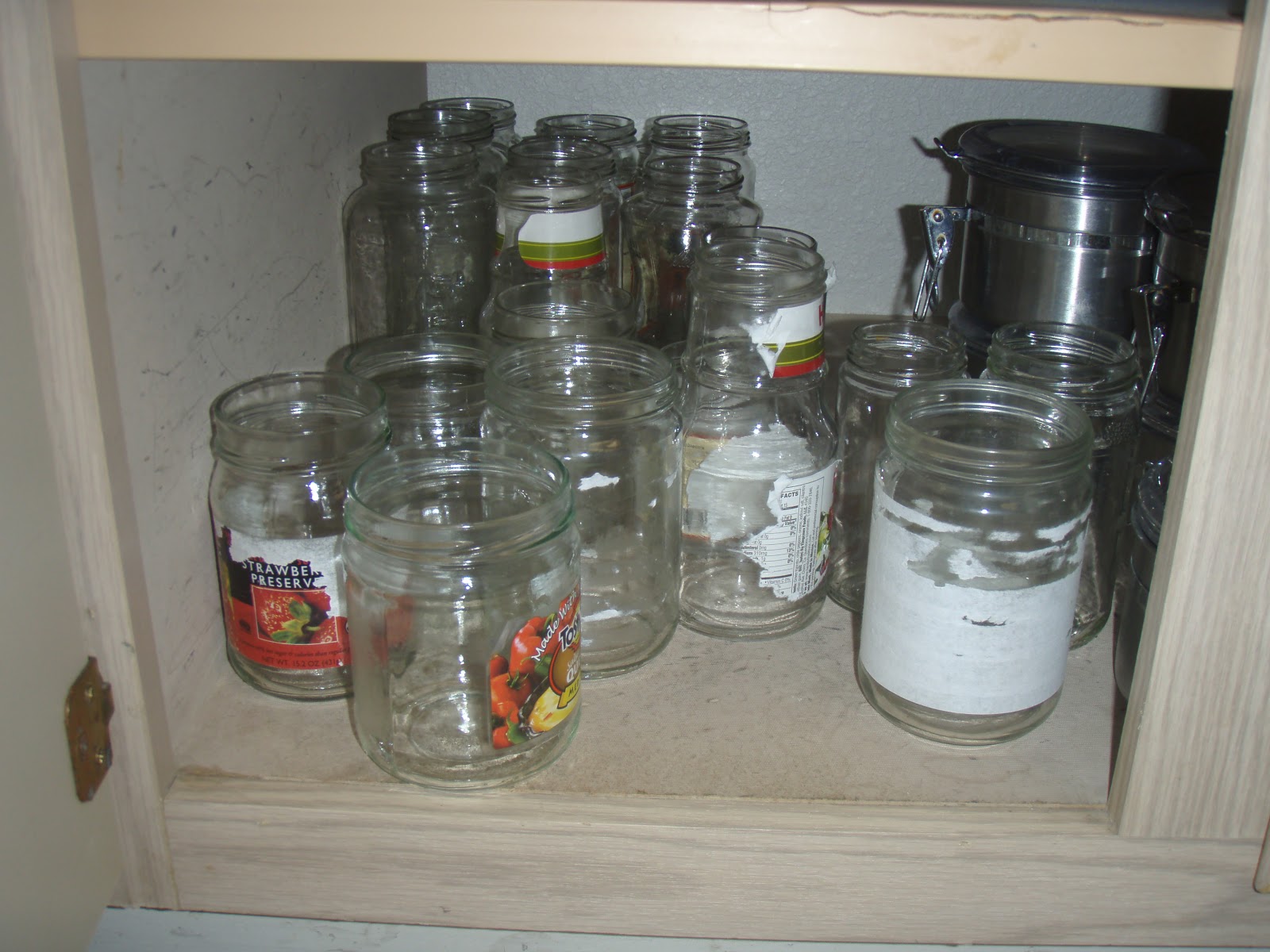
Second, we need to reuse the stuff that we buy. Okay, no free lunch here. The only thing you risk by reusing things is people thinking you are a little funny. You get to be that gal/fella who uses old peanut butter jars as Tupperware. Wash off your tinfoil and use it again! Bring your reusable mugs and bags! Patch your clothes! I get giddy even thinking about it. Bring to mind even one of those cheesy info-grams about how much plastic we would save is we all just brought our own bags to the store, and multiply this by your own creativity! What can you reuse? And then, after you have reduced your waste down to things you really want/need to buy and reused the stuff as much as possible, THEN you recycle it. And then all the dolphins smile and the little hippie-babies at the farmer’s market all dance for you. Really.
FINAL WORD: Recycling is way, way important, and I’m so glad to live in a world where the importance of accessible recycling is becoming a focus. However, recycling is not a cure all for our waste issues. It is up to us to change our behavior. Vote with your dollars on products you need that match your values, and thank the good Lord for Pintrest because reusing is so in right now. Whee!
What do you think? Are you sold on my view of the “3 r’s.” Have you read any cool articles that might apply to this issue? Got any creative reduce/reuse tips? How will this fit in with your lifestyle?
*The study found that recycling was economically beneficial in about 25% of small and regional municipalities. We must take into consideration the general differences in infrastructure between the US and Israel, but I believe the general lesson still holds true.
-D. Lavee. 2007. Is Municipal Solid Waste Recycling Economically Efficient? Environmental Management 40: 926-943.
-J. Morris. 2005. Comparative LCAs for Curbside Recycling Verses Either Landfilling or Incineration with Energy Recovery. Int. Journal of Life Cycle Assessment 10 (4): 273-284.
-Environmental Protection Agency. 2009. EPA.gov.


 Sweet Tea, Science