If you haven’t checked out Monday’s, Tuesday’s, Wednesday’s and Thursday’s blog posts, it’d be best to start there! This week we’re having a series of posts discussing scale and size. I’m hoping you all still have your imagination hats handy.
The concepts we’ve learned about during this week’s series, space and time, hold a very important role within scientific research, more specifically, within experimental design. We may also refer to these aspects as spatial and temporal factors, respectively.
 |
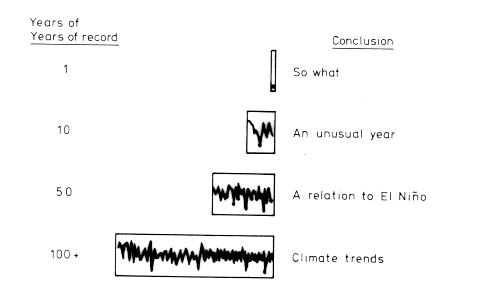
| An important question to ask in research: So What? |
Researchers need to be very mindful of these scales when asking their research questions. This questions will lead to treatment and experimental structure.
When scientists study genetics, they use fruit flies and not elephants. Life span is important.
When entomologists study insects, they often have to consider multiple life stages that occupy both aquatic and terrestrial habitats. Some insects live days, while some may live over a decade.
When climate researchers collect data, they do so over centuries. Perspective related to time is important. Repetition is vital to minimizing experimental error.
100+ years is a long time! Certainly longer than any one researcher could record. (Dang, that would be one heck of a PhD project). However, as science is a field of collaboration, communication, and networks, people have found a way to develop approaches to address the limitations our lifespans present. Long Term Ecological Research (LTER) is currently being conducted at 26 different sights in the U.S. that spans multiple ecosystem types, environmental conditions, and varying levels of human domination of the landscape.
 |
| Different Scales within Research |
But even looking at data that span a hundred, or even a thousand years becomes less impressive when you start talking to a geologist. A great way to visualize the time frame geologists must consider is to imagine the layers of rocks in the walls of the Grand Canyon. Geologist can match each rock type and layer position to a point in our Earth’s history. The further down the rock layer, the older it dates.
You may also confer with a planetary scientist. Or an astronomer. Even a cosmologist. They deal with temporal time scales that stretch back millions or billions of years. Even to that very first moment, the Big Bang.
This week has been a great experience for me. I’ll try and do series like these every so often. Next week, we’ll return to more sporadic topics for posts. Feedback on these posts is greatly appreciated. Just a head’s up, the next application announcements may occur this week. ‘Mid-April’ is a little vague, but I’m feeling very optimistic. Keep reading, sharing, and commenting if you’d like to read along while I’m on (fake) Mars!
Questions of the Day:
If you are a scientist conducting research, what are some of the spatial and temporal scales that you’ve had to consider?
If not, can you think of the spatial and temporal scale necessary if someone wanted to study you?
Further Reading:
Implicit Scaling in Ecological Research
Choosing appropriate temporal and spatial scales for ecological research
Relative Importance of Spatial and Temporal Scales in a Patchy Environment
Expanding the Temporal and Spatial Scales of Ecological Research and Comparison of Divergent Ecosystems: Roles for LTER in the United States




 Sweet Tea, Science