Collaboration Station: Google Drive

Collaboration is a vital part of the scientific process. Do you think I’m going to save the world on my own? Nope. I’m going to need at least a little bit of help. The more great minds working on a project, the faster advancements may be made. And we need advancements (I’m look at you, self-driving car peoples)! Any sort of collaboration is difficult across distances. Technology has made the process easier and email is currently the main tool for communication for researchers. While I’m really proud of the older generations of scientists for getting on track with email, I’m afraid I’m going to have to ask them, and everyone, to utilize Google Drive for their collaboration needs.

Being able to access my Google Drive from anywhere keeps me productive!

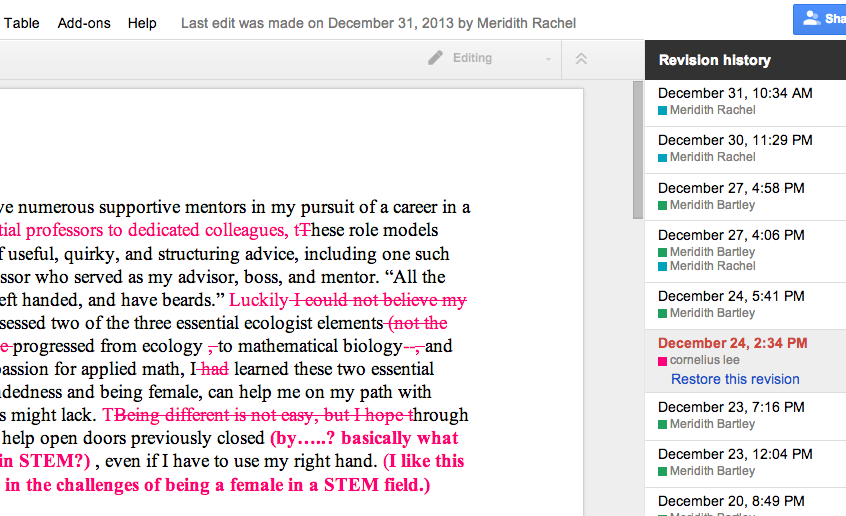
Google Drive was repeatedly been a useful resource throughout my graduate school years. I could share files and folders with my undergrads so they would always have access to protocols, data sheets, etc. It made for fast communication and kept my data safely stored in multiple locations. However, when I was working on writing manuscripts I would email it to all of my co-authors whenever they needed feedback and would inevitably have to shuffle their responses and changes back into a master copy. This updated copy I would then save as a new file. My third manuscript has yet to be submitted because my advisor and I accidentally worked on two different file versions, and now she has to incorporate her updates into my most recent version. I never wanted to use Google Drive to have people revise my papers because I couldn’t for the life of me find anywhere to turn on Track Changes. But when I was working on my PhD application essays and desperately wanted people’s feedback, I realized Google Drive always has track changes on! And it’ll keep track of who edits what, when, where, and why! Ok, not why. Unless they leave a comment!

So if you want to collaborate on a piece exclusively on Google Drive
1) Start a file – it can be a document, presentation, spreadsheet, drawing, etc
2) Share it with your collaborators. – You can share via a provided link or email. You may also control the level of privacy your work has.
3) Write and edit the file! – All together now!
4) Keep an eye on the changes/comments made by others – Anytime you want to open your revision history, click “All changes saved in Drive” at the top of the page.
5) Profit

So many revisions! So many colors!

Writing that army of essays was undoubtedly one of my least favorite parts about the graduate school application process. I absolutely could not procrastinate them because I wanted to get as many discerning eyes on them as I possibly can. Now that all of my PhD applications are submitted I have the power of hindsight, which allows me to see just how much my essays benefited from the help of several friends’ advice. Some ended up being completely rewritten multiple times. Multiple people were able to review and revise the essays at the same time, and I never had to compare different file versions emailed to me. No going back for me now. Go ahead. Put those theses into GDocs. Your manuscripts. Your group work assignments. Unleash the power of automatic track changes and maximize collaboration! Never worry about hitting save again.

The Great Grad Student Migration: One Woman’s Journey

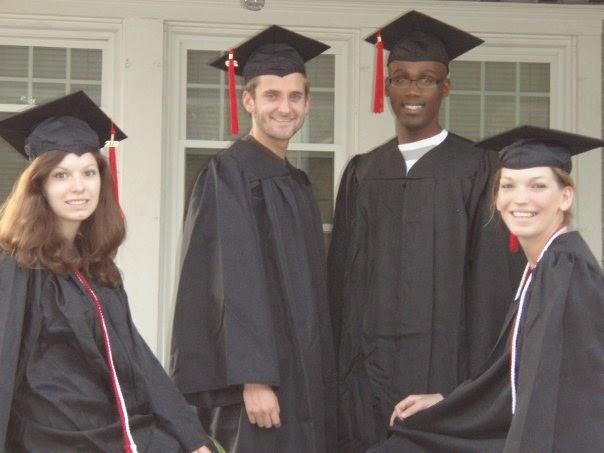
Two out of four WKU grads have no
idea how to wear their cap.

Well guys, I made it. One bedroom apartment. State College, Pennsylvania. In the five years since living with Rachel and Friends during our undergrad Wonder Years, I haven’t exactly had the best of luck with housing situations. Granted, living in the Chestnut Castle with my best friends really, really set the bar extra high.  Not to say that I’ve suffered through completely horrendous slum lord conditions with outrageous rent prices, but after spending half the time living with my parents and half hopping from place to place in New Mexico, I was absolutely ready for some stability in my own place. And it has been great so far.

I’ve been preparing for this move since getting back from last summer’s European adventures. Finding and getting into a PhD program was my main focus right up until the moment I was accepted back in March. After that, it was one big countdown until the next chapter in my life was ready to begin. And yes, my life chapters do happen to coincide with my academic life stages. I know a lot of you may have just graduated from undergrad, and it’s about time for the great grad student migration. Hopefully, since I made the move a little sooner than most, I can fill you in on what I’ve found to be most helpful during my transition. I started with a little research. First, checking out Rachel’s post from her move last summer, added a few other resources, and I deemed myself ready.


Part of preparing for a move is complete
 disregard for your soon to be former room, right?
Finding an apartment starting in June in a college town was a little challenging. Most leases run August-August, so my best bet was to find a summer sublet and then a more permanent situation. Searching remotely for apartments was a little frustrating, but I was able to ask around in my new department for advice. Remember, all of the other graduate students have already worked through these issues. They had valuable insight into where the best places to live were located. I used Craiglist to find possible locations, but ultimately it was talking directly to a potential landlord (instead of the subletter) that allowed me to find a place where I’d be covered for summer and all next year. Keep in mind you’ll have to pay rent and deposit up front, but your graduate stipend most likely will not kick in until a month after you start. Once you have a place secured, all you have to do is to move in. Sounds easy enough, right?

Step One, figure out what need to get done in advance. I don’t have a car, so that meant finding and renting a moving truck. Inspired by Rachel’s AAA computer discount (editor’s note: Props to my Dad for being wise to the ways of discount shopping!), I checked out the list of AAA member discounts. There were a lot more than I expected; I’ve been missing out. I ended up saving over $60 on the truck rental from Penske Auto. Next up, was to gather packing materials. I knew I didn’t want a stack of plastic bins taking up space in some closet or corner once I had arrived. Inspired by some of my research, I was able to fulfill all of my cardboard packing box needs in just one trip to my local Starbucks on their delivery day. I called ahead to find out what day they received shipments and inquired about acquiring their leftover boxes. Two relatively easy tasks, but getting them done quick and early helped me feel extra prepared.
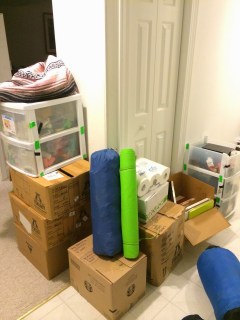
Who says you can’t go from
disorder to order?
Riding high on this sense of accomplishment, I would’ve probably been happy to wait until the absolute last minute to pack.  But since my life wasn’t the only one affected, I had to get shit done accordingly. With some gentle prompting (and subtle threats) from my landlords/chromosome donators, I began packing things up a month in advance. I only have one bedroom worth of belongings and several kitchen items, but I am still glad I got started early. Packing took much longer than I anticipated. Every box I completed seemed to make only the tiniest of dents in overall progress. The boxes I packed early were all nicely organized with clear labelling on the top:  Contents, locations they belonged, which room to put the box in upon arrival. Textbooks and other heavy/breakable items were scattered into each box; a careful packing job! If you’re like me, you’ve acquired a giant collection of textbooks. If you have the option of leaving some behind, think about the ones you’ll really need for your program. I only took my math/stats related books and left my biology ones behind for now. My last few boxes were thrown together in a hurry when I realized the rest of the moving truck was nearly packed and I still had random items strewn about the room. We don’t ever have talk about The Crevasse between my bed and the wall. (Editor’s note: Mer shouldn’t feel too bad about this!  I think the “random stuff box(es)” happens to the best of us!)  

Years of Tetris and Dr. Mario had
 prepared me for this moment.
As stressful as it may be, moving is still one of those nice reset opportunities. I’ve used mine as an opportunity to create a household where I can easily live an eco-conscious lifestyle, which means minimal plastic and buying new items. I have a wonderful collection of glass flip top jars for storing food that I got at thrift stores for about $3 each. Think about what sort of lifestyle you’d like to have and plan ahead. I’d recommend trying to get rid of/donate as many items as possible. Might I even suggest watching a few episodes of Hoarders to inspire you to purge some of your belongings? It’s seriously the best motivator for getting your clean on. Go through your closet and find items to donate. What doesn’t fit? What haven’t you worn? What shouldn’t you have worn? What’s been sitting around because you swear you’re going to alter or fix it? Let it go. That’s all less you’ll have to pack, haul, and unpack at a new location. Same goes for your other belongings. Pre- and post-move, I’ve keep a cardboard box in my room to chuck the stuff I’ve finally admitted I don’t need anymore.  


All ready to be unpacked!
Honestly, once the moving van was completely packed, it was all downhill from there. The drive was long, but made easier by my collection of podcasts on the ready and a driving buddy who made sure I was clear to switch lanes when needed (essential when driving a 12 foot truck with all of your belongings). I made the brilliant decision of moving somewhere I already had a close friend (10/10 would recommend) so when it came time for unpacking in a new city, she provided some extra hands that lead to a swift unloading leaving more time for beers! Everything else seemed to fall into place smoothly. We had lined everything up in the living room area since it was the most central. My box labels ended up being less useful than anticipated, but it’s only a one bedroom apartment, so nothing was ever far away. I had been waiting so long to have my own place and the ability to decide where everything went, so I found unpacking went relatively quickly. I just puttered around from box to box, focusing on kitchen items first. Because, you know…food in my face reasons. Several items I was glad to have packed on the top layer within a box include: tissues, glasses for water, and toilet paper. I did, however, forget a can opener and shower curtain. Can’t win them all.

How did your last move go? Any advice for all of the students that will be moving in August? We’d love to hear from you!

Finding a Graduate Advisor

This is a question for either of you to answer. Over the course of my last year in school I’ve had the most difficult time finding out how to go about seeking potential (M.S.) advisors for graduate school. Like, I’ve tried looking at schools I would like to go to, and looking at researchers there, but I have had little success in making conclusions when my interests are wide-spread. So, how the hell do I narrow down my interests, and what is a (possibly) better way of finding and approaching potential advisors? I am (mentally) paralyzed.


Thanks, freshlypluckedscientist, for the awesome post request! First off, it’s going to be ok! You are not the only one who has felt like this! I’m also fairly certain that we are not the only two who have felt like this! Rachel and I have both gone through this process twice (M.S. and PhD) and we understand how difficult and frustrating the entire process can be. Both times I tried to get a head start on the process and both times I felt like I was always behind schedule and running out of time! Before I even get started on any suggestions or tips, I’d like to reassure you that it’s completely ok to take a year off to figure things out and generally just chill. I took a year off after undergrad and nearly 2 years off after finishing my M.S. degree. I’m now going to be a few years older than the rest of my cohort, but I am going back fresh and excited and motivated!  Like so many big life decisions, you just have to do you.   


If you are looking for any sort of biological research program it can be nearly impossible to sift through departmental websites of universities you are interested in to find potential advisors. Yes, lots of them keep up-to-date websites with a convenient section for Potential Students, but many others do not. When I was looking for M.S. advisors I focused my search by perusing the EcoLog listserve and Texas A&M Job Board. You can keep an eye out for posts by advisors advertizing available positions instead of having to seek them out yourself. One plus to seeking an advisor in this way, if they are posting on a listserve or job board, they likely already have a project with some sort of funding available.  Keep an open mind and cast a wide net when you are finding potential advisors. Here is where you can let your varying interests guide you. Once you contact someone you can start to narrow your interests a bit.  Also, there is nothing wrong with narrowing your search based on where you actually want to live for the next few years of your life.  I know when Rachel was looking for graduate programs, she knew she wanted to live near the coast.  This initial choice actually lead her to studying tidal marshes (which she loves!) as opposed to the many other inland types of wetlands.

NMSU was a great place for my MS.

Write a basic cover letter and then customize it for each professor to whom you send it. Basically, you need to write a short introduction of yourself highlighting your best attributes and attach your CV and any other pertinent information they may have requested. I am working on a cover letter post for spottedsharkheart currently so more to come on the intricacies of that! If they reply, gauge their interest and try and set-up a time to have a phone or skype conversation to discuss your mutual interests. Not everyone is going to write back. Professors have a packed schedule and they are probably receiving many similar emails. Don’t be afraid to send a follow-up email reminding them of your inquiry. You can send more than one follow-up if you are extremely interested in working with an individual, but keep in mind that if they are too busy to reply to your email, they might not be a super good fit anyhow.  During this search and email phase, don’t be afraid to explore options outside of your comfort zone. My background is biology, and come fall I am entering a PhD program in Statistics. Granted, I hope to find research where I can apply my developing skill-set in stats to ecological problems, but you never know where your path may lead.


Once you are in contact with a potential advisor, this is the time when you need to show that you have focused interests that mesh well with their own, but keep in mind that you aren’t locked into anything you discuss initially. This also applies to those pesky essays you might need to write during the application process. I had the hardest time with these and Rachel had to tell me multiple times that I am not going to be contractually bound to anything I wrote in them! Narrowing your interests is a tough one. I honestly don’t know how to go about doing this particularly well. You can peruse MS Grad listings on to see what pops out at you. You may also want to consider specializing in a skill that can be applied to many different situations (GIS, Stats, etc) so you will be able to work in many different fields.  Having various interests also likely means you could be happy doing several different things!  There is nothing wrong with that, and it actually increases your odds of finding a cool graduate program that speaks to at least some of your passions.


Don’t let letdowns get you down. I had a rough time when searching for PhD programs. Sometimes, they just don’t ever respond. Sometimes, they responded a few times and then…..nothing?! Other times, you get as far as a skype conversation with a professor only to find out that it does not appear to be a good fit. It’s a little late in the year currently to find an advisor and join a program (not impossible). Ask current professors on your campus for help.They have been through this during their education and they have helped countless others through the same process.


Anyone else have amazing advice about applying to graduate programs?  I would love to hear about it in the comments sections.  It would be amazing to make this post a resource to refer others to in the future!