 |
| Weekly Farmer’s Market haul! |
My typical Friday afternoon goes a little something like this:
- 4pm- Begin simultaneous watching the clock and repeating the mantra “Be productive, stupid.” (Note: graduate school not always the best for increasing self-love.)
- 4:30pm- Start to feel like I’m really hungry and, I mean, it’s almost time to go anyway. Desperately try to make final progress on whatever task I have been attempting.
- 4:45 pm- Give up. Start filling in my OCD meal planning spreadsheet and making my shopping list.
So, just based on this 45 minute snap-shot, I’m going to take a wild guess and say that my approach to picking the groceries I purchase might be a little different than your own. Meal planning spreadsheet you say? List you say? It may sound weird, some might say it’s unnecessary, but these are a part of my household’s weekly shopping ritual. What’s more, I’m confident that these things, plus others I will discuss, help me to save money and cut back on the waste I produce. So I felt compelled to share, and another instillation of “5 Weird Things” was born.
As always, I would encourage you to not be overwhelmed by the thought of totally upending your shopping mojo. I didn’t wake up one morning and decides that I was going to do all these things at once. Like most life choices, these have come to me through a gradual evolution in my thoughts and actions based on lots of research and some provoking conversations. Maybe pick the one that interests you the most or that you think might make the most difference and give it a try! Then come back next month and pick up another one! That said, here we go.
1. Make a plan (meal plan, check the pantry, make a list!)
Let me set the scene for you. It’s Saturday morning. Myself and my fella’ have just gotten up and and moving around our apartment. Hopefully, on Friday evening we’ve looked online and through our cookbooks and picked out the meals we wanted to make during the week to come. In the less hopefully, and probably more typical scenario, I’m doing that on Saturday morning sitting in my bed. There is always the temptation to just wing it and head out into town. However, my mother’s voice in my head saying “a stitch in time saves nine” generally drowns out this alluring option, and I make sure to finish getting my plan together. You see, as far as I can tell, making a solid plan helps me to save money, waste less food during the week, and avoid eating out, which is usually way less nutritious than cooking your own dinners. I don’t want to get ahead of myself, so I’ll break down my process, then I’ll make my pitch.
So, what does this planning process entail exactly? It all starts with a spreadsheet. Like any good scientist (or anyone with a mild obsessive streak, guilty), I love a nicely organized Excel sheet. I catalog our meal choices into the spreadsheet which includes spaces for breakfast, lunch, dinner, and three snacks. I then look at the recipes we’ve chosen and list all the supplies right in the same tab. Thus, I’m basically making my shopping list as I’m meal planning. When you’re filling out your meal plan, it’s important to think of it as more of a road map and less of a contract. If your friend stops by on Monday who doesn’t care for couscous (weirdo), then you can switch your Monday and Thursday meals. Probably the hardest mental block to get around in this respect is planning your snacking. My rule is to buy enough fruit each week to eat as one of my snacks, then get two or three other things that we can eat throughout the week. It doesn’t matter really which days I end up eating those snacks, but writing it down helps me to visualize how much of each thing I will need to buy. Plus, if you love snacks like I do, having things on hand is the only way to keep yourself from purchasing stuff from the gas station and vending machine.
 |
| My meal planning spreadsheet. I loves it. |
Now that you know what you will be making and snacking on, and you have a list of all the ingredients you’ll need to make it happen, you need to take your computer into the kitchen and check your pantry. This will help you avoid buying double of anything you already own. Obviously, there are some things you will just know, but I can never seem to remember if I have chickpeas or not, and my hummus-making ambitions have been thwarted on several occasions when I didn’t take the time to double check. Now, you can transfer your shopping list to something more portable than your laptop. I usually type mine into my phone or jot it down on a piece of scrap paper from our scrap paper bin.
Okay, so here is the promised pitch. My process described above might seem like a lot of unnecessary effort to some. And for some people, perhaps that is the case. But for myself, planning my meals in this fashion has helped me in numerous ways. First, it’s really aided my efforts to waste less food. When I go to town with a plan made and a list in hand, I know what I’m going to actually need for the week. This really encourages me to avoid impulse purchases, especially impulse purchases of perishable items, because I know I won’t have time (or tummy space) to eat them. Also, making this meal plan and checking back with it during the weeks has given me a really thorough insight into how much food we can reasonable consume. I remember when I first started meal planning, I would pick out so many recipes that I was excited about, but I would end up with far too much food! For our little household of two individuals, we generally cook 3-4 dinners a week at home. For the other 3-4 evenings out of the week we work through our leftovers. We like to snack on things like fresh fruit, pretzels and homemade hummus, veggie and dip, peanut butter and apples, and the occasional granola bar. I also generally purchase enough produce to make salad for both of us for the week for lunch. For breakfast, we like oatmeal, smoothies, fruit, and toast. Wasting food is obviously a no-no on lots of levels, not the least of which is the impact food production has on the environment. But, hey, when you throw food out, you basically throw out money. Who wants to do that?
I think this quotation from a study performed by Parfitt and colleagues in 2010 sums it up pretty well. The U.S. stats are equally embarrassing but I chose the U.K. statistics as they were quantified in carbon emissions (Note: Mt stands for metric tons).
“More recently, the Waste and Resources Action Programme
(WRAP) has shown that household food waste has reached unprecedented levels in UK homes (WRAP 2008, 2009a,b), with 8.3 Mt of food and drink wasted each year (with a retail value of £12.2 billion, 2008 prices) and a carbon impact exceeding 20 Mt of CO2 equivalent emissions. The amount of food wasted per year in UK households is 25 per cent of that purchased (by weight).”
2. Reusable Bags, reusable containers, reusable foreva’
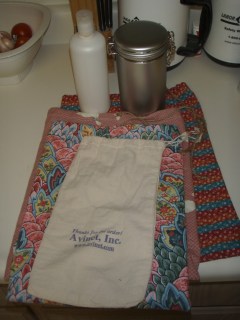 |
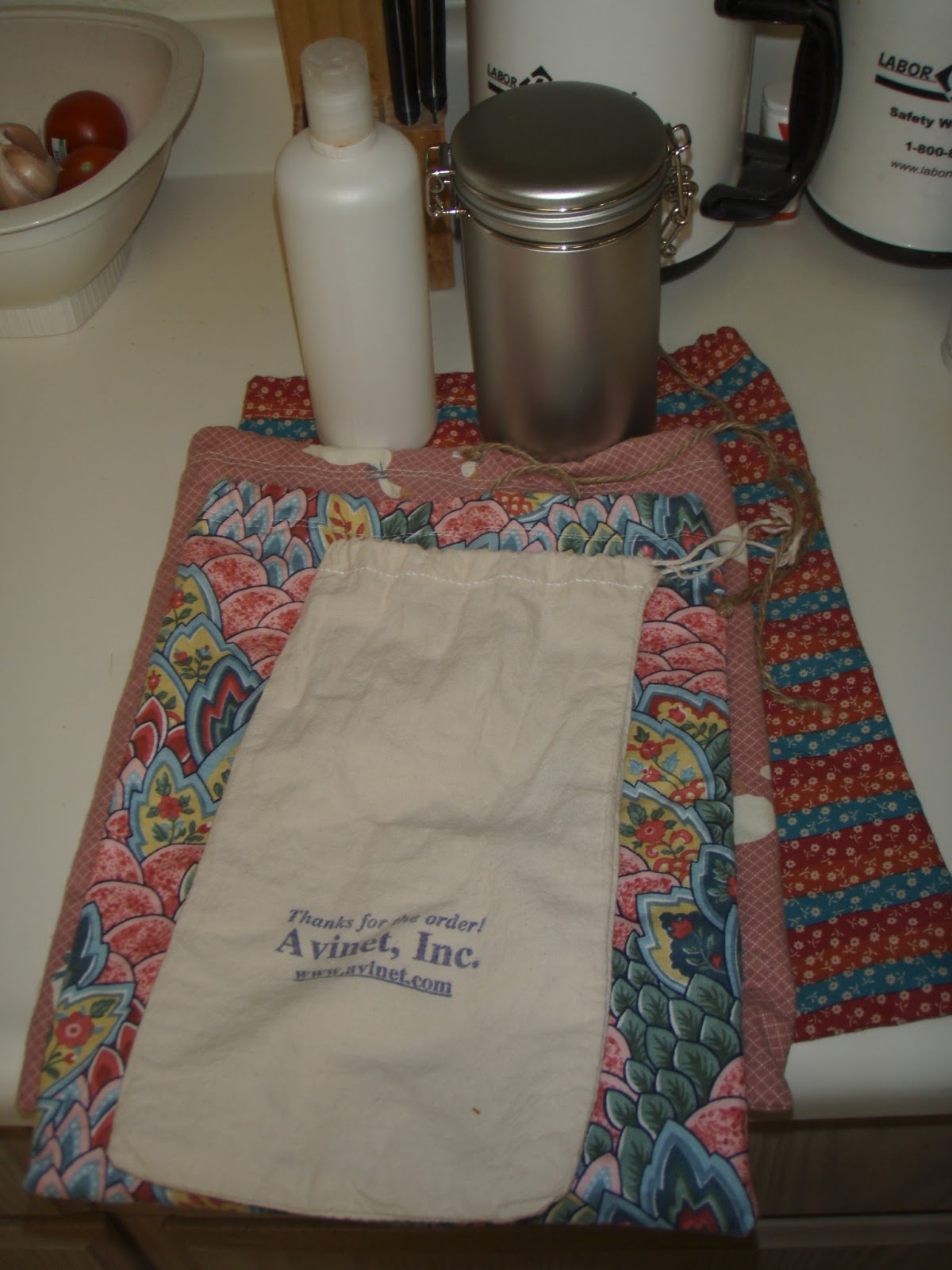
| Bulk bags and a selection of reusable containers. |
Once I have my list in hand, I get all my shopping accessories together. For me, that includes a team of reusable grocery bags, a bunch of reusable containers and bulk bags (we’ll get to the use of these below), and my reusable coffee mug (it’s my weekly treat to get a coffee from our Co-op). I’m a pretty firm believer that reduce and reuse are way more important “R’s” than recycle. I’ve talked about this view in length here. Thus, for anyone who is trying to reduce their impact on the planet, I’d say reusable shopping bags are a no-brainier. The next logical step is to start bringing your own containers for foods you purchase in the store such as meats from the deli (if that’s your situation), pre-made foods like salads, and the increasing number of bulk foods popping up in co-ops and large chain stores across the country. Depending on the store you go to, there might be some health concerns with using your own container for things purchased from the deli, but I’d be willing to wager that if you spoke with a manager you could figure out some solution that would work for everyone.
 |
| Reusable shopping bags. Way more fun. |
Here are a few reusable shopping tips I’ve developed over the years. First, buy one of these amazing ChicoBags or something similar. Put it in your car or your handbag/manbag. This is great for when you are just running to the store during the week and forget your normal fleet of reusable bags, or when you get a little excited at the store on the weekend and end up needing an extra shopping bag. Second, even if you have no bulk section and your deli is not allowing you to use your own container you can easily cut down your waste in the produce section by choosing products that aren’t wrapped in plastic and then bagging them with reused plastic/paper bags from home. I have a small collection of bags I used to put my store bought produce in before my mother made me a set of awesome bulk bags for Christmas.
Okay, now that we have all that stuff together, we can actually leave the house and go shopping!
3. Shop the Farmer’s Market
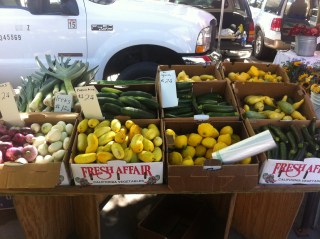 |
| FarMar Veg |
Oh, the joys of the Farmer’s Market on Saturday morning. This is one of the highlights of my week. We always arrive hungry and grab brunch at one of the food carts that is parked on the lot with all the farmer’s booths. After we are full (hunger is dangerous at the FarMar!), we take a stroll all the way down the isle of vendors, checking out the produce, referring to our list, and trying to find the best combination of quality and price for the items we want. The benefits of shopping at the Farmer’s Market are numerous, and you have likely heard many of them before…but I’ll repeat them anyway.
 |
| Beautiful summer produce! |
Probably the biggest impact of shopping at the Farmer’s Market is the minimal amount of miles your food have to travel to end up on your plate. Webber and Matthews (2008) found that “…for the average American household, “buying local” could achieve, at maximum, around a 4-5% reduction in GHG [green house gas]…” There are several things to consider about these findings. First, the paper never formally defines what “local” means, but the widely accepted definition is that local products are produced within 100 miles of where the consumer purchases them. Additionally, that figure is for a fully localized diet, which can be very difficult to achieve, even for the very devoted! Another interesting finding of this study is that not all food groups are created equally. According to their work, you could reduce your GHG impacts to equal that of a totally localized diet by shifting away from eating red meat one day a week, wow*. However, if you are only concerned with the farm-to-table travel impacts of your food (less holistic) focusing on local fruits and vegetables whenever possible will provide you with the biggest bang for your buck, as these foods generally make the longest trek from the producer to your plate. There are several other terms in the model which are clearly estimates and averages, and I highly recommend you check out this study, or any of the related literature on food miles if you are interested. The take-home here is that buying local, especially fruits and vegetables, does matter, but what we choose to eat can matter more (probably more on this in a later post). Remember, your personal impact might not be monumental when you change a single habit, but over time and in conjunction with other lifestyle changes, you can make a difference! Buying local has lots of other fringe benefits aside from reducing food miles, such as keeping money in your local community and getting to know the people who provide you with your food!
 |
| Lavender! |
Another great benefit of the Farmer’s Market is the lack of lots of unnecessary plastic packaging. Now, don’t get me wrong, the vendors at the FarMar will always be ready to give you a plastic bag to put your produce in, but you don’t have to take it! I know when I first started trying to avoid plastic, I felt a lot more comfortable politely refusing the nice person at the market and putting my produce straight in my reusable bag than I did carrying my peaches all willy-nilly up to the checkout counter at the store. I’m over that now by the way, and if I forget my reusable bag, I just bring a bunch of loose apples to the checker. It’s never seemed to cause anyone any problems!
Last, if you want to buy organic at the Farmer’s Market, you totally can! However, if you are only interested in pesticide free produce or you want to support a farm that is only just transitioning to organic and doesn’t have a certification yet, you can! The point is, if you have a question about your goods, you can ask the farmer! I can’t quite put into words the nice feeling of matching a name with your asparagus, but it’s a real thing.
4. Buy in bulk when you can, and ask for more bulk options
 |
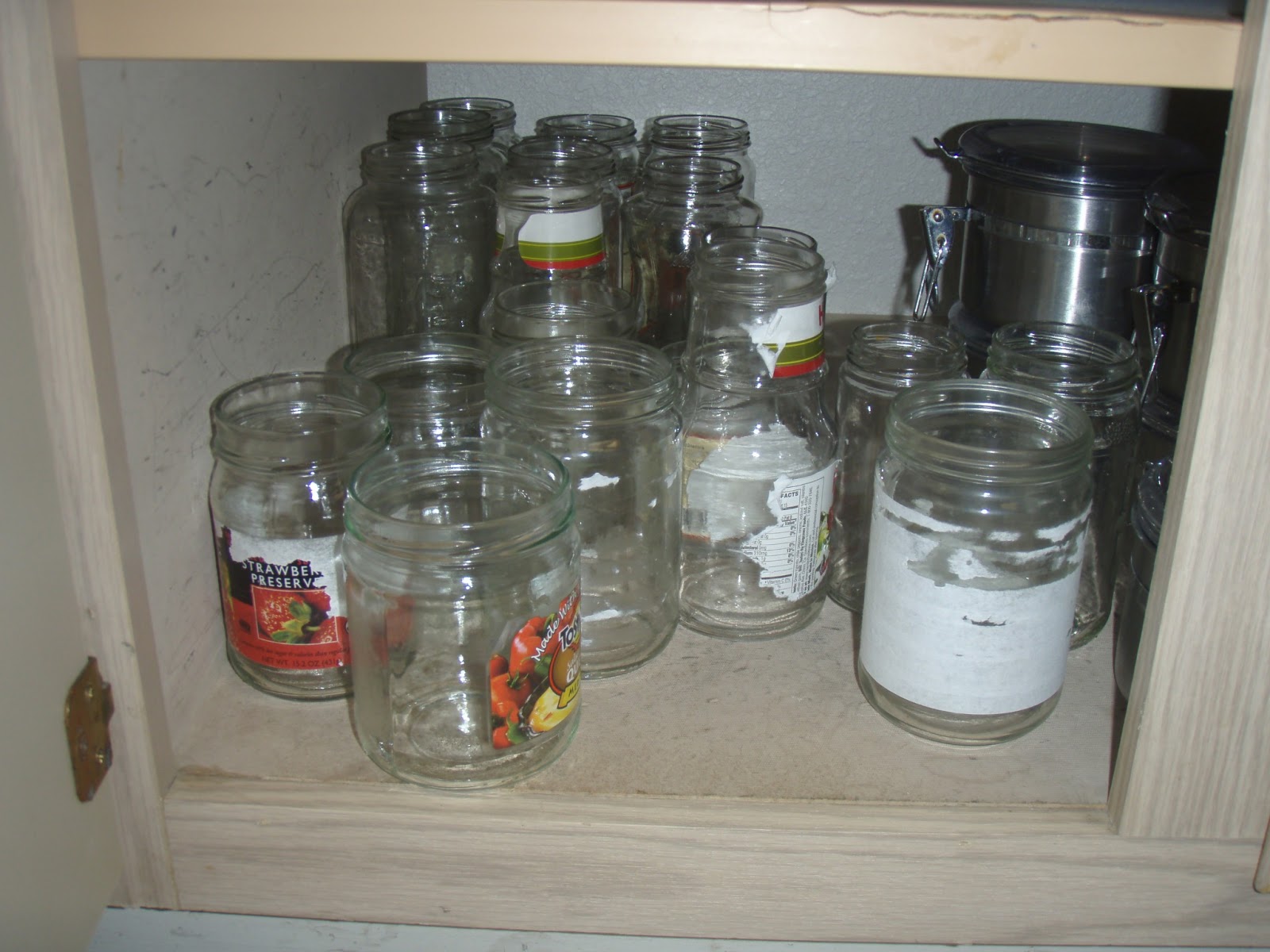
| Jars for bulk foods! |
This one isn’t an option for everyone, and I realize that. I’m supremely fortunate to live in an area where even the Safeway has some foods in bulk. This is a movement that is spreading however. When I was last home, I went to the store with my mother and saw many types of beans in bulk bins in her local chain grocery store. And if you are thinking, “There is a Whole Foods near me, but their bulk food will be too expensive!” you might be incorrect. Do a price comparison between what you usually buy and what you could buy in bulk at a health foods store. You might find the price difference is negligible, or the bulk foods might even been cheaper! Just beware the interior isles of places like Whole Foods. When you start buying pre-packaged foods from those stores, then you can end up saying “oops, there went 80 bucks!” Okay, what if you don’t live near any bulk food options? I would encourage you to ask for them! Speak to a manager, or write on a comment card. As I said, this option is spreading. Request it and support it.
Why buy bulk? You only have to buy the amount you need, which can lead to less waste of food in the end. And the obvious: less plastic, fantastic.
5. Shop once a week
This item is last on the list, but I think it’s still important. Shopping once a week (or less) does a lot of really good things for you. Initially, it makes all the tips mentioned above that much easier! You only have to plan and remember your reusables once a week, and then you can coordinate that with your trip to the Farmer’s Market and the store! Less travel also means you save gas. Running back and forth to the store multiple times per week can add up quicker than you might think. If you get all your major shopping done in one go, when you need this or that from the store, you can usually pick it up with your bike or just go to the store that is most accessible on your commute without worrying about price as much! Next, shopping once a week means you are prepared for the week to come. You know what you have in your pantry and fridge and, thus, you’ll have some idea of what you want to make for your meals. Even this small step, being stocked up by the time the week starts, can save you from the ever tempting trap of delivery/take-out/fast food, which we all know is less good for us, less good for the planet, and just generally less tasty than food we make ourselves! Plus, I find when I have all my supplies right off the bat, I can pre-prepare some foods to streamline my work week. For example, on Sunday (okay, usually Monday morning) I cut up and prepare salad and salad dressing for the entire week. That way, on most weekday mornings, I just have to assemble the veggies and head out the door! Last, making shopping an event makes it fun. In our house, we look forward to Saturdays. We know we get a Farmer’s Market treat, and it’s an uninterrupted time together to to plan something we are both invested in.
Last Word: I strongly believe considering our food choices is a cornerstone in attempting to live a more Earth-friendly lifestyle. We all have to eat right? This post was all about the little tweeks we can me in getting that food in order to avoid food waste, stay away from too much packaging, and begin considering the foods we actually choose! I hope you learned something new, or were inspired with a new idea.
 |
I was obsessed with these pepper wreathes this fall
at the FarMar. |
What do you think? Do you do any strange things when shopping because you feel they reduce your impact on the planet? Any suggestions for me to try out/research? I’d love to hear what you have to say.
Sources:
- Parfitt J, M. Barthel, and S. Macnaughton. 2010. Food waste within food supply chains: quantification and potential for change to 2050. Philosophical Transactions of the Royal Society 365: 3065-3081.
- Webber C.L., and H.S. Matthews. 2008. Food-miles and the relative carbon impacts of food choices in the United States. Environmental Science and Technology 42: 3508-3513.

 I have not posted in quite some time now and I know exactly the moments to blame. I’ve decided that the best way to explain this event is via a comparison to Mario Kart, everyone’s favorite Nintendo themed racing game. Periodically during the race your character (in my case, Peach or Daisy) will encounter boost strips in a certain area of the path. If you can manage to get your kart over to pass overtop the strip, you’ll get a short boost of speed, so hopefully you can pass up your siblings for the win. I somehow managed to navigate myself to a fabulous CouchSurfing festival in Edinburgh and was given a giant burst of speed and excitement! Edinburgh Rocks 7 opened my eyes to a whole new side of the CS experience!

 The festival was very well planned,with plenty of time for chatting up and getting to know everyone involved (pub meet-ups, speed friending, BBQ, Scottish breakfast) amid the more intricate events (ceilidh, Highland games, scavenger hunt, talent show, free hugs, movie night). My excitement began with a night of ceilidh (apparently pronounced “kay-lee” – hhhmm). What is ceilidh, you ask? I wondered the same. As far as I could tell when the night was over it’s a Scottish Gaelic word for ‘intense evening of crazy folk dancing during which you will sweat, laugh, fear for your life, be stepped on, and enjoy every bit’. I was hooked and attended every single event during the festival. Between competing on Clan Highlanders and winning the scavenger hunt with Team LIFIA in an epic talent show tie breaker, I developed several friendships and learned about people from all over. And those new relationships are what propelled my adventures into overdrive.
  I received several offers of couches to visit during my journey. Another American traveller and I followed two fellow Rockers (and Clansmen!) to Newcastle where we continued the fun times. From there I met back up with another new Edinburgh friend in Manchester and we spent four wild days backpacking and mountain hiking in Snowdonia national park. Then back to Newcastle for a killer electro pop show featuring Static Soul, my host’s flatmate’s band. A night of wild dancing with some of the loveliest Gordies before early morning buses to Glastonbury festival where another friend (this time from home) had procured production and stage passes for me for the last day. Somehow my most relaxing day in nearly three weeks was spent backstage watching Vampire Weekend and Nick Cave & The Bad Seeds rock the main stage before enjoying some whiskey and Mumford & Sons from the dressing room area with several lovely characters.
  Are you exhausted from just reading that last bit? I’m tired from just reliving it all as I typed! I still can not believe how just one weekend can shape so much of my trip. Even now, weeks later, I am heading to Amsterdam to join back up with the same traveller that came too to Newcastle and later I hope to meet up with another in Budapest. So many thanks are due to so many people for their hard work, generosity, and friendship. This is only one of many CS camps, festivals, and other major events that are hosted through the summers. I will be on the constant look out for others and hope to return again eventually for another Edinburgh Rocks!

























 Sweet Tea, Science