Road Trip Record: Three Ecosystems in One Hike

RMNP Montane Ecosystem
Time to get in the wayback machine for a trip down science/nature travel memory lane.  In the summer of 2012, just after I had finished my MS degree and just before I was slated to move on (and up the coast) to start my PhD, Meridith and I planned and executed the Amazing Besties National Parks Road Trip!  Meridith was tantalizingly close to completing her MS degree as well, so it totally counted as a double celebratory trip!  Our goal was to see as many national parks as possible, with an eye to balancing quality and quantity, and road trip our way from Las Cruces, New Mexico (Mer’s former hood), up to Portland, OR for the Ecological Society of America conference, then scoot back down the California coast to Long Beach, where I would pack my stuff into a truck and move!  If you’re new to this series of blog posts, I highly recommend you check out the summaries of the early stages of our trip, which were originally posted on Meridith’s former blog and later migrated to our current one.  Clickity-click for:  the take-off, Carlsbad Caverns National Park (days one and two), ABQ New Mexico, on the road, Zion National Park (day one and two), me getting us really lost, Arches National Park, a babal about invasive species, and Rocky Mountain National Park day one!   


Day 11
Rocky Mountain National Park
Total Miles Hiked: 8.9 (67.2 overall)
About 95% certain this is a portion of Bear Lake from above.

When last we left our Amazing Besties National Park Road Trip, we had just finished our first full day in Rocky Mountain National Park.  We had taken an awesome hike up Deer Mountain, seen 18 big horned sheep, and I had beaten Meridith in a friendly game of pool.  We didn’t let all this fun keep us up too late though.  We had big plans for the next day, July 20, 2012.  


Pretty sure this is Meridith “being a critter” in the montane ecosystem.
We got up early, as per the instructions of the friendly park ranger we spoke with on the previous day.  We were planning to hike the Flattop Mountain Trail, which peaked in altitude at 12,324 ft!  The ranger had warned us afternoon thunderstorms were common in the region, so we wanted to get an early start and avoid getting caught in the weather on an exposed mountain.  Plus, Bear Lake Road (the road to the trail head) would be closing after 9am, necessitating a shuttle trip if we didn’t get up and get going.  The many benefits of getting friendly with the park rangers!  I love having the inside scoop.
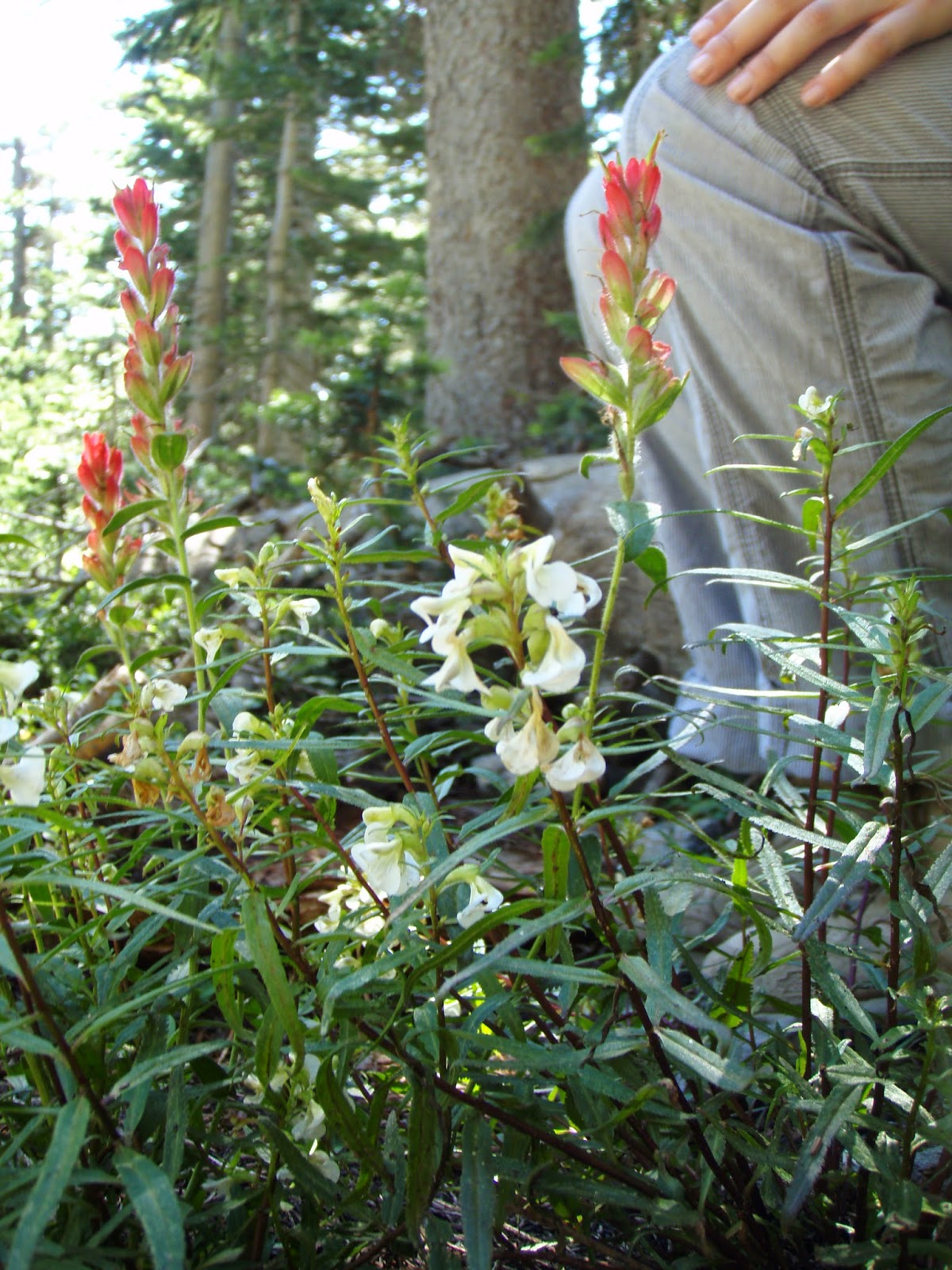

Wildflowers and feetz
We were rewarded for our early start with a sparsely populated Bear Lake area, which is one of the most popular spots in the park.  After a stop to apply sunscreen (easy to get sunburned at high altitude!) and fill up our hydration bladders, we found the Flattop Mountain trailhead and began our ascent.  The park ranger had suggested this trail based on our desire to get a bit of a physical challenge (8.9 miles roundtrip and almost 3000 feet of elevation gain) and see all three high altitude ecosystems the park had to offer. We are the nerdiest of nerds.  

We started off in the montane ecosystem, much like what we had hiked through the day before on Deer Mountain.  According to the park’s website, montane ecosystems occur between 5,600 and 9,500 feet.  We saw many of the characteristic pines of this ecosystem.  We were also treated to some lovely lupins (Lupinus), Indian piantbrush (Castilleja), as well as some other pretty wildflowers whose faces don’t have a name in my mind.  One of my favorite parts of climbing up is looking back down at the same landmark over and over again.  Watching Bear Lake get smaller and smaller as it peeked from between trees made the first mile or so go very quickly.


Subalpine Ecosystem, everything look so intense!
That is a huge cairn, which we though was hysterical.
As we moved up into the subalpine ecosystem, spanning the range from 9,000 to 11,000 ft in elevation, the vegetation began to change.  Short, gnarled subalpine spruce and Engelmann fir dominated the landscape, but a few pines persisted.  Most of the larger trees we spied had the tops snapped off, making them look a little naked.  We hypothesized (like you do) that snow was the likely culprit.  I remember being in Africa and thinking I could tell, just by the character of the plant life, that this was a hard place to live.  I felt the same way about the tough looking scrub trees along the trail.  Way to stick with it, guys!  At this point in the hike, the types of animals we saw also started to change.  We saw our first yellow-bellied marmot!  These guys are essentially just fatty squirrels.  It’s funny, because the noises we made upon catching our first glimpse were very similar to the noises he made while checking us out from his rock.  Appreciative squeaks all around!  
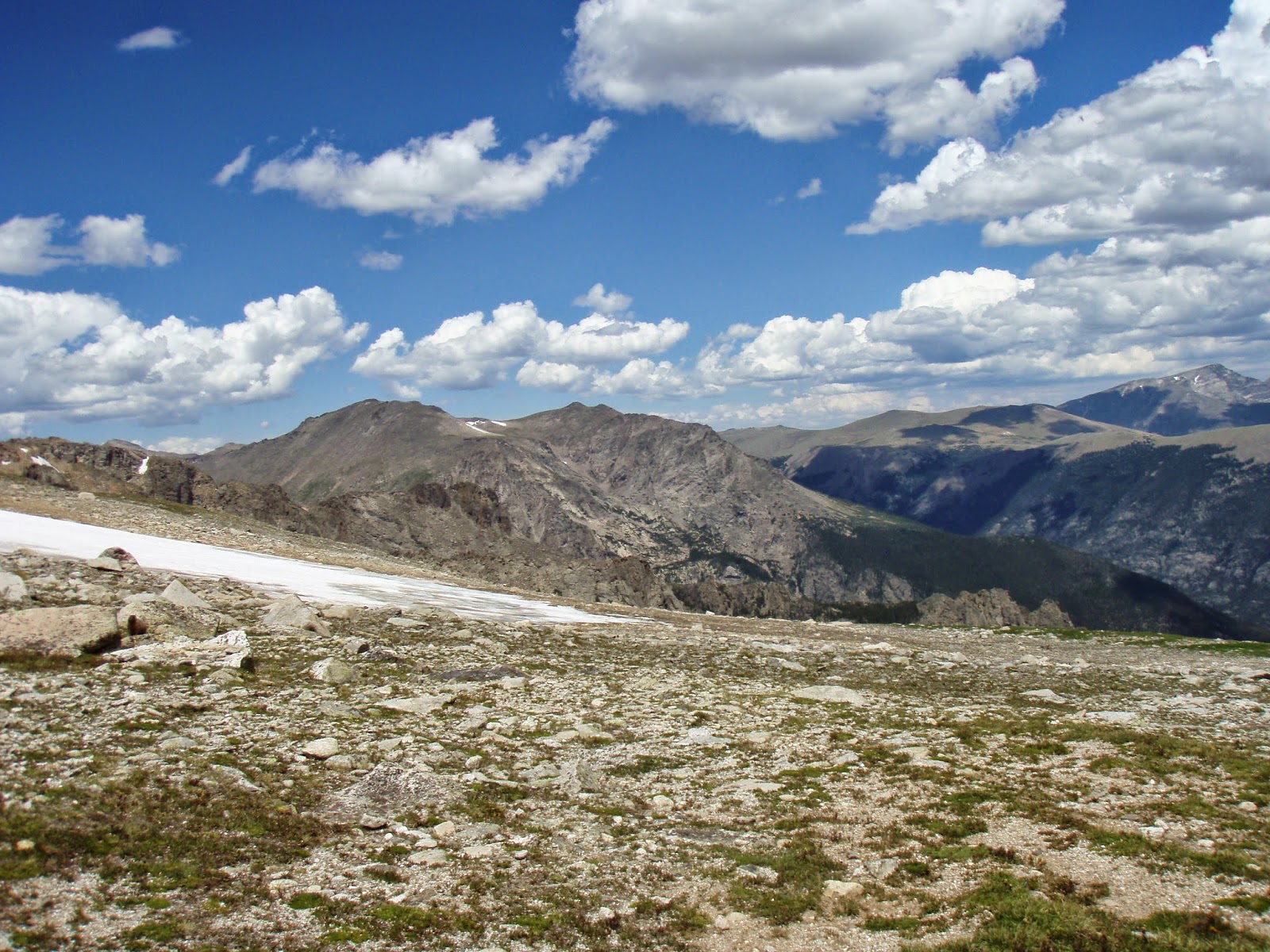
Amazing alpine tundra!
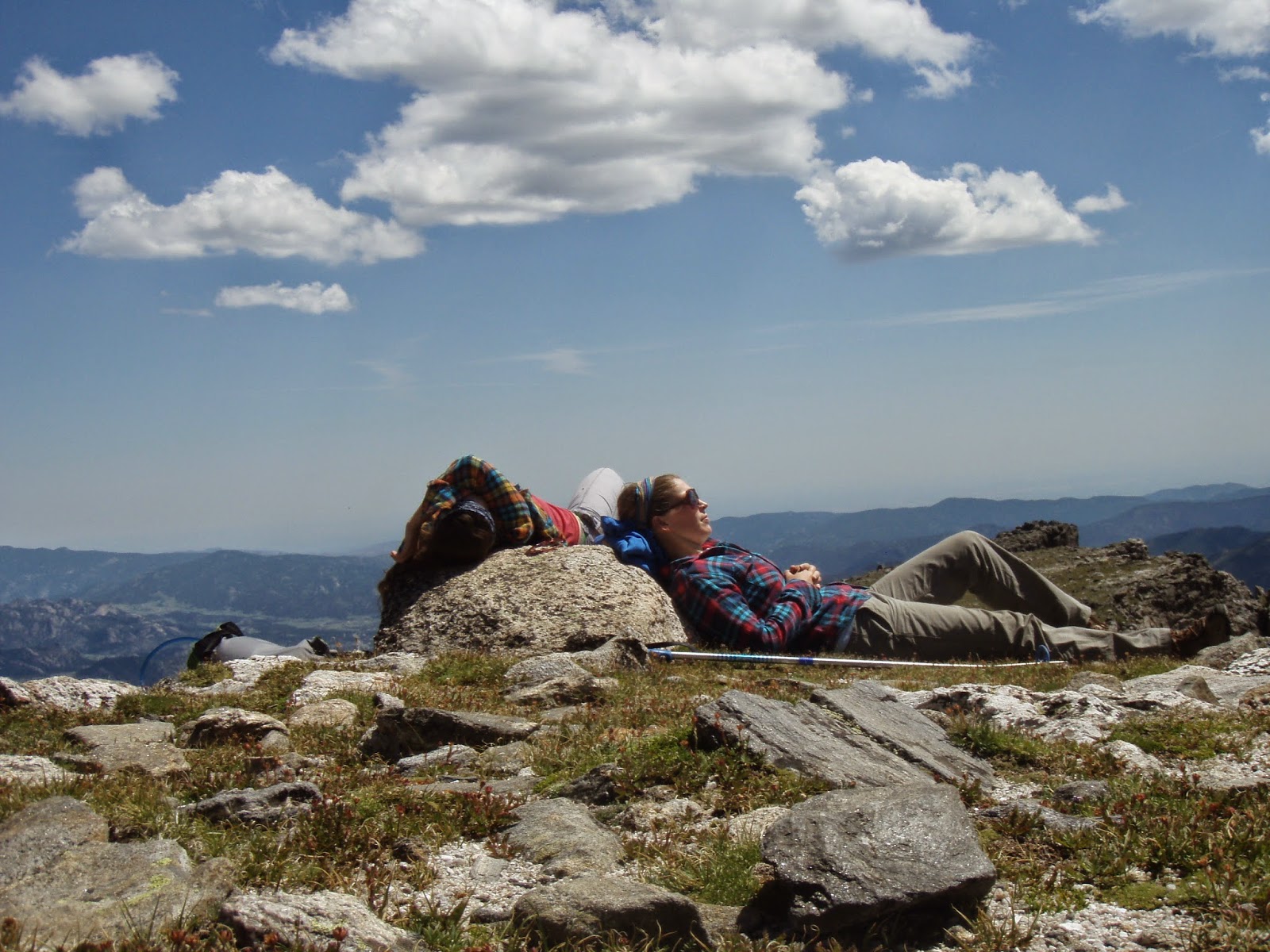
Mt. top naps for the win.
Finally, our hike brought us into a true alpine tundra ecosystem.  I think I might have been annoying Meridith a little bit with the phrase, “I totally have a crush on this ecosystem.”  I totally do!  It’s just so fascinating.  This ecosystem begins around 11,000 or 11,500 ft in elevation, past the point where trees can grow.  Due to the exposure, liquid water is a major limiting resource, meaning tundra is basically a type of desert ecosystem.  I was instantly squatting down, peaking at plants, and pointing out adaptations I thought were similar to those we had seen at Zion and Arches National Parks.  Suddenly, we heard the most precious of little sqees.  A pika!  This adorable alpine guinea pig pretty well made my day.  Due to my love affair with the tundra, it took me a little while to notice that Meridith had flagged down and boarded the Struggle Bus.  The impacts hiking at high altitude have on a person are, in my experience, not correlated at all with physical fitness.  In retrospect, Meridith likely had a touch of altitude sickness.  Pro tip for those prone to such things, a preemptive Advil or some such thing can help you make it!

Being the total trooper that she is, Meridith made it to the top of Flattop Mountain (and so did I)!  We both oohh-ed and awww-ed at the view for about 2.5 seconds before taking an epic mountain top nap.  Highly recommended.  When we awoke, we were both feeling grand.  We ate a spot of lunch, then poked around the mountain top, enjoying our accomplishment, before heading back down the way we had come. (Editor’s note: This is about the time I decided to aggressively drop my camera for the umpteenth time, dislodging some vital wiring innards, essentially rendering the back screen useless. However, it still managed to arrive alive at the end of our journey!) See Meridith’s previous post about the proper way to descend on a hike.
For example, on the way down, you might notice a huge field of wildflowers
you missed on the way up!
We were feeling really good about ourselves at this point, and super excited about the play day we had set-up with one of our friends from the previous night.  We shared food and chatted around the campfire well into the evening.  He convinced us to take Myers Briggs Personality test and, as fate would have it, Meridith and I have super compatible personality types.  The descriptions pretty much said, “You guys should be best friends and take lots of adventures together.”  Noted Myers Briggs.  Eventually, we had to break-up the party and head to bed.  The next day, we were hitting the road again, this time for Yellowstone National Park!
Obligatory NP Sign Pic

Top 5 Science Podcasts

Screen capture from my list of podcasts!

I’ve been out of the academic atmosphere for over a year now. Sometimes I just really miss getting my learn on. Academia pretty much ruled my entire life before I graduated with my MS degree (and it’s about to take back over!), so you would think I’d enjoy a well deserved break from, well…thinking. But no, I missed it terribly and have found becoming an avid podcast listener to be one of my more enjoyable hobbies. I love that I have a nice little list of podcasts queued up on my phone, so whenever I find myself with an extra 20 minutes or so I can just hit play. There’s no decision making, which is really nice for someone as indecisive as I am.

While I’m sure the internet has many sites for finding podcasts, iTunes is a great starting place. Their podcasts are collected, organized, and ranked, making it easy to browse categories of your interest and subscribe to those you’d like to have pushed to your device. Again, I always listen on my phone, but you can choose where to store your podcasts. I download a few episodes at a time when I’m around wi-fi so I don’t have to use up any cellular data. If you aren’t able to listen in this manner (maybe you don’t have a compatible phone/device) there are a few alternatives. Android users can use the Podkicker app. You can listen through iTunes on your PC. You could listen through a podcast website, such as Podcast Alley, from any computer. Several podcasts even have their own websites where you can listen.

I have loads to listen to currently.

I originally listened most of the time in the car. I often had 30 minute drives to/from schools when I substitute taught or between going to tutor the kiddos. However, now that I am about to settle down in Penn State sans car, there are plenty of other times I have been able to squeeze in a listen. People who conduct research often have simple, yet time consuming tasks to accomplish. Try listening to podcast or two while processing those samples or running those tests. I know a few runners that enjoy listening to podcasts while they go for a jog. Really, most times you are listening to music you could switch to an informative podcast instead*! If you’re really trying to get your learn on in a shorter amount of time, you can always listen to podcasts on 1.5x speed and enjoy a slightly faster, more hilarious experience.

When I first started storing podcasts on my phone I got very overwhelmed by all the options and episodes and those mocking red bubbles with the number of new episodes available! I actually ended up deleting and unsubscribing from everything for a while. I was spreading myself too thin. I can’t catch, errr, listen to ‘em all (editor’s note: Meridith’s geek girl side is one of my favorite things about her!). After this period of initial frustration, I went back and resubscribed to only a few podcasts, this time being much more selective. I also only focused on finding recent episodes that related to my interests. Then, I download these specific episodes so they are ready when I am!

Top Natural Science Podcasts on iTunes

You want a few suggestions? Here are some of mine and Rachel’s favorite podcasts.

 Sweet Tea, Science’s Favorite Science Podcasts

    1. Science Friday [Tumblr, website, Twitter]
    2. The Naked Scientists [website, Twitter]
    3. The family of “How Stuff Works” Podcasts (esp. Stuff You Should Know and Stuff You Missed in History Class, which often has science history episodes!)
    4. Star Talk [Tumblr, website, Twitter]
    5. RadioLab [Tumblr, website, Twitter]

     Bonus: New podcast BBC World Service Elements


    Tell us your tale! Are you on the Podcast Bandwagon? Have any favorite ones (science or otherwise) that you’d like to recommend? Just checked out one of our recommendations and loved/hated it? Let us know in the comments!

     *I just turned off my music and turned on SciFri. Listening to my own advice!

    Eco-Life Hacks: Making Homemade Stock

    There are a few things that I truly love in this world:  science (obvi), my family/friends/cat, NAPS(!), and finding new life hacks that are both thrifty and eco-friendly.  Don’t get me wrong, I like things that are thrifty or eco-friendly, but when you get the two together…  These are usually little things or habit changes that I can pretty easily sneak into my normal routine.  They make me feel positive about my choices and they make it a little easier for me to buy obnoxious (read: more expensive) organic kale.  Win, win!  Right?


    Allow me to play Devil’s advocate for a moment.  Our environmental problems are big, huge even.  The impacts of our personal choices are generally small, potentially imperceptible.  I get this.  People who tell you otherwise are not being straight with you.  So, why do I still make these small lifestyle changes in the face of all the facts?  There are a couple of reasons.  First, I think that over my lifetime my small choices can add up, and maybe that still won’t make a huge difference, but at least I can say I did my best.  Second, I truly and strongly feel a cultural shift toward these choices in the population at large can make a big difference in the years to come.  As we have seen so many times over the decades, a cultural revolution is the most effective way to make lasting change.


    In an effort to shift our thinking toward an “environment first” mind-set, I’m going to share a series of these small eco-life hacks.  Please let me know if you guys like these tips and tricks!  By all means share them around, that’s the point.  Also, feel free to speak up if there is a certain part of your life that really drains your wallet or your stores of eco-karma.  I’ll do my best to focus on what you ladies and gents want to hear.


    This first life hack is one of my favorites.  It is quick, super easy, and will save you some serious pocket money in the long run.  I speak, naturally, of making your own vegetable stock!  I know, I know, there are about a billion (you can quote me on that) blogs out there telling you how to make homemade stock.  But how many will give you a source citation to tell you why you should?  Now, there is at least one.  Essentially, by making your own vegetable stock, you are turning all the stems, cuttings, and bits of fruits and veggies you might otherwise throw out into a delicious and nutritious broth that can be used for a plethora of other kitchen tasks.  You are turning your food waste into something!  Good for you, that’s impressive and important.  I think this quotation from a study performed by Parfitt and colleagues in 2010 sums up why pretty well.  The U.S. statistics are equally embarrassing  but I chose the U.K. statistics because they were quantified in carbon emissions (Note: Mt stands for metric tons).    


    “More recently, the Waste and Resources Action Programme (WRAP) has shown that household food waste has reached unprecedented levels in UK homes (WRAP 2008, 2009a,b), with 8.3 Mt of food and drink wasted each year (with a retail value of £12.2 billion, 2008 prices) and a carbon impact exceeding 20 Mt of CO2 equivalent emissions. The amount of food wasted per year in UK households is 25 per cent of that purchased (by weight).”


    Yowza.  Are you sold?  Let’s take it to your wallet.  When I don’t have time to make my own stock (which is really never, it’s usually just because I’m stressed and won’t even make time to wash my slow cooker) I generally buy this brand of vegetarian vegetable bouillon for about 3 dollars.  Not bad really.  But making my own is literally free, because I would be purchasing all those vegetables that provide the scraps anyway!  And three dollars is enough to buy that bourge-y Buddah hand fruit that you’ve been wanting to try.  After a month of stock making, you could even go see a movie you would otherwise have had to pass on attending.  So there you go.


    On to the stock!


    Step One:  Collect your vegetable scraps.
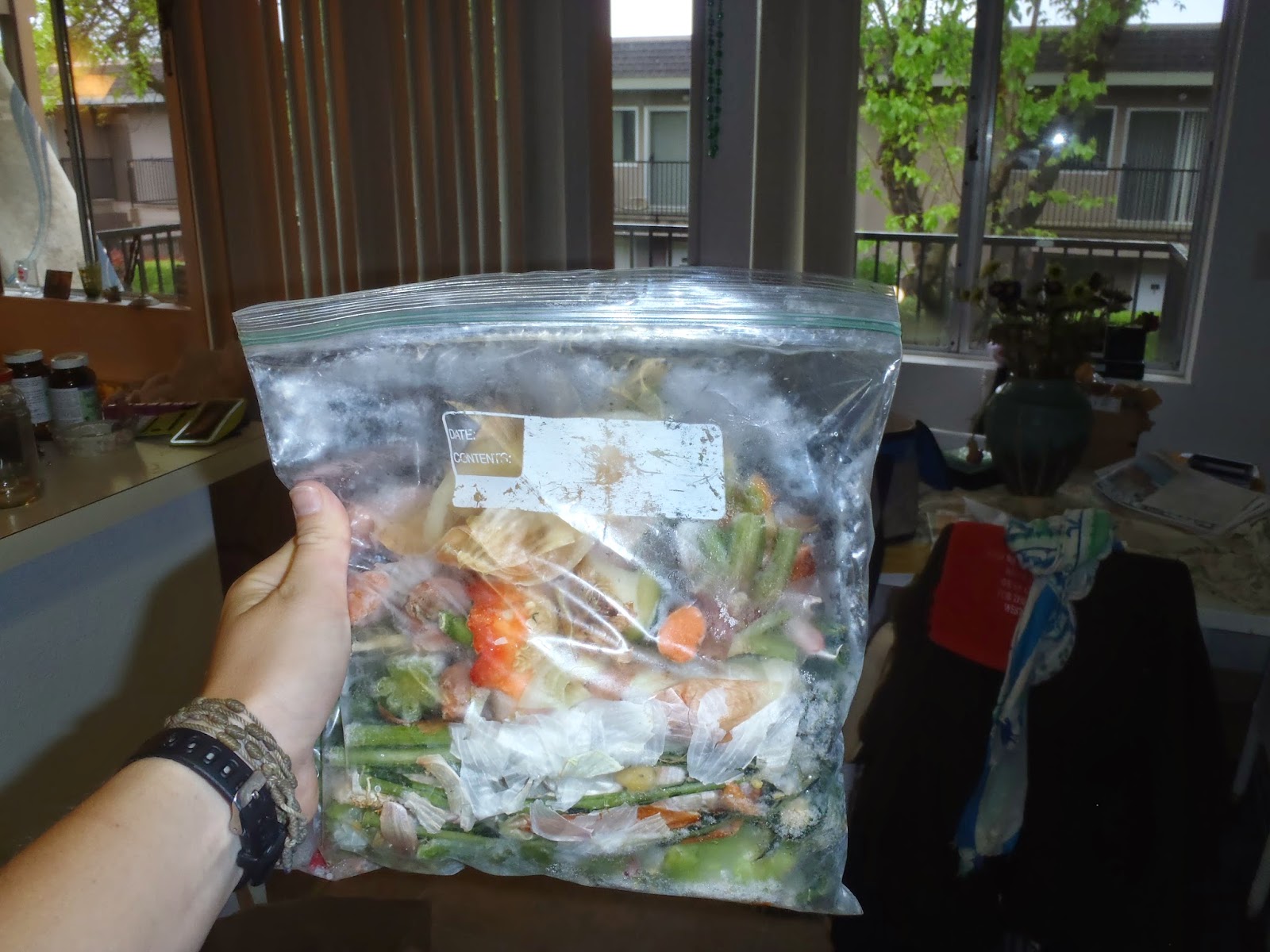
    There are several ways to go about this, depending on how much produce you consume and how often you want to make stock.  During the summer when I am a produce monster, I keep a bowl in my fridge and just toss all the scraps in there for safe keeping.  During the other seasons, I keep a tupperware or a baggie in the freezer and put my scraplets in that.


    Things that work really well:  potato or carrot peels, stems of kale or other greens, skins of garlic and onion, tops of any root vegetables you don’t want to eat, apple cores, strawberry tops, lettuce stems, broccoli stalks, pulp from making juice, etc., etc.


    Things that aren’t great:  banana peels…this is the only thing that has been a big regret for me.  Maybe this seems obvious to everyone else?  


    Step Two:  Clean your scraps.
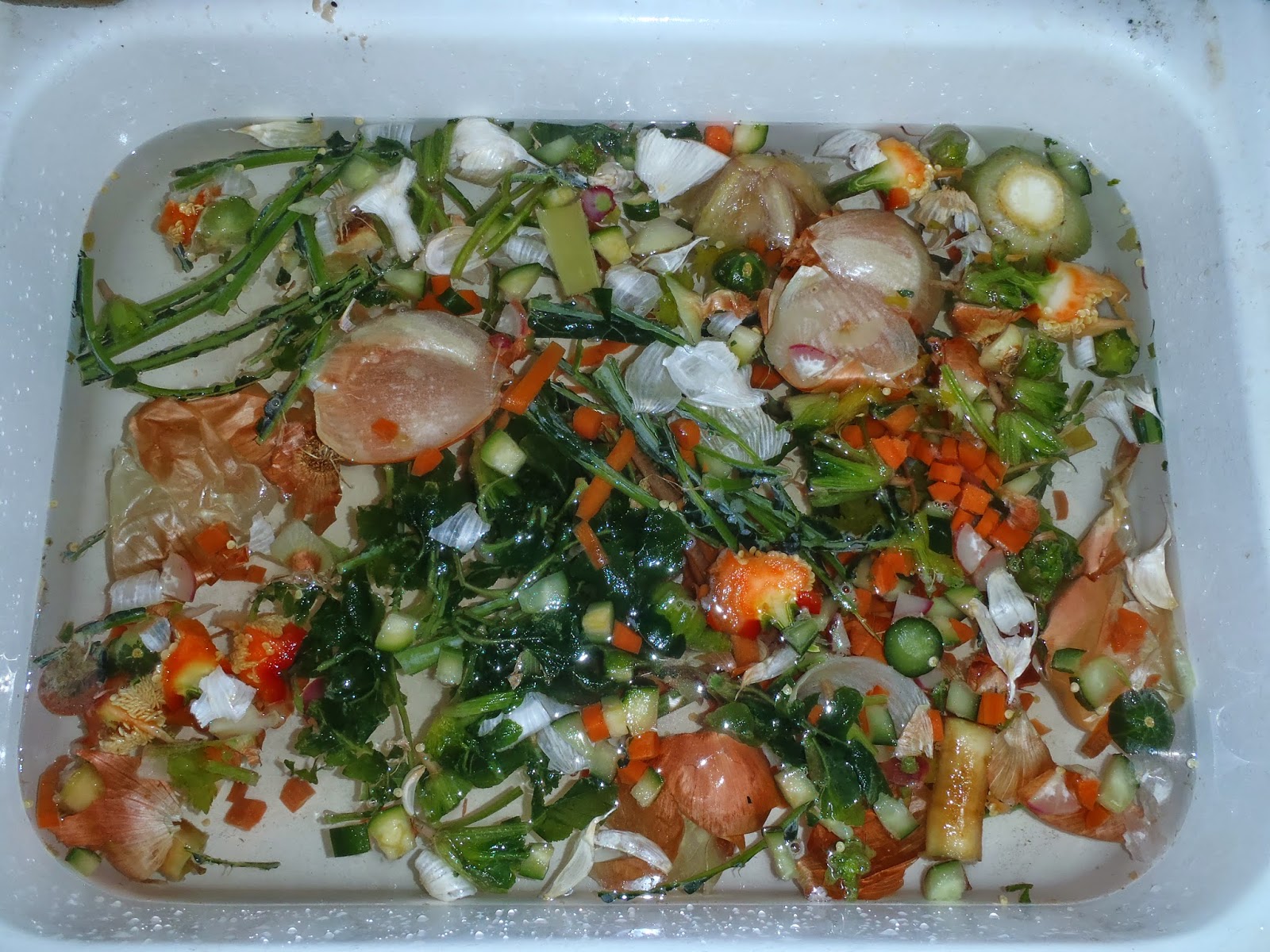
    Once you have enough scraps collected (I use a full one gallon baggie), you want to wash them by soaking them in some sort of weak organic acid, like apple cider vinegar.  This will help to remove any dirt, pesticide, or wax that might still be hanging around on your food.  I think this step is particularly important because many of the scraps I use are the outer leaves of onions, garlic and carrot peels, and other parts that are particularly dirty or exposed.  I tend to just dump my frozen veggie in the water and let them thaw that way.  You can also let the bag thaw in the fridge overnight, but that just adds a step.


    Step Three:  Rinse your veggies well and put them in the slow-cooker
    First off, you can just as easily do this on the stovetop on low heat, but that requires that you be in the house.  I love using the slow cooker because I can put all my veggies in, set the heat to low, and go to work.  When I come home, my house smells like food!


    You will want to add about 8 cups of water to the veggies in the pot.  At this point, you can feel free to get creative.  I usually add about a tablespoon of olive oil, some parsley, basil, crushed red pepper, rosemary, cumin, and a few bay leaves (bay leaves HIGHLY recommended!).  You also want to make sure an add at least half an onion and a few cloves of garlic if those two veggies don’t feature in your collected scraps.  They are always well represented in mine, so I tend not to add any extra.  


    If you are using the slow-cooker, you can now set it and forget it for about 8 hours on low heat.  If you are cooking on the stove-top, I would just cook it on low heat for at least 2 hours.  Let it cook for longer if you can stand it.


    Step Four:  Drain and store your stock.
    Once you have cooked all the nutrient rich goodness out of your fruit and vegetable scraps, you want to strain the stock through a fine mesh sieve to get all the little bits of cooked veggies and spices out.  I tend to pour off the majority of the liquid, then spoon the solid veg into the sieve and give it a little smash to get more of the good stuff.


    You can store your stock in several ways.  You can put it in jars and keep it in the fridge for immediate use.  I do this with about half of the batch.  The rest, you can freeze and save for later.  Initially, I was measuring one cup servings into plastic baggies and storing the extra stock that way, but it wasn’t very user friendly and I hate washing out plastic baggies (because I can’t just use them once!).  Now, I freeze it all in ice cube trays and transfer them to a bigger container once they have frozen through.  This allows me to easily customize the amount I can use from the freezer.  If I just want a little bit to saute some vegetables in, I’ll get out one cube.  If I need several cups, I will take out a bunch of cubes and melt them in the microwave or on the stove top.  If I over shoot and have taken out more than I need, I just stick the extra back in an ice cube tray.  Easy.    


    As for your now mushy vegetable scraps, they have lived two lives and have served you well!  You can either trash them or try to find another use for them!  Any ideas?  I have a few that I am working on as we speak. Compost is the most obvious.  Maybe you’ll hear about them soon.


    And there you have it!  A eco-life hack that could equally serve the broke college crowd or the young professional trying to make the world just a little bit better.  Hint:  You can easily be both those things at once.  Remember, if you want me to try and hack your life, or just a certain part of it, let me know in the comments!  I’ll do my best to oblige.  


    Literature Cited:


    Parfitt J, M. Barthel, and S. Macnaughton.  2010.  Food waste within food supply chains:  quantification and   potential for change to 2050.  Philosophical Transactions of the Royal Society 365: 3065-3081.