Collaboration Station: Google Drive

Collaboration is a vital part of the scientific process. Do you think I’m going to save the world on my own? Nope. I’m going to need at least a little bit of help. The more great minds working on a project, the faster advancements may be made. And we need advancements (I’m look at you, self-driving car peoples)! Any sort of collaboration is difficult across distances. Technology has made the process easier and email is currently the main tool for communication for researchers. While I’m really proud of the older generations of scientists for getting on track with email, I’m afraid I’m going to have to ask them, and everyone, to utilize Google Drive for their collaboration needs.
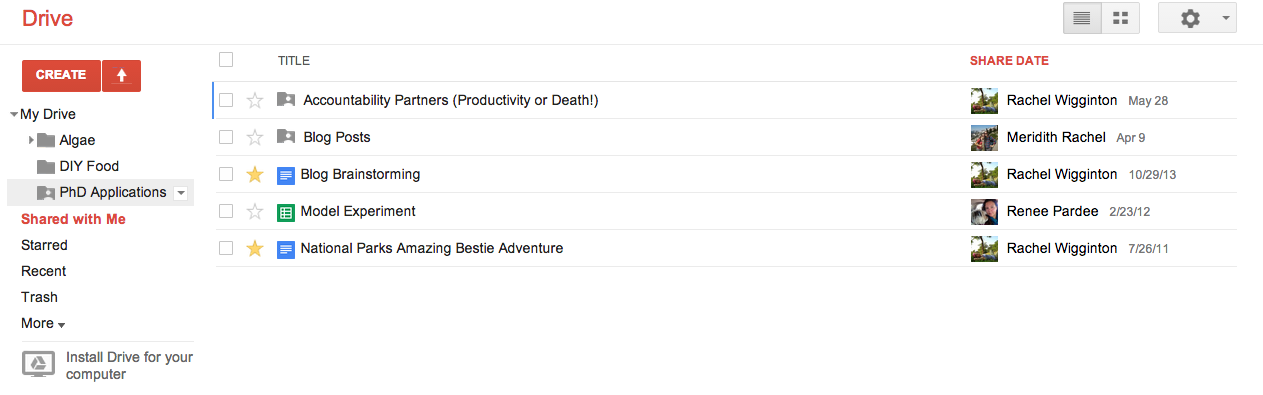
Being able to access my Google Drive from anywhere keeps me productive!

Google Drive was repeatedly been a useful resource throughout my graduate school years. I could share files and folders with my undergrads so they would always have access to protocols, data sheets, etc. It made for fast communication and kept my data safely stored in multiple locations. However, when I was working on writing manuscripts I would email it to all of my co-authors whenever they needed feedback and would inevitably have to shuffle their responses and changes back into a master copy. This updated copy I would then save as a new file. My third manuscript has yet to be submitted because my advisor and I accidentally worked on two different file versions, and now she has to incorporate her updates into my most recent version. I never wanted to use Google Drive to have people revise my papers because I couldn’t for the life of me find anywhere to turn on Track Changes. But when I was working on my PhD application essays and desperately wanted people’s feedback, I realized Google Drive always has track changes on! And it’ll keep track of who edits what, when, where, and why! Ok, not why. Unless they leave a comment!

So if you want to collaborate on a piece exclusively on Google Drive
1) Start a file – it can be a document, presentation, spreadsheet, drawing, etc
2) Share it with your collaborators. – You can share via a provided link or email. You may also control the level of privacy your work has.
3) Write and edit the file! – All together now!
4) Keep an eye on the changes/comments made by others – Anytime you want to open your revision history, click “All changes saved in Drive” at the top of the page.
5) Profit
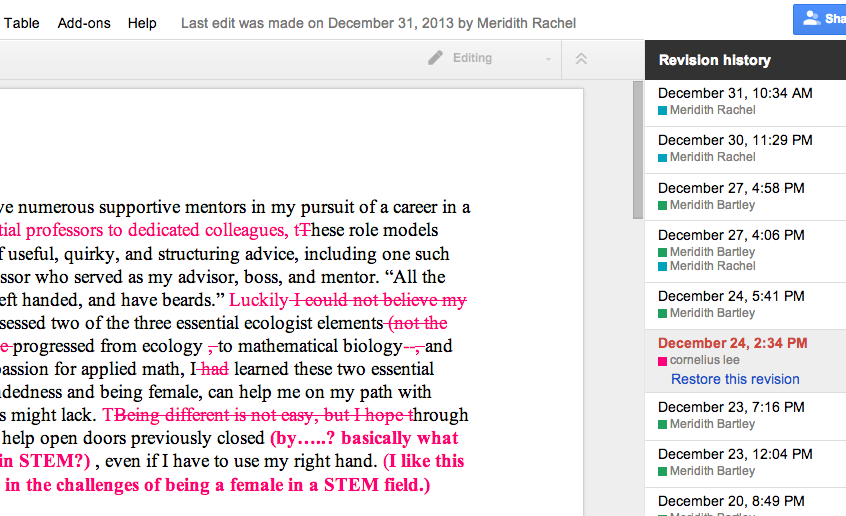
So many revisions! So many colors!

Writing that army of essays was undoubtedly one of my least favorite parts about the graduate school application process. I absolutely could not procrastinate them because I wanted to get as many discerning eyes on them as I possibly can. Now that all of my PhD applications are submitted I have the power of hindsight, which allows me to see just how much my essays benefited from the help of several friends’ advice. Some ended up being completely rewritten multiple times. Multiple people were able to review and revise the essays at the same time, and I never had to compare different file versions emailed to me. No going back for me now. Go ahead. Put those theses into GDocs. Your manuscripts. Your group work assignments. Unleash the power of automatic track changes and maximize collaboration! Never worry about hitting save again.

Welcome to Sweet Tea, Science

Mt. St. Helens, Summer 2012

Let us start by first saying welcome! We are excited and proud to be launching the Sweet Tea, Science blog today. We are two scientists from Kentucky currently working on obtaining our PhDs.  Aside from academic pursuits, we are passionate about sharing our interests in various STEM topics, travel, and sustainable living. It is our hope that through Sweet Tea, Science we can share our knowledge, practice our communication skills, and learn from you!

Costa Rica, Winter 2007

In addition to being hysterical scientists, we are also real life friends! We met in 2005 at Western Kentucky University where we both obtained a BS in Biology with concentrations in Biodiversity, Ecology, and Conservation. Meridith is an overachiever, and also has a minor in mathematics! During our time at WKU (go Tops!), we both completed Honor’s theses and graduated from WKU’s Honors College.  While in college we studied (we took pretty much every biology class together), traveled (numerous Central and South American countries, Africa, Michigan…), and adventured together (everything is an adventure!).  After graduating, we continued to learn and explore as a team, and now we are tackling the blogging world as a dynamic duo.

Florida, Spring 2007

Meridith went on from WKU to study algae cultivation for biofuel production at New Mexico State University for her Masters in Wildlife Science, with a minor in Applied Statistics. Again, overachiever. Her blog and Facebook page, Always A Scientist, started in early 2012 as part of an application to HiSEAS. Meridith continued with the blog off and on for two years, enjoying it immensely, but never fully committing to posts. She is currently about to start her PhD in Statistics and looks forward to the opportunity to apply stats to ecological systems.  Rachel went from WKU to sunny southern California to work on a Masters in Biology at California State University, Long Beach.  She completed her degree in the summer of 2012 and moved on up the coast to the central valley to tackle a PhD! Similar to Meridith, Rachel started her blog, Practical Ecologist, in November of 2012 and really enjoyed it, but didn’t have the time to commit to it like she really wanted.  What were two lady scientists to do?

Grand Canyon, Spring 2010

In November 2013, we decided to combine our powers and create a new blog (and associated media) to share our passions and interests. By working together on this endeavor we hope we can stay motivated and provide more consistent content for our readers. We envision this blog as a way to share longer posts about STEM-related topics, advice for students, peaks into life as a graduate student, fun science-y projects, insights into sustainable practices, and snapshots of how the process of science works.  We imagine our audience to be diverse and include people generally interested in science (everyone?), those who want to explore science with their kids or friends, college students, and aspiring graduate students seeking advice.  We will share shorter content via Tumblr, Twitter, Facebook, and Instagram. Follow us on all the things!

South Africa, Summer 2008

With that being said, we also want to hear from you about your interests, questions, and requests. What topics would you like us to cover and how? All the content from our old blogs can be found on this website, so feel free to give is a look over and tell us things you like or dislike.  Do you need help in any of your classes and think we could explain a concept more in depth? Are you looking to plan a fun vacation and want some amazing science or nature related activities included? Let us know! We are also eager to find guest contributors of all ages.