2014 Reflections, Resolutions, and Round-Up

Hello, 2015! Rachel and I are living it up with our lovely friends in Boston. This year has been wonderful thus far, but we wanted to take a few moments and reflect on the great things that 2014 brought to us.  One of the most rewarding things for us, in the last year, was starting this blog.  From the launch of our Tumblr blog in January of 2014 to occupying this space in May, we feel so blessed to have this space to share our experiences as travelers, learners, and burgeoning female scientists!

Starting the new year sharing the same physical space is always a blessing for us as a creative duo.  We’ve been discussing our ideas/hopes/dreams for the future of Sweet Tea, Science, and you can rest assured that we are cooking up some exciting content for 2015!

We are so thankful for all of our fantastic readers and everyone who has read and shared our posts in 2014.

The top five STS blog posts from our inaugural year are as follows:

  1. STS and the Super Science Side of Tumblr’s TA Tips 
  2. Getting a Motivational Makeover
  3. Tricks of the Trade: LaTeX
  4. Ten Tips for Tackling that Thesis!
  5. What’s in Her (Field) Bag?
What’s in Store for 2015:
  • More guest posts
  • Rachel getting married!
  • The continuation and conclusion of our Amazing Besties National Park Road Trip Series! (About time, right?)
  • Meridith’s qualification exams.
  • Tons of photos of Rachel’s quality time in the marsh!
  • More science travel and conference visits!
  • Lots of Tumblr posts all week long in addition to weekly blog posts on Tuesdays! 
Thanks for the love and support this year. We’re also eager to hear all about your plans and motivation for the future, so make sure to drop us a comment/note/tweet/carrier pigeon! 

Is there a Doctor in the House?

I’m over a month into my PhD program and I’m still oscillating between wild, ecstatic optimism and stone cold, stop you in your tracks fear of the route ahead.  Completing a Master’s degree was two and a half years of hard work and setbacks culminating in one of the proudest, happiest moments of my life – successful defending of my thesis. I’m back on track for five more years of the grad student life, but these will be harder, faster, stronger times ahead than before. Good thing I’ve got my Daft Punk pandora station ready to go. My Masters program didn’t entail any qualifying or comprehensive exams so they seem like lofty, impassable goals now. A sentiment shared by my cohort members, but we’ve found that the more information we have the more confidence we gain. We here at STS would like to share what we know about our own roads to knowledge with you the readers so that you guys can find the confidence to face this journey too.

Not freaking out. I am not freaking out. I’m not. 

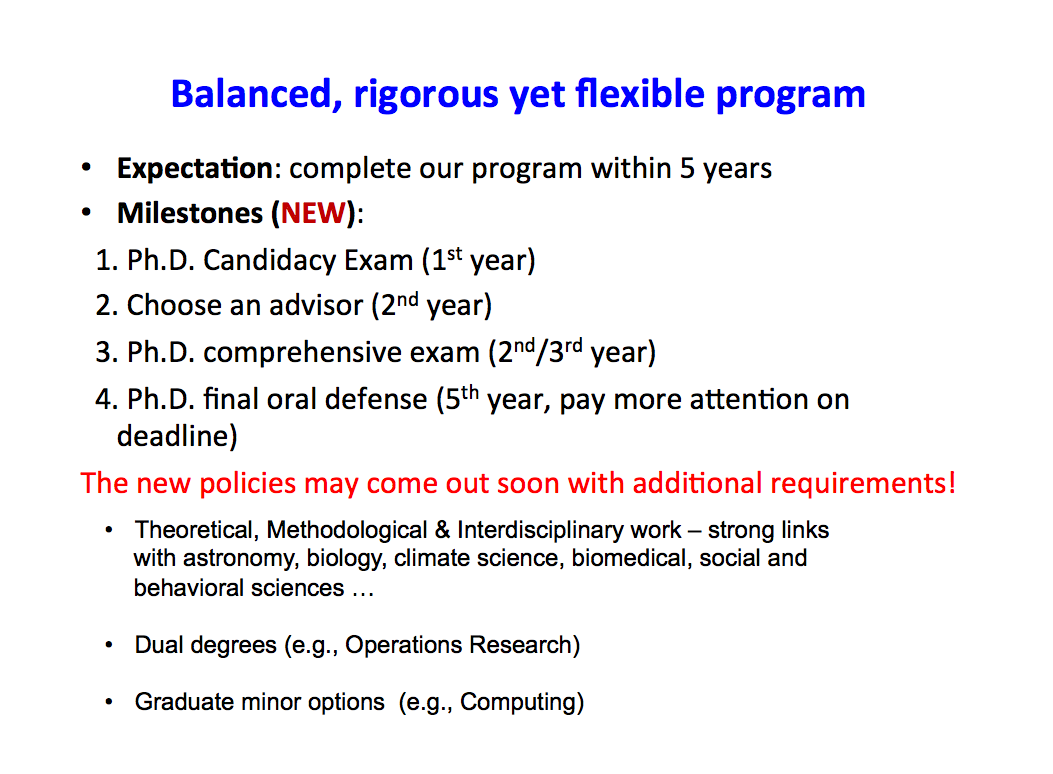
First things first, what exactly is the difference between quals, comps, and a thesis defense? Well, if you’re in grad school you at least know enough to be shaking in your boots at the prospect of any one of them. As you progress through your PhD program the powers that be (general your advisors) will want to ensure that you’re advancing at the desired pace, thus a few intense, intimidating milestones are thrown at you. The first of these, the Qualifying exam, serves to assess whether the student is capable of conducting doctoral research/scholarship. Quals often also serves as the PhD candidacy examination. Qualification exams are taken early in your program and are often based on required coursework. Once you pass your quals (and sometimes it takes a few tries, don’t worry!) feel free to relax a tiny bit and allow yourself to celebrate! Throw a wild soiree with your cohort! The PhD Comprehensive exam is given by members of your committee once a student has completed the required coursework (generally year 2 or 3, but ultimately depends on your program) and serves to evaluate mastery of the major studied. Sometimes presenting your research proposal can be wrapped up within Comps, as a way so show you have mastered the content necessary to proceed. If you’ve passed your Comps go ahead and celebrate once more! Now all you have left is research, thesis writing, and a thesis defense! It’ll be tough, but you’re in the home stretch. A lot of students are terrified by the time they are fast approaching their thesis defense. A lot rides on that final presentation of research and oral examination by the committee, but honestly once your committee signs off on a date for you to present and defend you’re practically finished already! They don’t want to set you up to fail (it reflects poorly on them as well)! Smooth sailings on through to your doctorate! Congrats once more! You’re a doctor!!

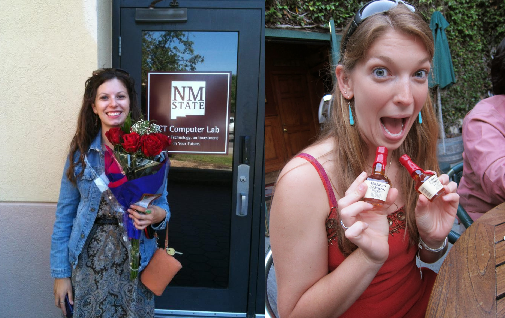
Post Masters Celebrations!

If you picked up on how it sounds like your committee has a lot of power of your progress through your PhD project, then you’re not far from the truth! However, they will also be there to provide you with all of the guidance and insights that you could possibly need. After all, they’ve been in your shoes before and have helped others through your journey. The majority of your committee will be comprised of professors from your department, but if you’re one of those brave souls that goes for a more interdisciplinary approach you’ll likely find members from other departments or even other institutions.  You are in charge of approaching and inviting generally four professors to serve on your committee. Something to keep in mind while forming your own band of professors is that you’ll want to ensure that you choose members that will have the time and resources to help you with your thesis research, writing, and defending. You’ll need to have a close working relationship with these people so don’t be afraid to choose based on how well you foresee getting along with them. A highfalutin big wig in your field sounds great to have involved, but if they have no time for you then maybe it’s best to find someone else to serve instead. You want people who are passionate about being on your team and helping your grow and develop to ensure that upon completion of your PhD you’ll be ready to find a postdoc or a job in a variety of fields!

Workin’ hard with the cohort.

 If you are, like me, at the very beginning of your program with all of these hurdles strewn in your future it can be incredibly intimidating. A lot of doubts can creep into your mind about your ability to gain a mastery of the content, especially if you’ve changed fields! I’ve had quite a few chats with my cohort already about our looming quals at the end of this year. Our department recently changed it’s program for PhD students and we’re the first group to go through this new design! We feel a lot like guinea pigs – the kind that people eat rather than keep for pets! I have dealt with this nervousness by finding out as MUCH as I can about how I am expected to progress through each year. But what has really quelled my quals fears has been talking to my academic advisor and hearing his reassurance that no, the department really isn’t trying to scare anyone off or try and weed us out. They earnestly do want each and every one of us to pass and will provide us with all the resources to do so! Rather, instead of being a weed out process, the qualification exam more serves as a way to ensure that WE are absolutely sure that we want to put in the work necessary to earn a PhD. I’m so grateful that I am part of a large, wonderfully supportive cohort that is already working hard to make sure no one falls behind. If I can recommend just one thing to new graduate students feeling that fear creep in, it’s to talk to your cohort, the grad students that are ahead of you, and professor in your department. The reassurance I’ve gotten from admitting my fears and insecurities to others and in turn hearing theirs has been a tremendous confidence booster!

You can check out my (Meridith’s) Statistics PhD program expectations in the slide included! If you are interested in hearing about Rachel’s Ecology program (she’s in her 3rd year and has just schedule her comps!) you’ll want to keep an eye on our Sweet Tea, Science Tumblr this week! If you are also working on getting your PhD (or Masters!) we’d love to hear how these major exams work in your field/department! There’s so much variety that we can’t hope to cover how these things work for everyone, but go ahead and let your experiences be known down in the comments.


claimtoken-5437fb02be371

Fiscal Responsibility feat. Sweet Graphs

Back in April, I took a big step towards being a Real Adult and started my own budget spreadsheet. After just the first month, I was completely shocked at how much I was actually spending (read: THAT much on dining out?!) Now that I’m heading back into the tight grip of grad schooldom, I know that I need to prepare myself for the grad school lifestyle. Which, of course, means living within my means. My first step in this preparation process was to create a budget spreadsheet for myself. I’m a big believer in ‘knowledge is power,’ and had to embrace that mantra to keep my head up while working on this project.

I started in Excel with two of the provided templates: College Cash Flow and Monthly Home Budget. Both templates provides you with a file already outfitted with calculations to auto-fill the green boxes based on data in the yellow boxes. In the College Cash Flow file, you input your starting money on hand and monthly expenses by convenient categories likely to be used by college students (e.g. books, tuition, etc). Your total income, expenditures, cash flow, and ending balance are automatically calculated for each month. The Monthly Home Budget sheet performs a similar task, but on a shorter time scale. You also have an opportunity to compare your actual income/expenses to budgeted ones. Together they are both useful, but I found that with a little extra work I could create a more interconnected, useful budgeting tool, complete with visuals.

I wanted to know more about my individual purchases in addition to total monthly charges, so I added a section to the Monthly Home Budget sheet at the bottom where I could input each individual purchase with Date, Cost, Type, and Notes. I found that having to record each transaction separately also helped me stay aware of my spending as the month progressed. I have Office 2008 for Mac on my computer, so everything I mention subsequently will be specific to that version of Excel.The major amendments to the spreadsheet templates are as follows:

  1. I wanted to have a drop down menu of categories for when I input individual purchases, to eliminate the possibility of typos. This was more an issue of formatting than coding. 
  2. Screenshot 2014-05-21 21.28.05.png
    May was a pretty cool month. I was much more conscious of what I spent even after a month of keeping track and budgeting.
    1. Highlight the boxes where you want the drop down list.
    2. Data -> Validation
    3. Allow: Select “List”
    4. Source: highlight the categories from the Variable Expense section
    5. Okie doke. You can also copy/paste this format into other cells.
  3. Next, I wanted the “Actual” cost cells in my Variable Expense column to automatically update from my individual transaction list. But that meant that each categorical cell would only update with it’s specific type of expense.
    Let me reassure you, this was not too difficult at all! And I felt like such a badass every time I figured out a tiny little thing. 
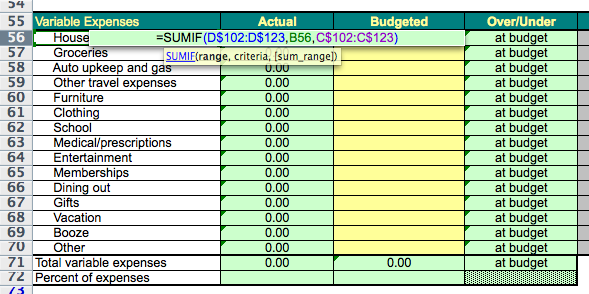
    1. In the Actual column next to the first category (household) type “=SUMIF(“
    2. Highlight “Type” column then insert a comma
    3. Click the category name then another comma
    4. Highlight the expenses column and end parentheses
    5. Repeat steps for each category/type (e.g. household, groceries, gas, etc.)
    6. Now that the Variable Expense Actual cost cells auto update, I changed the color to light green.  
  4. I wanted my monthly expenses to automatically be filled in on the College Cash Flow sheet. In hindsight, I could’ve made this a little easier on myself by rearranging the “Expenditures” list to match the ordering on the Monthly Home Budget sheet. 
    Oh man, Meridith, there’s not much going on here. Are you going to release a template for everyone. Maybe. Just maybe. 
    1. I started in April, so I would’ve gone to that month’s column in the CCF sheet. Clicked on the cell that matches up with the Household Costs row.
    2. Entered =’April Budget’!$C$55, where April Budget is the name of my Monthly Spreadsheet for April and C55 is the cell where my Household Variable Expenses are totaled. 
    3. Some expenses on the yearly sheet, like utilities, may be broken down into more specific categories on your monthly sheets. You can use =SUM() to compile those cells. 
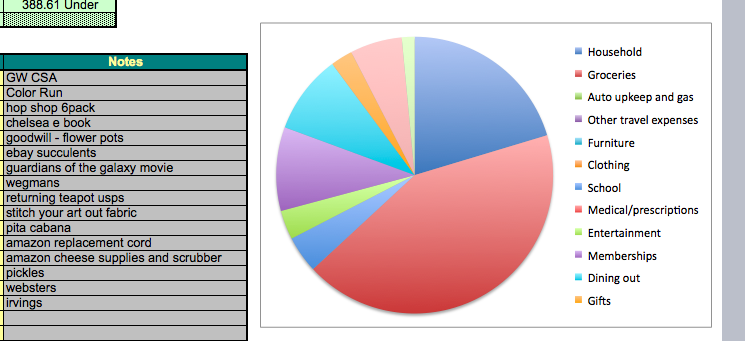
  5. I love visualizations. I wanted to see these data represented so I could see, at a glance, where my spending was occurring. Where are the sweet graphs?! Missing?!  No sweat, I just had to make my own. I had a pie chart of my variable expenses on my monthly spreadsheets. I kept the fixed expenses off because huge costs like rent would just overwhelm the graph. 
    Can you tell I like food?
    1. Highlight “Variable Expenses” and “Actual” columns
    2. Insert > Chart > Pie > whatever the most basic one is
    3. I also did a similar pie chart for the yearly sheet using the “Expenditures” and “Yearly Totals” columns.
Celebrating my time in Newcastle the proper
 way – dancing my heart out. 

Ahhhh, fiscal responsibility and organization. You really can’t beat it. Don’t be afraid to try your own tweaks to the budget sheets. I’d love to hear your insights. The important thing is that you’re staying aware. I’ve known many a young lad and lassie who just wanted to ignore their financial obligations and responsibilities. Your twenties are not for mistakes and frivolity! Ok…they are a little bit. I’ve mistaked and frivoled. But I’ve also been conscientious of long term savings, and because of that (in addition to supportive parents and lots of living at home) I’ve been able to do some really frickin’ cool shit! After completing my Master’s degree I moved home, worked for a few months, bought a plane ticket, packed a bag, and left for a completely wild 90-day, self-funded, solo adventure through Europe. I had zero responsibilities. Minimal worries about my funds. And all of the funs. All of them! Sure, it meant watching my money closely during my time in New Mexico. I rarely went out and spent money on beers and food. I lived with roommates with ridiculously cheap rents. I nearly never went shopping for clothes. But it was all completely worth while when I landed in Dublin and immediately had adventure after adventure!

I’ve been looking into what other things I can be doing to be extra responsible with my finances. I’m not anywhere near 40, but this cool article has really inspired me to think about awesome next level goals I can set for myself. I’ll be studying for my PhD for the next five years, and while that comes with a stable stipend, it’s not the same as having a job with a 401K and retirement plans and all of these other benefits that I’m mostly clueless about. If you are looking into other ways to keep yourself in check with your cheques, then you might want to consider the many financial apps available. SciFri has a lovely podcast on them. You know how much we love podcasts. I have friends that also swear by the cash envelope system. Each month you take out the budgeted amount of cash (lump sum or broken into categories) and that’s all you have for the month. You run out…tough cookies.

If you’d like more money saving tips throughout the week keep an eye on our STS Tumblr for extra posts. We’ll share different articles and our own personal insights on how we live on the cheap! We also want to hear about what’s your method? Any super awesome money life hacks that we could benefit from? By all means, let us know!