Elk, Deer, and Sheepsies, oh my!

Day Ten

Rocky Mountain National Park

Total Miles Hiked: 10.24 (58.3 overall)
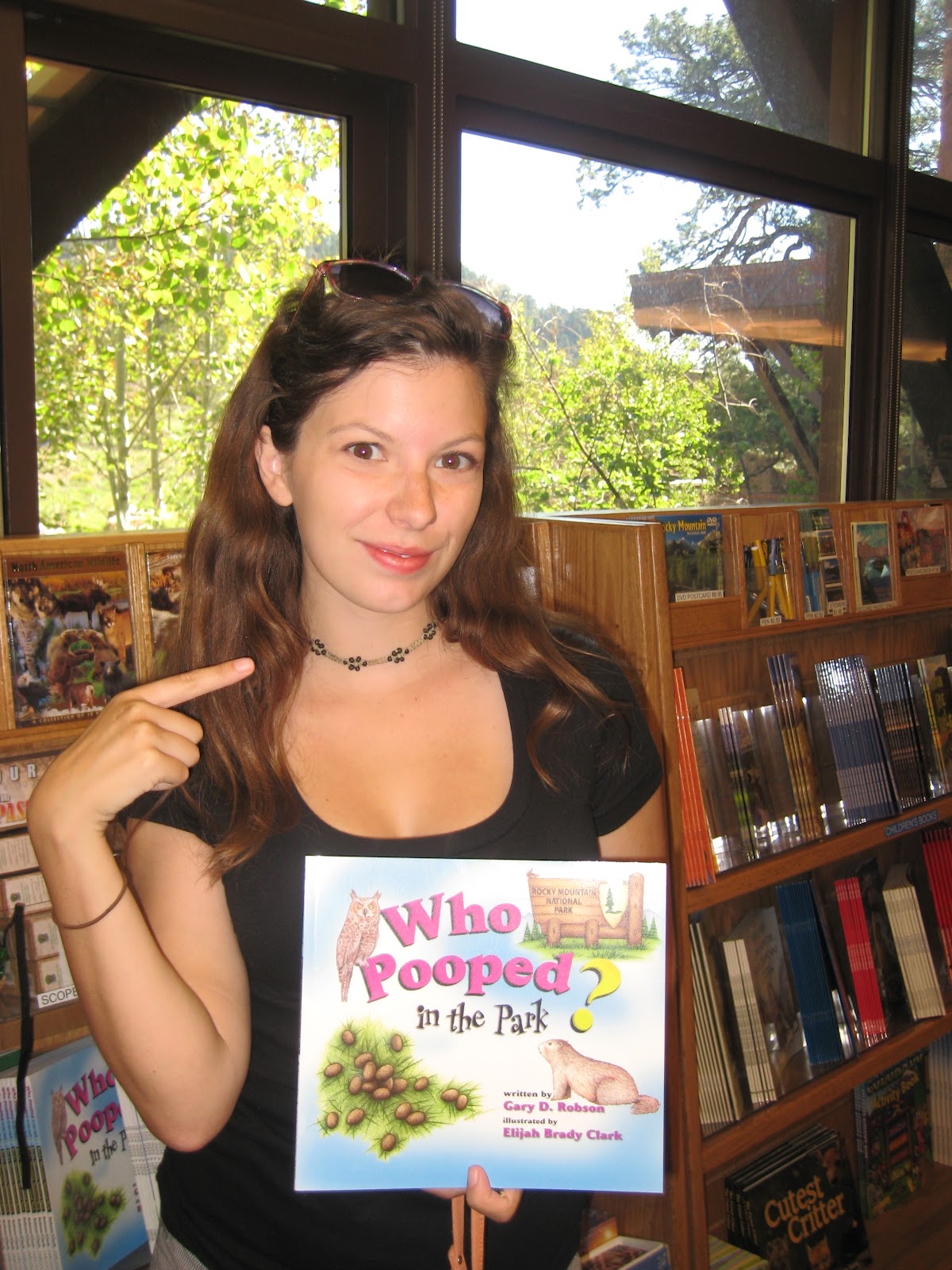
 

Who Pooped in the Park? Who?!

The ranger who helped us (this time I didn’t remember to peep his name tag) could tell right away that we were bonafide nature nerds. You start dropping science slang like ‘ecosystems’ and ‘habitat’ and you’ll see the smile on the rangers face. You’re one of them now. He suggested a long hike up Flattop Mountain for the next day. We’d have to wake up early to make it to the trail head before the road closed in that direction; we were too late to do so today. We could, however, try our luck with the Deer Mountain loop as well as varying other short trails with wildlife opportunities. We were certainly gaining experience in hikes with high elevation gains. I’m not sure if they ever get easier. Perhaps, you, oh reader, knows an answer? Deer Mountain was a 6.2 mile trail with a 1000 ft gain. Our quads and calves would take most of the strain. And a strain it would turn out to be at the very end. Stairs. Stone stairs to the top. Don’t they know I’ve already hiked up a few thousand feet. Is this some kind of a joke? Rachel soldiers on ahead, while I take the ol’ slow and steady tortoise approach. Breath. 

A little yellow flower child hiding in the bushes.

There is no better motivation that looking up to see a small scrap of a girl looking down at you inquisitively. 

“You’re almost to the top.”

“I don’t know, is the view worth it? Or should I just turn around?”

“I think you can do it.”


Her solemn answer cinched it. And at the top, I arrived. Rachel giggled down at me, knowing I had it in me the whole time, and sometimes I can be a bit of a slow poke. 
We laid out our prepared picnic, but soon had to battle both the habituated chipmunks and the dark clouds rolling our way. We don’t need much of an impetus to scarf down our sammies after that hike, and we soon do a quick tour of the available views before descending once more. Now, some people will try and tell you that going down is much harder than going up the hill. I find this to be utterly preposterous and question the sanity of these naysayers. Hiking down hill, you are more relaxed, less sweaty, often full of a snack or lunch, and generally in a much better mood. The worst is over. You get down so much faster than the hike up took you.  There’s a reason for the phrase ‘it’s all downhill from here’. You can smile and chat with the hikers still on the struggle bus. “So close! Watch out for lightening!” You may even hold your arms out like your an airplane and let gravity pull you faster and faster down the slope. Airplane noises are optional, but recommended. Keeping an eye out for rocks and switchbacks is required. 
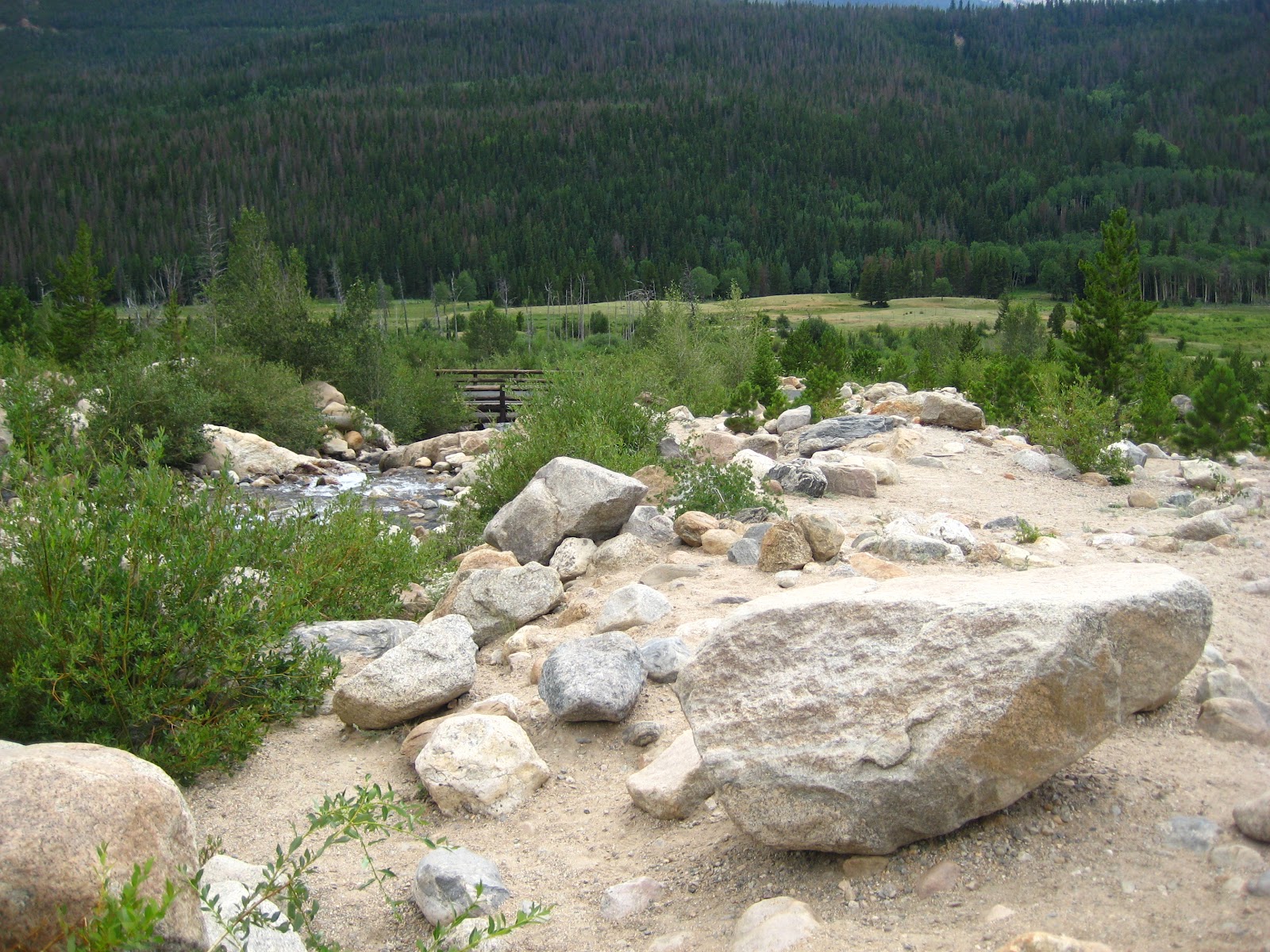
Rocked carried down to the alluvial fan.


The visitor center may be my new favorite way to start my mornings. Especially visitor centers when you’re in a new park. New postcards to look through (still need everyone’s snail mail addresses: alwaysscientist@gmail.com), new stickers, new patches (my favorite), new books, new maps, new poop books. Also, we can chat with new rangers. As stated previously, Rachel and I love figuring out what sort of sights we’d like to see and how far we want to hike during our stay and getting suggestions from the Information Desk. It has yet to let us down. We knew we wanted another moderate-strenuous hike, we wanted to hike in and explore all three available ecosystems, and we desperately wanted to see some bighorn sheep or a moose. 

And then you’re magically back at the trail head. No time at all.

We opted for a tiny viewpoint for our resting area/mid-day reprieve. A 70+ year old  reservoir dam had burst in 1982 releasing 220 million gallons of water to race its way to Horseshoe Park. That much water moving with such speed is a deadly, and often startling, in its sheer force. The aquatic juggernaut scooped up rocks, trees, and whatever else it darn well pleased and carried them along it’s path, pounding into anything that dared get in the way. It was only an observant garbage collector, who phoned in the roaring noises, that saved the majority of the people in the path of the water catastrophe. Three people still lost their lives as the rush of water swept through a campground. The debris the flood carried was deposited in a large fan-like array (alluvial fan) that even 25+ years later can be easily observed. 

We left feeling somber and in awe of the raw power that nature possess. 

We were in need of relaxation after such an impressionable stopover. 
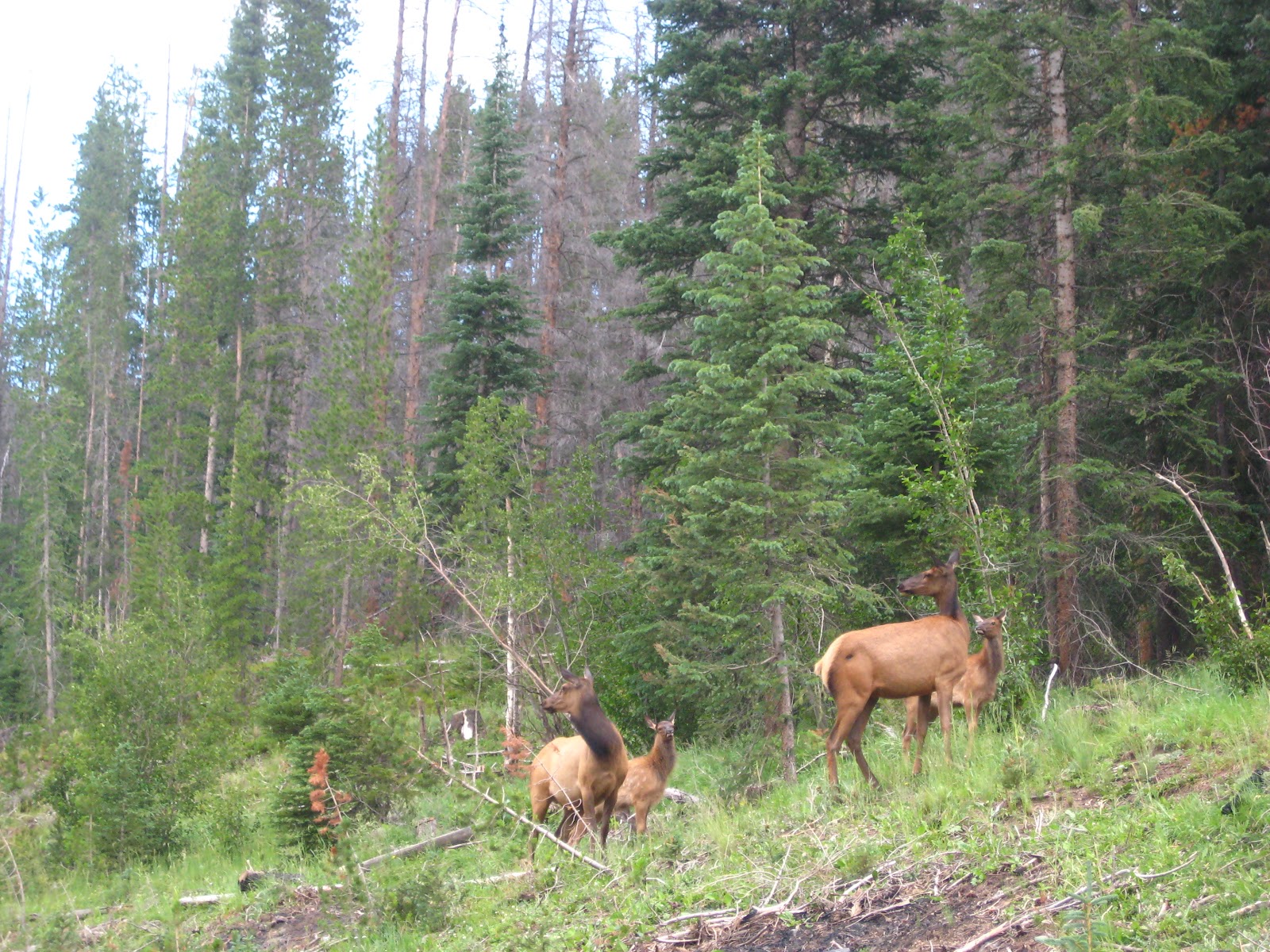
Elks.

After two parks of hoping and searching, we were still on the hunt for the elusive Bighorn Sheep. We had seen deer all over the place. They were no big deal at this point. Elk nearly immediately greeted us the evening before on our drive into Rocky Mountain NP. Herds could be seen along the roads and moving carefully through campgrounds. Our last stop of the day was a quick drive to Sheep Lake. We focused really hard on our desire to see the sheepsies. 

And then the cars ahead of us slowed to that tell-tale creep that indicated the sighting of some charismatic critter. Could we be so lucky?

Sheepsies.


Yes. 

We got to the pull-in and parked.

We’d arrived just in time to watch a herd of sheep cross the meadow in front of us. Mommas and babies. 

They’d spent the day frolicking and were now heading back into the hills.

We nearly missed them. 

But we didn’t!

BIGHORN SHEEP!

We had a nice rest while we watched the few lingerers and chatted up the ranger on duty in the area. Ranger Volunteer Gina was lucky enough to be assigned to the Sheep Lake station for the day instead of her usual visitor center position. She informed us that the sheep hadn’t been viewed in the area since Independence Day weekend. She told us more about her adventurous summer as a park intern and how she often ran programs at the visitor centers. Talk about an awesome guest post…here’s hoping!


Feeling alive with satisfaction, we managed to pull out a few more miles that evening during our periodic jogs. We found a path leading to a road and subsequent trail from our campground and had a mini-evening adventure. If you’re a runner, you must head to the National Parks for some of the most gorgeous scenery ever. Just don’t pull a Meridith and stumble all over the place while craning your neck to see the views.  

We were so pumped with energy from our day and run that we decided to head into the nearby town of Estes Park for some sugary Starbucks drinks and internet time. Can’t be a mobile grad student without a little productivity. 

We were so starved for solid internet connections that we were eventually (politely) kicked out of the coffee shop and continued to suck up the precious from the outside tables. We must’ve seemed like normal, decent people that didn’t smell like days of hiking and driving because we eventually garnered invitations for drinks and pool in the nearby bar from barefoot boys. Rachel knows better by now to try and dissuade me when beer, billiards, and bare feet are involved. 

We stayed long enough for Rachel’s team to dominate in a fair Best Two Outta Three round and for me to find a co-author for my envisioned, future e-textbook on biostatistics before we retreated back into the park for sleep. 

Question of the Day:
Could Rachel and I beat you in a game of pool?
Hello, Goodbye

Day Nine


Arches to Rocky NP


Total Miles Hiked: 0 (48.06 overall)


We knew leaving Arches NP and Moab that our destination would be vastly different than our origin. I was more than happy to finally be trading the sand, sun, and rock formations in for the soul refreshing mountains, trees, and streams. Such an eventful day of driving deserves to have its own road trip mix. We’ve jammed to all of these songs on our drives.


Rachel’s Ramblings:
I was a bad invasive species ecologist for the first few stops on our trip.  Meridith and I had discussed out travels before leaving and both agreed we wanted to minimize our impact on the parks we visited.  One of the major challenges facing many ecosystems on the planet are invasive species.  If any of you have been with Meridith’s blog for the long haul, you know over her spring break she came and profiled my (and my lab’s) work on wetlands in California.  If you’re just now following her, the short version is this:  I study the impacts of invasive species on ecosystem processes, usually applying potential impacts of invasive to food web structure within a certain community.  Invasive species are, by definition, any organisms non-native to an area which cause some sort of harm by their presence. Thus, I’m uniquely concerned about my own ability to spread the species I study around the different areas I work.  To keep this from happening, because, really, how embarrassing would that be, I take some pretty simple precautions.  

So, why do I feel I was bad for the first few stops on our trip?  You see, Meridith and I had developed a plan for avoiding spreading seeds, spores, or small critters between parks, but we failed to implement it until we were traveling from Arches NP to Rocky Mountain NP.  I justified it because Carlsbad, Zion, and Arches were all pretty similar ecosystems with lots of species overlap.  That aside, we didn’t follow the plan, and we should have, but now we are, and you can too!  I’d like to point out before going on, that this method is really more my opinion and based on conversations I’ve had with other scientists.  I haven’t looked up these things in the scientific literature (though I know the literature exists, and I would love it if you sent me some!).  However,  I think these steps are practical and that they do help, or at least they certainly don’t hurt.  I would encourage everyone traveling between ecosystems, especially those known to have invasive species, to take similar steps or do their own research on the topic.


A Few Simple Tips to Avoid Being a Vector for Invasion:

  1. Clean your shoes between locations.  Seeds, small mollusks, fungal spores, and lots of other things can cling to the bottom of your shoes, or get stuck in the tread of your boots.  If you can, make a bleach solution and soak the soles of your shoes.  If you don’t have access to bleach (like we don’t) give the soles a good scrubbing, then spray them down with 409 and let it sit for a little while (remember this is what the ranger did to our boots at Carlsbad Caverns NP).
  2. Wash and dry (preferably on high) clothes worn in one area before wearing them in another area.  You know how plant parts love to stick to your socks and pants and everywhere while you are hiking in the woods?  Plants are clever, but you can outwit them.
  3. It’s the whole “take only pictures, leave only footprints” thing, this is just one more application of this really important advice.  This goes a little without saying, but we have heard the Junior Rangers at each park promising to leave the pretty flowers they see so that other can enjoy them (so cute!).  Another good reason to not pick flowers, buy seed packs from areas outside your home region, or otherwise transport wild plants or animals is to avoid the spread of invasive species. 

Question of the Day:
Will you adapt any of Rachel’s tips to help stop the spread of invasive organisms?

Love in the Desert?

Day Eight

Arches National Park
Moab, UT
Founded: 1971

Total Miles Hiked: 10.5  (48.06 overall)

We’d arrived too late to secure a camp spot in the park, however the nearby city of Moab had a plethora of private campgrounds to choose from. After consulting our handy Fodor’s guide, we soon were on our way to the recommended Slick(Shady)rock campground. It had all of the typical amenities: small grill, shade, restrooms, office wi-fi, pool, hot tubs, showers. We may not be in the park, but we’d be living in luxury and leave smelling like delicate desert flowers. For however long that lasts.

We only had the one day in the park, so we made sure to wake up early to make the most of our time. Someone once told me that Arches NP is where you go to fall in love with the desert. Now, I’ve been living in the desert for over two years now and have only a mild toleration for an area that is mainly devoid of forests and streams. But, I wanted to give the desert another chance.

As always, we stopped off at the visitor’s center for our trinkets and usual chat with the Rangers at the information desk. We’ve yet to be disappointed by the advice of the Rangers, and this morning Steven and Emma were not about to break that streak. Rachel and I usually try and have a basic idea of what we want to accomplish in a park. How far we want to hike (usually about 10 miles per day) and what sights we would like to see (arches and some bighorn sheep, please). Steven recommend the full Devil’s Garden trail (with primitive loop), a restful afternoon out of the sun, a quick walk around Balanced Rock, and then to top it off with a sunset trip to the Delicate Arch. Emma was our go to for bighorn sheep questions. Where can we find them? Does she know where they are right now. Is she hiding them? Can she let them come out and play? We were informed that sheep sightings are still rare in the park, but to keep an eye out during the first three miles. Oh, Emma, I don’t think you realize how badly we want to see the sheeps!

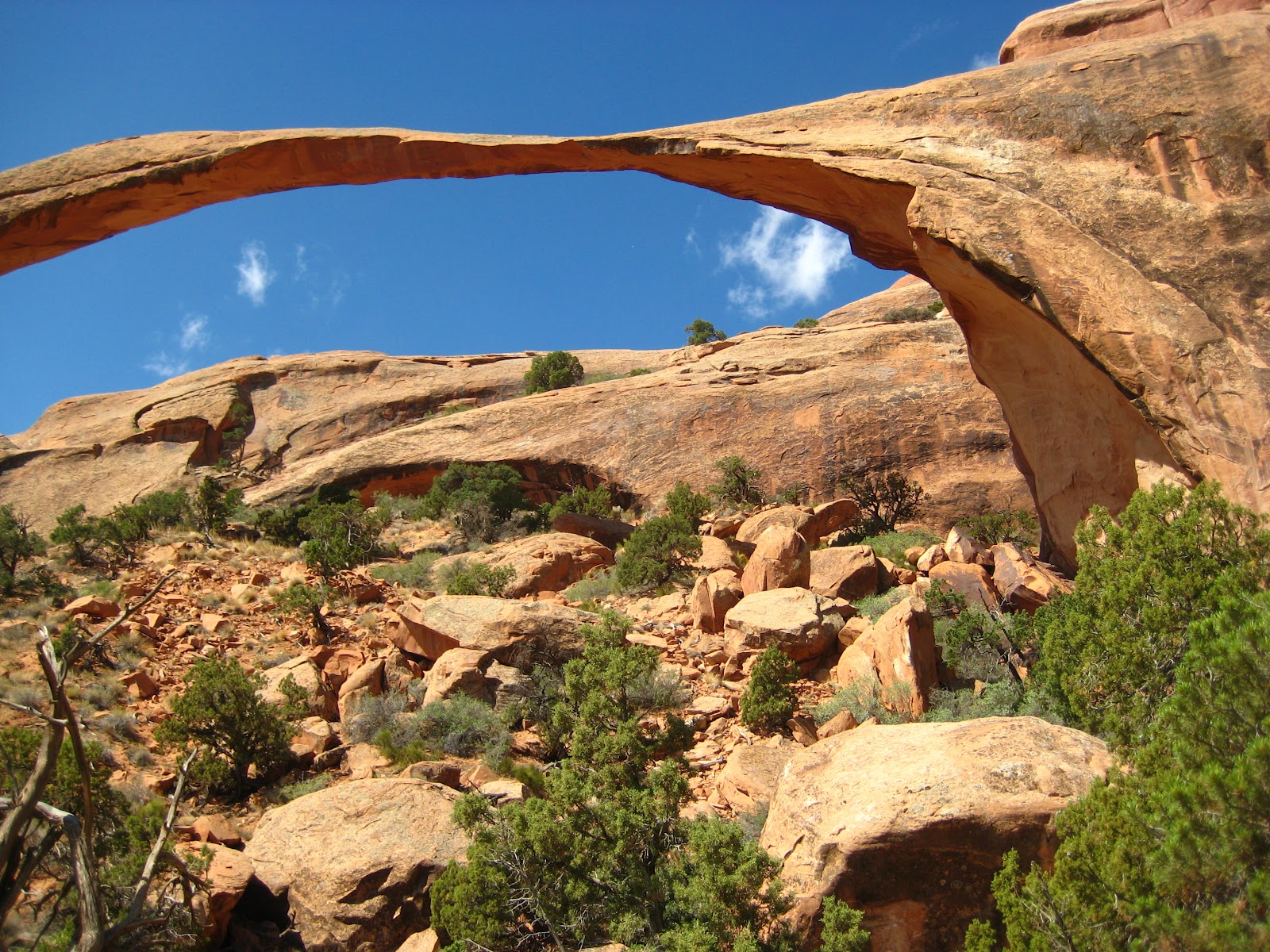
Landscape Arch. Can you tell where a slab fell?

Our first trail was at the far end of the park, so we enjoyed the drive out by obsessively searching for sheep. Devils Garden is a trail that may be enjoyed at several different difficulty levels. Many of the arches available for viewing are towards the beginning of the journey directly off the gravel path. You may go as far as Landscape Arch, the longest in the park, before the primitive loop begins. Here, we were soon traversing and scrambling over rocks and ridges. Rachel’s choice of wearing a hiking dress that day was nearly a poor one, but she managed to stay decent. The crowd thinned as we encountered more and more arches and more and more difficult pathways. The rock cairns I explained yesterday were especially helpful on this terrain, and they often kept us on the right route.

We’d started off on the trail in the mid-morning hours, and were able to enjoy the cooler morning temperatures for some time. However, the desert is good at heating up once the sun is comfortable high in the sky. We aren’t ones to disregard park warnings, so we were well equipped with our water bladders in our packs, each holding 3 liters of water.

When we reached the end of the trail we were more than happy to have a rest and picnic in the limited shade we could find. Dark Angel looked over us as we munched our sammies and snacks. Then, once more, we were in the sun hiking back. Our second wind was more of a sweltering breeze due to the heat, and we were soon grateful to stand in whatever shady patch we could find. Despite the liters of water consumed, our hands were still swollen slightly by the time we reached the main trail again, a sure sign of the start of dehydration. The trail head and accompanying water supply were a welcoming sight.

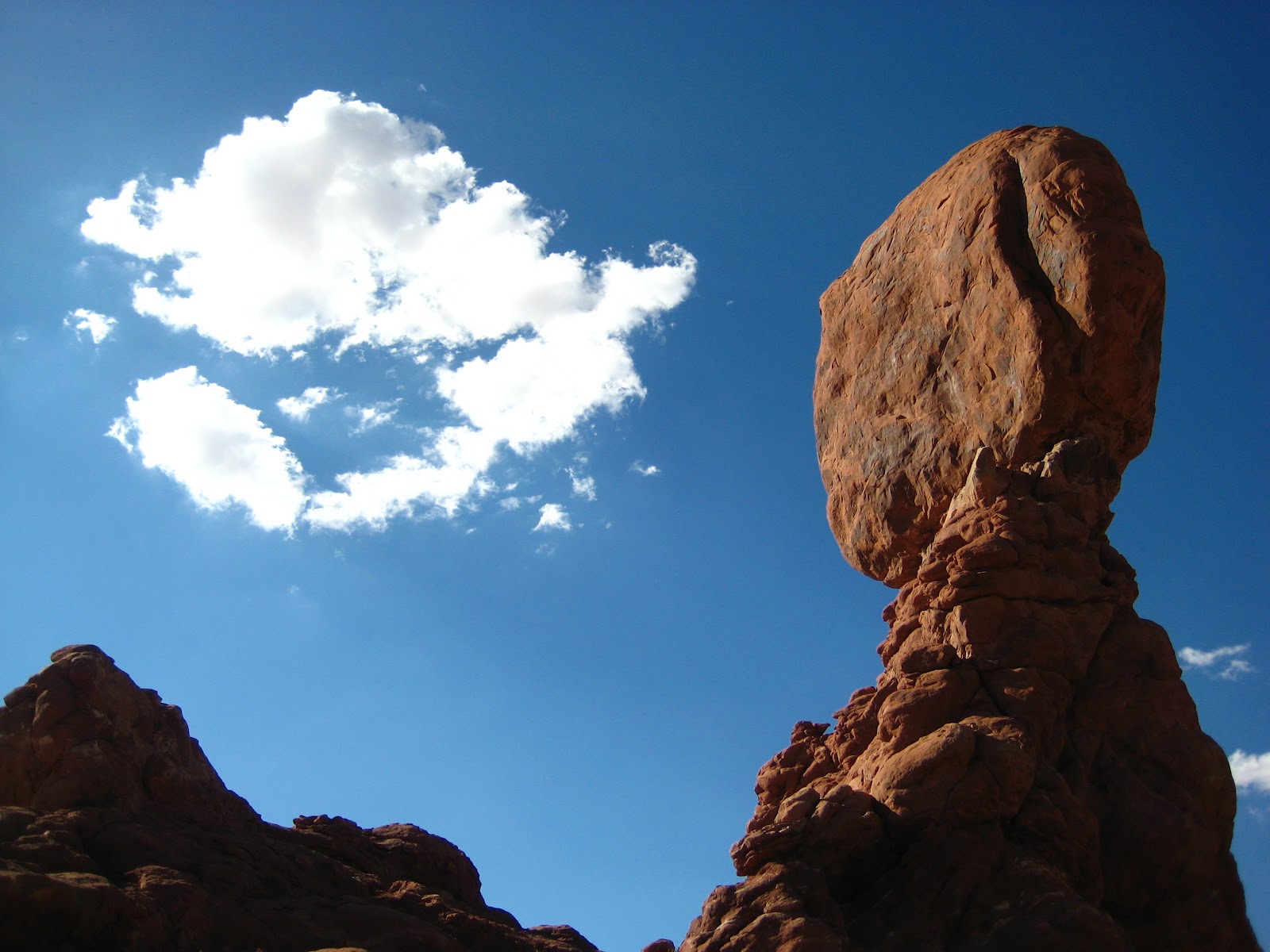
Balanced rock being all balanced and such.

We had plenty of time to spare before we needed to head out towards Delicate Arch for sunset and little desire to stay in the sun for much longer and, so, set out to find a place with shade to rest, write, and snack.

The picnic area across from Balanced Rock proved to be just the place for all of our needs. While most of the tables were in the blistering sun, we managed to score one with a lovely tree bending over to protect us with its shade. I tried to write some informative words for you, oh readers, but Rachel’s napping just looked so peaceful and I knew I wanted to join.

“Meridith….Meridith. Your face it in the sun.”

Rachel, once again saving me from certain cancerous doom.

To recover from our slumber, we got after some hummus with pita chips in a completely unladylike manner. But, it did the trick and we were soon back on the trails where we explored the mini loop around Balanced Rock before setting off for the Delicate Arch trail head.

We had plenty of time to meander along the route to the most famous of all arches in the park. We encountered the homestead of the first settler in the area. An Ohio man, who escaped to the West for the drying, presumed healthier, climate.  He built a teensy one room home for himself and his son. Later, when his daughter and her family joined them, he built a proper house with wood floors and everything. It was still teensy and perhaps had just slightly more space for the 4+ people than Rachel had when she lived in my laundry room senior year of college. Teeny tiny.

Continuing once more, ever closer to the final destination, we came upon what Rachel holds among her top 10 favorite things she’s ever seen. Petroglyphs on a rock above the trail. Perhaps as old as 400 years, these markings revealed horseback Ute Native Americans hunting bighorn sheep.  Small dog like creatures were also included. We were really impressed with the lasting power of the art and we walking on finally, still wondering about the markings that didn’t last the years and the individual who had sat there so long ago patiently carving the scene.

After some unexpectedly steep uphill climbs, we finally turned a corner and were presented with a sight we’d only seen in photographs, postcards, and nature documentaries. Delicate Arch. We’d arrived early enough to get a decent spot among the droves of people with the same sunset plans we had. It did, however, prove difficult to get a shot of the arch without a group of ridiculously posed tourists. The line of groups and families waiting to get that perfect picture under the arch seemed never ending, and if any stayed too long blocking the shots of other photographers wanting that solitary shot of the majestic arch, they were requested in no polite tones to move along.

We had both expected the sun to set behind the arch, however it actually slunk away behind our backs, drawing the shadows up over the arch from the bottom. Still a wonderful sight to behold. Several adventurous young sightseers took in the view from atop the nearby rock formations. The darkness grew, yet we stayed behind to enjoy the desert night. We were well prepared with jackets and headlamps, so felt no anxiety towards the upcoming night hike back to our vehicle.

The darkness welcomed us and we welcomed the sounds and sights of the nocturnal wildlife, awaking with the moon. We kept a slow pace so that everyone could pass us and take their noises with them. It’s always good to hear people enjoying the natural beauty of the parks, however many do not realize that the show is not over. It’s just starting. Once the night air was empty of these sounds, it began to offer up its own. We chose a spot on a small bridge over a pool of water. Day or night, water is a great place to find wildlife. We waited. It was not long until we were rewarded with the sounds of bullfrogs calling to potential mates, the flapping of bat wings as they whiz by us, and various insects chirping and humming. We listened and watched the stars come out before we said our final goodbyes to the park.

I don’t know if I’m in love with the desert yet. It’s still hot and often times not as elaborate or as colorful as Arches. Maybe I’m a little in love with shade in the desert, and that counts.

*more photos later – I can only do so much on stolen Yellowstone Staff wifi!*

Question of the Day:
What is your favorite type of landscape?